
Note
Go to the end to download the full example code.
Einstein’s mass-energy equivalence#
In the last of his 1905 papers, Einstein showed that a body’s rest mass
and rest energy are the same quantity, \(E_0=mc^2\) – the rest-frame
special case of the fully relativistic relation
\(E^2=(pc)^2+(mc^2)^2\).
FourVector builds exactly this
object, with its .mass property returning the invariant
\(\sqrt{E^2-|\vec p|^2}\). This example checks that the invariant
mass a moving observer computes agrees exactly with the rest energy
measured in the particle’s own rest frame – true at every boost
velocity, however fast – and that summing four-vectors before taking
the mass, rather than after, is what makes invariant mass differ from
simply adding up individual particle masses.
import matplotlib.pyplot as plt
import numpy as np

from physicskit.particle.kinematics import FourVector, boost
The rest-frame mass is boost-invariant#
A particle of rest mass 1.0, boosted to a sequence of speeds – the invariant mass recovered from E and p agrees with the rest mass at every single one, even as E and p themselves grow without bound as beta -> 1.
m0 = 1.0
p_rest = FourVector(m0, 0.0, 0.0, 0.0)
betas = np.linspace(0.0, 0.999, 200)
E_values = np.array([boost(p_rest, b).E for b in betas])
p_values = np.array([boost(p_rest, b).p_mag for b in betas])
mass_recovered = np.array([boost(p_rest, b).mass for b in betas])

print(f"rest mass:                    {m0}")
print(f"invariant mass at beta=0.9:   {boost(p_rest, 0.9).mass:.10f}")
print(f"invariant mass at beta=0.999: {boost(p_rest, 0.999).mass:.10f}")
print(f"max |recovered mass - m0| over the whole sweep: {np.max(np.abs(mass_recovered - m0)):.2e}")

fig1, (ax1, ax2) = plt.subplots(1, 2, figsize=(11, 4.2))
ax1.plot(betas, E_values, label="E (grows without bound)", color="steelblue")
ax1.plot(betas, p_values, label="|p| (grows without bound)", color="firebrick")
ax1.set_xlabel(r"$\beta$")
ax1.set_ylabel("E, |p|")
ax1.set_title(r"$E$ and $|\vec p|$ individually diverge as $\beta\to1$")
ax1.legend(fontsize=8)

ax2.plot(betas, mass_recovered, color="darkorchid")
ax2.axhline(m0, color="0.6", ls="--", lw=1)
ax2.set_xlabel(r"$\beta$")
ax2.set_ylabel("recovered mass")
ax2.set_title(r"but $m=\sqrt{E^2-|\vec p|^2}=m_0$ always")
fig1.tight_layout()
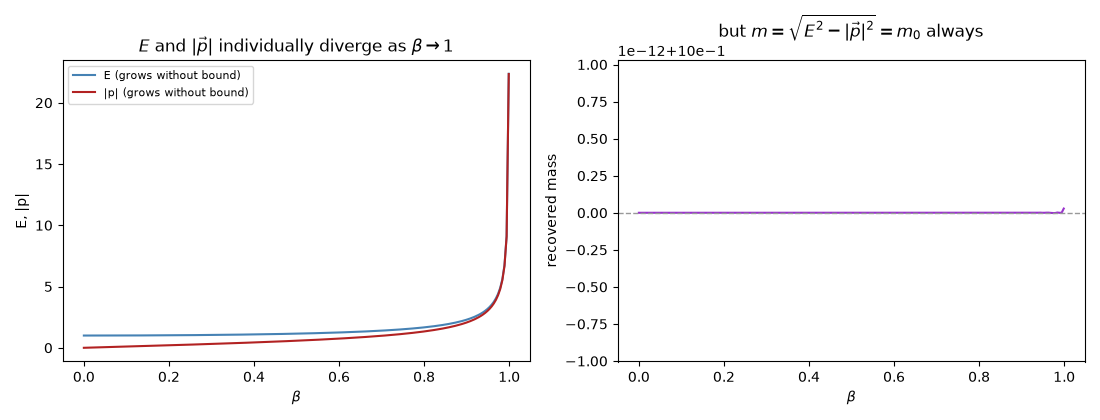
rest mass:                    1.0
invariant mass at beta=0.9:   1.0000000000
invariant mass at beta=0.999: 1.0000000000
max |recovered mass - m0| over the whole sweep: 2.84e-14
Why invariant mass is not just the sum of masses#
Two identical particles of rest mass 1.0, fired at each other with equal and opposite momenta: their individual masses sum to 2, but the invariant mass of the combined system – what a detector actually reconstructs from the total four-momentum – is larger, because the system also carries the kinetic energy of the collision.
p1 = boost(FourVector(m0, 0.0, 0.0, 0.0), 0.6, axis="z")
p2 = boost(FourVector(m0, 0.0, 0.0, 0.0), -0.6, axis="z")
system_mass = (p1 + p2).mass
print(f"\ntwo particles, each rest mass {m0}, each boosted to beta=+/-0.6:")
print(f"  sum of individual masses:      {p1.mass + p2.mass:.6f}")
print(f"  invariant mass of the SYSTEM:  {system_mass:.6f}  (larger -- it also carries the collision's kinetic energy)")

plt.show()
two particles, each rest mass 1.0, each boosted to beta=+/-0.6:
  sum of individual masses:      2.000000
  invariant mass of the SYSTEM:  2.500000  (larger -- it also carries the collision's kinetic energy)
Check#
m^2 = E^2 - p^2 is invariant: E = gamma m, p = gamma beta m; two masses colliding at +-0.6c make a system of mass 2 gamma m = 2.5 m.
assert np.max(np.abs(mass_recovered - m0)) < 1e-12
gamma = 1 / np.sqrt(1 - betas**2)
np.testing.assert_allclose(E_values, gamma * m0, rtol=1e-12)
assert abs(system_mass - 2 / np.sqrt(1 - 0.6**2)) < 1e-12
Total running time of the script: (0 minutes 0.063 seconds)