
Note
Go to the end to download the full example code.
Hahn, Strassmann, Meitner, and Frisch: nuclear fission#
Late in 1938 Hahn and Strassmann found barium among the products of uranium bombarded with neutrons, a nucleus about half uranium’s size. Meitner and Frisch explained it with the liquid-drop model. A uranium nucleus is so highly charged that its Coulomb repulsion nearly cancels the surface tension holding it round. A small kick from an absorbed neutron can stretch it until it splits in two, and the two fragments fly apart with about 200 MeV.
This example computes that energy three ways: from measured masses with
q_value(), from the liquid-drop
binding energies of
semf_binding_energy() over every way
of splitting the nucleus, and from Meitner and Frisch’s own back-of-envelope
Coulomb estimate. It then shows why only the heaviest nuclei are close
to splitting.
import matplotlib.pyplot as plt
import numpy as np

from physicskit.constants import AVOGADRO, ELECTRONVOLT
from physicskit.particle.nuclear import q_value, semf_binding_energy

U = 931.494
Energy release from masses#
One observed channel: \(n+{}^{235}\mathrm U\to{}^{141}\mathrm{Ba}+ {}^{92}\mathrm{Kr}+3n\).
Q from measured masses (Ba-141 + Kr-92 + 3n): 173.3 MeV
Every possible split, from the liquid drop#
The compound nucleus 236U splits into fragments \((Z_1,A_1)\) and \((92-Z_1, 236-A_1)\), each at the charge that keeps the fragments’ charge-to-mass ratio equal to uranium’s. The energy release is the gain in total binding energy. It is large and positive for any roughly even split.
B_parent = semf_binding_energy(92, 236)
A1 = np.arange(40, 197)
Q_split = []
for a in A1:
    z = int(round(92 * a / 236))
    Q_split.append(semf_binding_energy(z, a) + semf_binding_energy(92 - z, 236 - a) - B_parent)
Q_split = np.array(Q_split)
print(f"liquid-drop Q, symmetric split (A = 118 + 118): {Q_split[A1 == 118][0]:.0f} MeV")
print(f"liquid-drop Q, Ba/Kr-like split (A = 141 + 95): {Q_split[A1 == 141][0]:.0f} MeV")
liquid-drop Q, symmetric split (A = 118 + 118): 188 MeV
liquid-drop Q, Ba/Kr-like split (A = 141 + 95): 176 MeV
Meitner and Frisch’s Coulomb estimate#
Two fragments of charge \(46e\) just touching, radii \(1.2A^{1/3}\) fm, repel with \(Z_1Z_2e^2/(4\pi\varepsilon_0 d)\). That electrostatic energy becomes the fragments’ kinetic energy.
R_frag = 1.2 * 118 ** (1 / 3)
E_coulomb = 1.44 * 46 * 46 / (2 * R_frag)
print(f"Coulomb energy of two touching Pd-118 fragments: {E_coulomb:.0f} MeV  (order 200 MeV)")

energy_per_gram = AVOGADRO / 235.0 * Q_masses * 1e6 * ELECTRONVOLT
print(f"\nfissioning 1 g of U-235 releases {energy_per_gram:.1e} J, about {energy_per_gram / 4.2e9:.0f} tonnes of TNT")
print(f"per atom, about {Q_masses * 1e6 / 5:.0e} times a chemical bond energy (~5 eV)")
Coulomb energy of two touching Pd-118 fragments: 259 MeV  (order 200 MeV)

fissioning 1 g of U-235 releases 7.1e+10 J, about 17 tonnes of TNT
per atom, about 3e+07 times a chemical bond energy (~5 eV)
The fissility parameter#
Stretching a liquid drop slightly raises its surface energy by \(\tfrac25\epsilon^2E_S\) and lowers its Coulomb energy by \(\tfrac15\epsilon^2E_C\). The drop has no barrier at all once \(E_C > 2E_S\), i.e. when the fissility \(x=E_C/(2E_S)=a_CZ^2/(2a_SA)\) reaches 1, at \(Z^2/A\approx50\). Uranium sits at \(x\approx0.7\): close enough for a captured neutron’s energy to push it over.
a_C, a_S = 0.711, 17.8
nuclei = {"Fe-56": (26, 56), "Sn-120": (50, 120), "Pb-208": (82, 208), "U-236": (92, 236), "Pu-240": (94, 240), "Fm-256": (100, 256)}
x = {name: a_C * Z**2 / (2 * a_S * A) for name, (Z, A) in nuclei.items()}
for name, xv in x.items():
    print(f"  {name:7s} fissility x = {xv:.2f}")

fig, (ax1, ax2) = plt.subplots(1, 2, figsize=(12, 4.2))
ax1.plot(A1, Q_split, color="firebrick")
ax1.axhline(Q_masses, color="steelblue", ls="--", label=f"measured Ba-141 + Kr-92 channel ({Q_masses:.0f} MeV)")
ax1.set_xlabel("mass number of one fragment $A_1$")
ax1.set_ylabel("energy released Q [MeV]")
ax1.set_title(r"Splitting $^{236}$U: liquid-drop Q for every split")
ax1.legend(fontsize=8)
ax2.bar(list(x), list(x.values()), color=["0.6", "0.6", "0.6", "firebrick", "firebrick", "firebrick"])
ax2.axhline(1.0, color="k", ls="--", label="x = 1: no barrier left")
ax2.set_ylabel(r"fissility $x = E_C / 2E_S$")
ax2.set_title("Only the heaviest drops are close to splitting")
ax2.legend(fontsize=8)
fig.tight_layout()

plt.show()
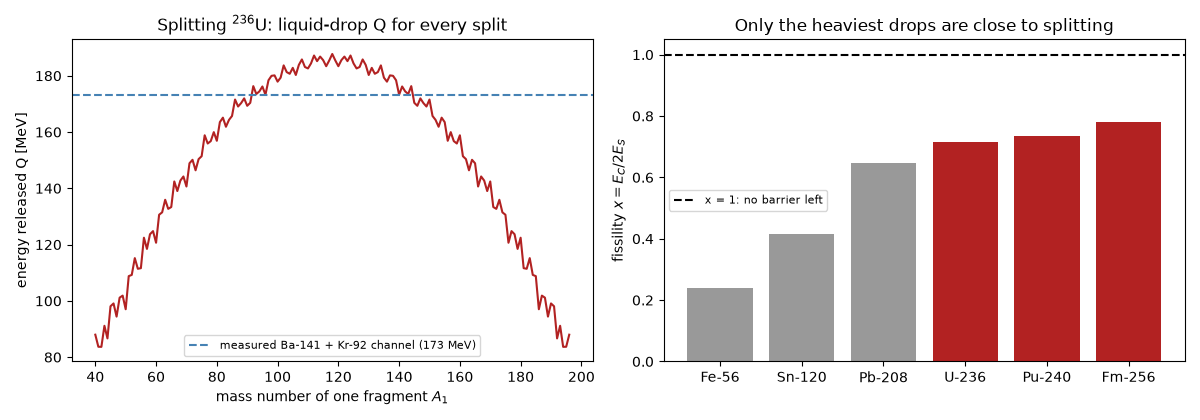
Fe-56   fissility x = 0.24
Sn-120  fissility x = 0.42
Pb-208  fissility x = 0.65
U-236   fissility x = 0.72
Pu-240  fissility x = 0.74
Fm-256  fissility x = 0.78
Check#
U-235 + n -> Ba-141 + Kr-92 + 3n releases ~173 MeV (7e10 J per gram, ~3e7 times a chemical bond); fissility grows with Z^2 / A.
Total running time of the script: (0 minutes 0.069 seconds)