
Note
Go to the end to download the full example code.
Chadwick’s discovery of the neutron#
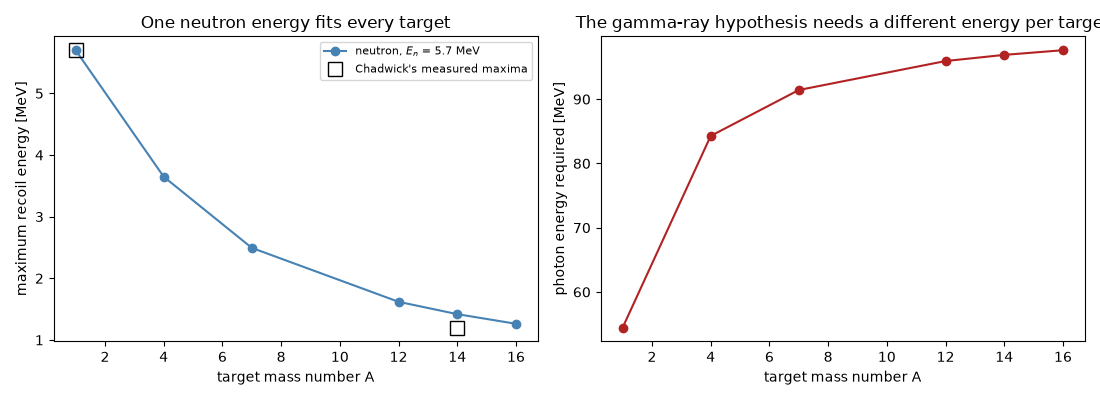
Bombarding beryllium with polonium alphas produced a penetrating neutral radiation that knocked protons out of paraffin wax at up to about 5.7 MeV. Curie and Joliot took it to be gamma rays. In 1932 Chadwick showed the numbers didn’t work for photons. A photon would need about 55 MeV to give a proton that much recoil in a Compton collision, and it would have to be even more energetic to explain the nitrogen recoils he also measured. The same energy could not account for both. A neutral particle with about the proton’s mass, colliding elastically, accounts for both recoils with a single energy.
This example redoes both halves of the argument: the Compton
kinematics, built with FourVector
and checked with invariant_mass(),
and Chadwick’s mass measurement from the maximum recoil speeds of
hydrogen and nitrogen nuclei.
The gamma-ray hypothesis fails#
A photon of energy \(E_\gamma\) hitting a nucleus of mass \(M\) head on gives it at most \(T_{\max} = 2E_\gamma^2/(M+2E_\gamma)\). Invert for the photon energy each observed recoil requires.
def compton_T_max(E_gamma, M):
    return 2 * E_gamma**2 / (M + 2 * E_gamma)


T_p_obs, T_N_obs = 5.7, 1.2  # MeV, maximum recoils Chadwick measured
E_for_p = brentq(lambda E: compton_T_max(E, m_p) - T_p_obs, 0.1, 1000)
E_for_N = brentq(lambda E: compton_T_max(E, m_N14) - T_N_obs, 0.1, 1000)
print(f"photon energy needed for a {T_p_obs} MeV proton recoil:  {E_for_p:.0f} MeV")
print(f"photon energy needed for a {T_N_obs} MeV nitrogen recoil: {E_for_N:.0f} MeV")
print("-> no single photon energy explains both")

# Check the head-on collision with explicit four-vectors: photon + proton at rest.
k = FourVector(E_for_p, 0, 0, E_for_p)
p_in = FourVector(m_p, 0, 0, 0)
k_out = FourVector(E_for_p - T_p_obs, 0, 0, -(E_for_p - T_p_obs))  # back-scattered photon
p_out = FourVector(m_p + T_p_obs, 0, 0, E_for_p + (E_for_p - T_p_obs))
print(f"four-momentum check: sqrt(s) in {invariant_mass([k, p_in]):.3f}, out {invariant_mass([k_out, p_out]):.3f} MeV; recoil mass {p_out.mass:.3f} MeV")
photon energy needed for a 5.7 MeV proton recoil:  55 MeV
photon energy needed for a 1.2 MeV nitrogen recoil: 89 MeV
-> no single photon energy explains both
four-momentum check: sqrt(s) in 991.407, out 991.407 MeV; recoil mass 938.272 MeV
A neutral particle of mass \(\approx m_p\)#
In an elastic head-on collision, a particle of mass \(m\) and speed \(v\) gives a target of mass \(M\) a recoil speed \(2mv/(m+M)\). Chadwick measured maximum recoil speeds of \(3.3\times10^9\) cm/s for hydrogen and \(4.7\times10^8\) cm/s for nitrogen. Their ratio fixes \(m\) without knowing \(v\):
Chadwick's neutron mass from recoil speeds: 1.16 proton masses (modern: 1.0014)
One neutron energy explains every recoil#
With \(m=1\), a neutron of kinetic energy \(E_n\) gives a nucleus of mass number \(A\) a maximum recoil energy \(4A/(1+A)^2\,E_n\). A single \(E_n\approx5.7\) MeV reproduces both the proton and nitrogen recoils; the photon hypothesis needs a different energy for each target.
A = np.array([1, 4, 7, 12, 14, 16])
E_n = T_p_obs
T_recoil_n = 4 * A / (1 + A) ** 2 * E_n
print(f"\nneutron of {E_n} MeV: nitrogen recoil {4 * 14 / 15**2 * E_n:.2f} MeV (observed about {T_N_obs} MeV)")

E_gamma_needed = [brentq(lambda E: compton_T_max(E, a * 931.494) - t, 0.1, 5000) for a, t in zip(A, T_recoil_n)]

fig, (ax1, ax2) = plt.subplots(1, 2, figsize=(11, 4))
ax1.plot(A, T_recoil_n, "o-", color="steelblue", label=f"neutron, $E_n$ = {E_n} MeV")
ax1.plot([1, 14], [T_p_obs, T_N_obs], "s", color="k", mfc="none", ms=10, label="Chadwick's measured maxima")
ax1.set_xlabel("target mass number A")
ax1.set_ylabel("maximum recoil energy [MeV]")
ax1.set_title("One neutron energy fits every target")
ax1.legend(fontsize=8)
ax2.plot(A, E_gamma_needed, "o-", color="firebrick")
ax2.set_xlabel("target mass number A")
ax2.set_ylabel("photon energy required [MeV]")
ax2.set_title("The gamma-ray hypothesis needs a different energy per target")
fig.tight_layout()

plt.show()
neutron of 5.7 MeV: nitrogen recoil 1.42 MeV (observed about 1.2 MeV)
Check#
No single photon energy explains both recoils (55 vs 89 MeV), while one neutron energy does (4A / (1+A)^2 E_n); the Compton kinematics conserve four-momentum.
Total running time of the script: (0 minutes 0.059 seconds)