
Note
Go to the end to download the full example code.
Cowan and Reines: direct detection of the neutrino#
More than two decades after Pauli’s postulate, Cowan and Reines caught the “undetectable” particle directly, searching for inverse beta decay,
next to the intense antineutrino flux of a nuclear reactor. This
example treats the reaction as the same kind of two-body-like fixed
final-state-momentum kinematics used throughout this chronology’s weak
decays – two_body_decay_momentum()
gives the fixed final-state momentum once the available energy is
known – and checks the reaction’s energy threshold, the minimum
antineutrino energy for which it can occur at all against a proton at
rest.
import matplotlib.pyplot as plt
import numpy as np

from physicskit.particle.decays import two_body_decay_momentum
The energy threshold#
In the lab frame with the proton at rest, the reaction is energetically allowed only once the antineutrino carries enough energy to produce the (heavier) neutron and the positron at rest in the final center-of-mass frame – the standard threshold calculation for a 2-to-2 reaction with one particle initially at rest.
m_p = 938.272
m_n = 939.565
m_e = 0.511

# Threshold: s_min = (m_n + m_e)^2, and s = m_p^2 + 2*m_p*E_nu (massless
# nu_bar hitting a proton at rest) -> solve for E_nu.
s_min = (m_n + m_e) ** 2
E_nu_threshold = (s_min - m_p**2) / (2.0 * m_p)
print("reaction: nu_bar_e + p -> n + e+")
print(f"threshold antineutrino energy: {E_nu_threshold:.4f} MeV")
print("(a reactor's antineutrino spectrum, peaking around a few MeV, sits comfortably above this --")
print(" exactly why a reactor was the practical neutrino source Cowan and Reines chose)")
reaction: nu_bar_e + p -> n + e+
threshold antineutrino energy: 1.8057 MeV
(a reactor's antineutrino spectrum, peaking around a few MeV, sits comfortably above this --
 exactly why a reactor was the practical neutrino source Cowan and Reines chose)
Final-state kinematics well above threshold#
At a typical reactor antineutrino energy, well above threshold, the center-of-mass energy fixes a definite final-state momentum for the neutron-positron pair, via the same Kallen-function machinery used for every two-body decay elsewhere in this chronology.
E_nu = 4.0  # MeV, a typical reactor antineutrino energy
s = m_p**2 + 2.0 * m_p * E_nu
sqrt_s = np.sqrt(s)
p_star = two_body_decay_momentum(sqrt_s, m_n, m_e)
print(f"\nat a typical reactor antineutrino energy E_nu={E_nu} MeV:")
print(f"  center-of-mass energy sqrt(s) = {sqrt_s:.4f} MeV")
print(f"  fixed final-state momentum p* = {p_star:.4f} MeV/c")
print("  (the delayed-coincidence signature Cowan and Reines actually detected: a prompt e+ annihilation")
print("   flash, set by this momentum and the positron's kinetic energy, followed by a delayed neutron-capture flash)")
at a typical reactor antineutrino energy E_nu=4.0 MeV:
  center-of-mass energy sqrt(s) = 942.2635 MeV
  fixed final-state momentum p* = 2.6459 MeV/c
  (the delayed-coincidence signature Cowan and Reines actually detected: a prompt e+ annihilation
   flash, set by this momentum and the positron's kinetic energy, followed by a delayed neutron-capture flash)
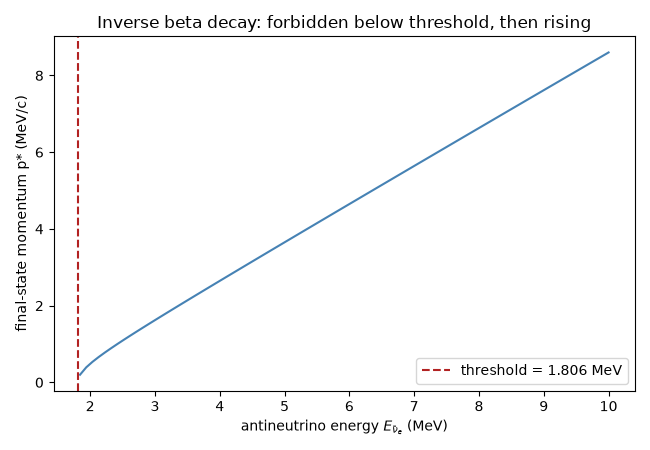
How far below threshold looks different#
E_nu_values = np.linspace(0.5, 10.0, 100)
s_values = m_p**2 + 2.0 * m_p * E_nu_values
allowed = s_values >= s_min
p_star_values = np.full_like(E_nu_values, np.nan)
p_star_values[allowed] = np.array([two_body_decay_momentum(np.sqrt(s), m_n, m_e) for s in s_values[allowed]])

fig, ax = plt.subplots(figsize=(6.5, 4.5))
ax.plot(E_nu_values, p_star_values, color="steelblue")
ax.axvline(E_nu_threshold, color="firebrick", ls="--", label=f"threshold = {E_nu_threshold:.3f} MeV")
ax.set_xlabel(r"antineutrino energy $E_{\bar\nu_e}$ (MeV)")
ax.set_ylabel("final-state momentum p* (MeV/c)")
ax.set_title("Inverse beta decay: forbidden below threshold, then rising")
ax.legend()
fig.tight_layout()

plt.show()
Check#
Threshold E = ((m_n + m_e)^2 - m_p^2) / 2 m_p = 1.806 MeV; no final state below it.
assert abs(E_nu_threshold - 1.8057) < 1e-3
assert np.all(np.isnan(p_star_values[~allowed])) and np.all(p_star_values[allowed] >= 0)
Total running time of the script: (0 minutes 0.036 seconds)