
Note
Go to the end to download the full example code.
Wigner phase-space quasi-probability#
The Wigner function represents a quantum state as a quasi-probability distribution over classical phase space \((x,p)\),
built here from the harmonic-oscillator Fock eigenstates \(\psi=\phi_n(x)\). Unlike a genuine probability density, \(W\) can go negative; its \(x\)- and \(p\)-marginals still reproduce the ordinary quantum probabilities, \(\int W\,dp = \lvert\psi(x)\rvert^2\). The ground state (\(n=0\)) stays a positive Gaussian, but the first excited state (\(n=1\)) develops genuinely negative regions – a hallmark of non-classicality with no counterpart in any classical phase-space distribution.
import matplotlib.pyplot as plt
import numpy as np

from physicskit.quantum.chapters.harmonic_spin import HarmonicOscillator
from physicskit.quantum.visualizers.phase_space import WignerVisualizer

ho = HarmonicOscillator()
x = np.linspace(-6, 6, 220)
wv = WignerVisualizer(n_p=180)
The n=0 and n=1 Fock-state Wigner functions#
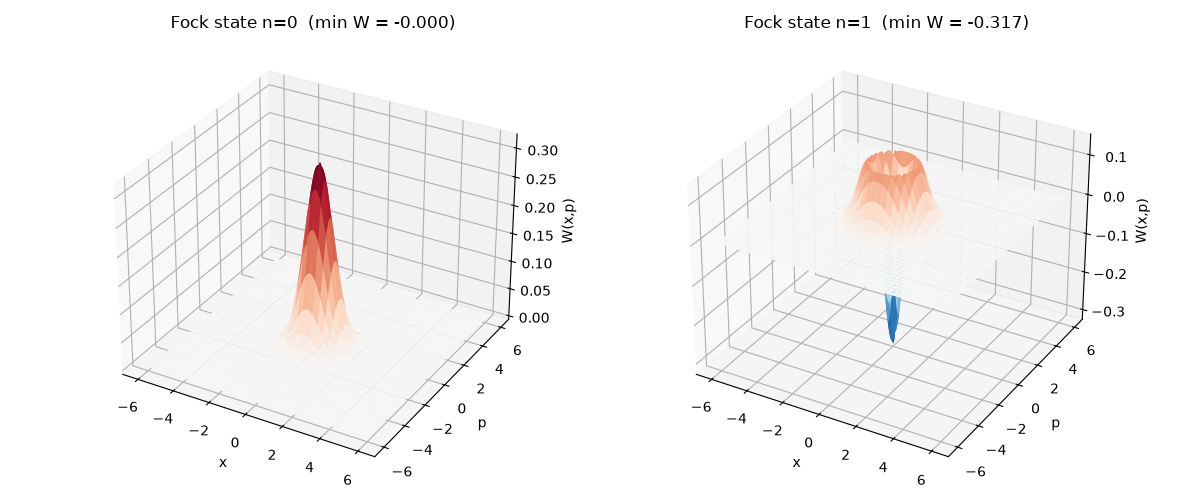
Sanity check: integrating W over p should recover \(\lvert\psi(x)\rvert^2\).
max |marginal - |psi|^2| = 2.937931927970397e-10
Phase-space interference fringes in a Fock-state superposition#
A single Fock state’s Wigner function is rotationally symmetric in phase
space, but a coherent superposition of two Fock states develops genuine
interference fringes between them – oscillatory, sign-alternating ripples
with no classical counterpart – built here with
superposition_wavefunction()
and rendered with the (previously unused)
plot_contour().
psi_super = ho.superposition_wavefunction([0, 2], [1.0, 1.0], x, t=0.0)
xg_s, p_s, W_super = wv.compute(x, psi_super, p_max=6.0)

fig2, ax_super = plt.subplots(figsize=(6.5, 5.5))
wv.plot_contour(xg_s, p_s, W_super, ax=ax_super)
ax_super.set_title(r"Wigner function of $(|0\rangle+|2\rangle)/\sqrt{2}$" "\n(interference fringes between the two lobes)")
fig2.tight_layout()

print(f"min W of the superposition (non-classicality): {W_super.min():.4f}")
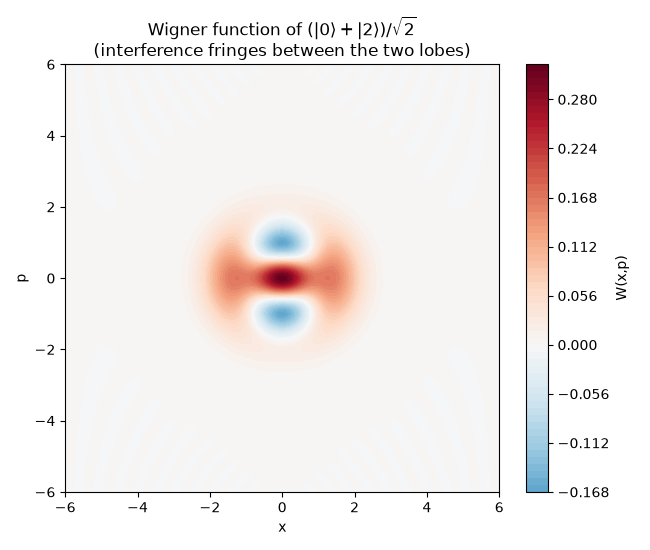
min W of the superposition (non-classicality): -0.1647
Check#
The position marginal of W is |psi|^2; the first excited state has W_1 = (2 rho^2 - 1) exp(-rho^2) / pi with rho^2 = x^2 + p^2 (hbar = m = omega = 1), negative near the origin; so is the superposition’s.
Total running time of the script: (0 minutes 0.375 seconds)