
Note
Go to the end to download the full example code.
Heisenberg’s uncertainty principle#
Checks the Heisenberg bound \(\Delta x\,\Delta p \ge \hbar/2\) directly
from harmonic-oscillator wavefunctions with
uncertainty(), and verifies the
underlying canonical commutation relation \([\hat x,\hat p]=i\hbar\) in a
truncated Fock basis with
commutator(),
position_operator(), and
momentum_operator().
import matplotlib.pyplot as plt
import numpy as np

from physicskit.quantum.chapters.harmonic_spin import HarmonicOscillator
from physicskit.quantum.core.operators import commutator, momentum_operator, position_operator
from physicskit.quantum.utils.measure import uncertainty

ho = HarmonicOscillator()
x = np.linspace(-12, 12, 4000)

n_values = np.arange(0, 8)
dx_vals, dp_vals, prod_vals = [], [], []
for n in n_values:
    psi_n = ho.eigenfunction(int(n), x)
    dx, dp, prod = uncertainty(x, psi_n, hbar=ho.hbar)
    dx_vals.append(dx)
    dp_vals.append(dp)
    prod_vals.append(prod)
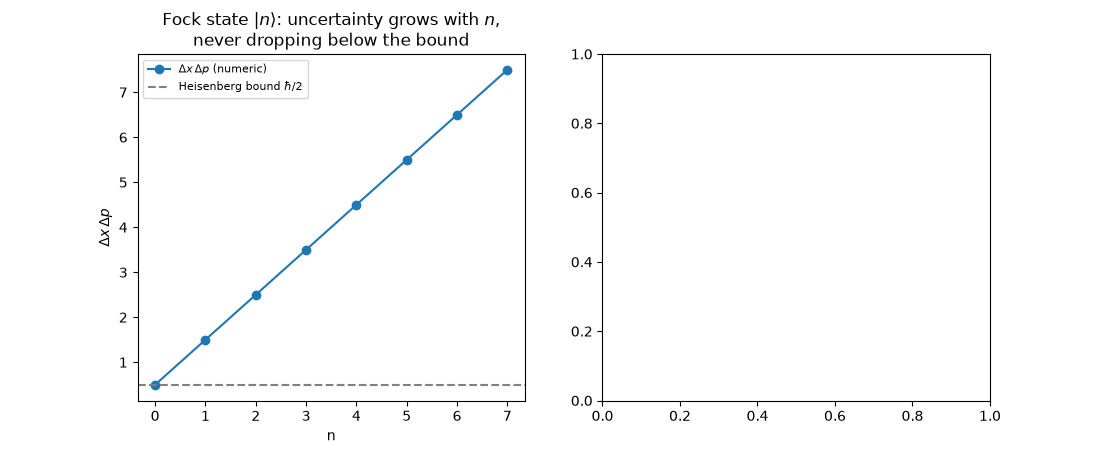
\(\Delta x\,\Delta p\) for Fock states \(|n\rangle\), always at or above the Heisenberg bound (equality only at \(n=0\)) ————————————————————————–
fig, axes = plt.subplots(1, 2, figsize=(11, 4.5))

axes[0].plot(n_values, prod_vals, "o-", label=r"$\Delta x\,\Delta p$ (numeric)")
axes[0].axhline(ho.hbar / 2, color="gray", ls="--", label=r"Heisenberg bound $\hbar/2$")
axes[0].set_xlabel("n")
axes[0].set_ylabel(r"$\Delta x \, \Delta p$")
axes[0].set_title(
    r"Fock state $|n\rangle$: uncertainty grows with $n$,"
    "\nnever dropping below the bound"
)
axes[0].legend(fontsize=8)
<matplotlib.legend.Legend object at 0x34fb9ca10>
The canonical commutation relation, verified in a truncated Fock basis#
n_max = 40
x_op = position_operator(n_max, m=ho.m, omega=ho.omega, hbar=ho.hbar)
p_op = momentum_operator(n_max, m=ho.m, omega=ho.omega, hbar=ho.hbar)
comm = commutator(x_op, p_op)
target = 1j * ho.hbar * np.eye(n_max)

# Truncation breaks the relation only in the last diagonal entry (raising
# out of the truncated basis is cut off there); the bulk matches i*hbar*I
# exactly.
bulk = slice(0, n_max - 1)
max_err_bulk = np.max(np.abs(comm[bulk, bulk] - target[bulk, bulk]))
print(f"max |[x,p] - i*hbar*I| over the bulk (excluding the last row/col): {max_err_bulk:.2e}")

im = axes[1].imshow(np.imag(comm[bulk, bulk]), cmap="RdBu_r", vmin=-1.2, vmax=1.2)
axes[1].set_title(
    r"Im $[\hat x,\hat p]$ in a truncated Fock basis"
    "\n(should be $\\hbar$ on the diagonal)"
)
fig.colorbar(im, ax=axes[1], fraction=0.046)

fig.tight_layout()
max |[x,p] - i*hbar*I| over the bulk (excluding the last row/col): 1.42e-14
The squeezed-vacuum momentum uncertainty away from the squeezing axis#
squeezed_vacuum_wavefunction()
takes a squeezing angle \(\phi\) that rotates the uncertainty
ellipse in phase space: at \(\phi=0\) position is squeezed, at
\(\phi=\pi/2\) momentum is, and in between the squeezing sits
along a rotated quadrature, so \(\Delta x\) and \(\Delta p\)
both depend on \(r\) and \(\phi\), and their product exceeds
\(\hbar/2\) away from the two axes even though the state is still
a minimum-uncertainty state for its own rotated quadratures.
r_values = np.linspace(0.0, 1.2, 40)
phi_values = np.linspace(0.0, np.pi / 2, 40)
dp_map = np.zeros((len(r_values), len(phi_values)))
prod_ratio = np.zeros_like(phi_values)
x_sq = np.linspace(-10, 10, 1500)
for i, r_val in enumerate(r_values):
    for j, phi_val in enumerate(phi_values):
        psi_rp = ho.squeezed_vacuum_wavefunction(x_sq, r_val, phi_val)
        _dx_rp, dp_rp, prod_rp = uncertainty(x_sq, psi_rp, hbar=ho.hbar)
        dp_map[i, j] = dp_rp
        if i == 0:
            prod_ratio[j] = prod_rp / ho.hbar

fig2, ax2 = plt.subplots(figsize=(6.5, 5))
im2 = ax2.pcolormesh(phi_values, r_values, dp_map, shading="auto", cmap="magma")
ax2.set_xlabel(r"squeezing angle $\phi$")
ax2.set_ylabel(r"squeezing amplitude $r$")
ax2.set_title(r"Squeezed vacuum: $\Delta p(r,\phi)$" "\n(anti-squeezed at phi=0, squeezed at phi=pi/2)")
fig2.colorbar(im2, ax=ax2, label=r"$\Delta p$")
fig2.tight_layout()

print(f"Delta p(r={r_values[-1]:.2f}, phi=0) = {dp_map[-1, 0]:.4f}   Delta p(r={r_values[-1]:.2f}, phi={phi_values[-1]:.2f}) = {dp_map[-1, -1]:.4f}")
print("Delta x*Delta p/hbar along the r=0 row (the vacuum, whatever phi):")
print("  ", np.round(prod_ratio[:: len(prod_ratio) // 4], 4))
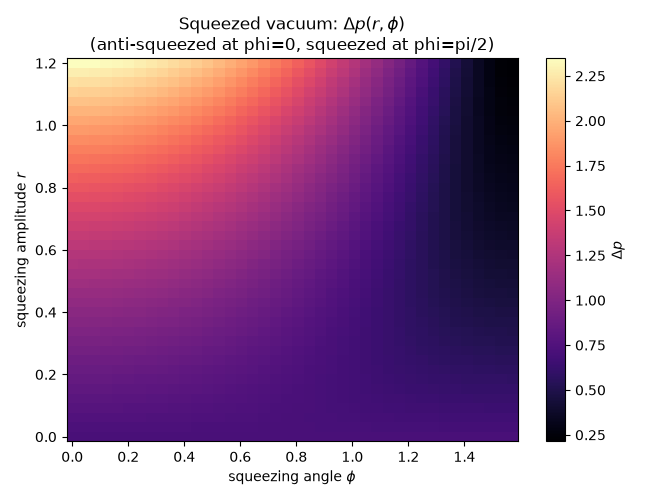
Delta p(r=1.20, phi=0) = 2.3477   Delta p(r=1.20, phi=1.57) = 0.2129
Delta x*Delta p/hbar along the r=0 row (the vacuum, whatever phi):
   [0.5 0.5 0.5 0.5]
Check#
Fock states: dx dp = (n + 1/2) hbar. [x, p] = i hbar below the truncation. Squeezed vacuum: dp = e^(+-r) / sqrt(2), with dx dp = hbar/2 for the vacuum.
np.testing.assert_allclose(prod_vals, (n_values + 0.5) * ho.hbar, rtol=1e-6)
assert max_err_bulk < 1e-12
assert abs(dp_map[-1, 0] - np.exp(r_values[-1]) / np.sqrt(2)) < 1e-3
assert abs(dp_map[-1, -1] - np.exp(-r_values[-1]) / np.sqrt(2)) < 1e-3
np.testing.assert_allclose(prod_ratio, 0.5, atol=1e-6)
Total running time of the script: (0 minutes 0.246 seconds)