
Note
Go to the end to download the full example code.
The WKB approximation: connection formulas on the quantum bouncer#
Wentzel, Kramers and Brillouin (1926) wrote the wavefunction in a slowly varying potential as an amplitude times a fast phase,
The approximation fails where \(p\to0\), at the classical turning points. Kramers’s contribution was to match it through each turning point to the exact local solution, an Airy function. This fixes the phase lost at a soft turning point at \(\pi/4\), against \(\pi/2\) at a hard wall. Those phases are the difference between the old rule \(\oint p\,dq = nh\) and the correct spectrum.
The quantum bouncer (a particle above a hard floor in uniform gravity,
\(V=mgx\)) has one of each kind of turning point, and exact
solutions given by Airy functions. This example compares the exact
levels with WKB using the Kramers phases, built from
classical_momentum() and
wkb_action(), and with the
uncorrected integer rule. Units: \(\hbar = m = g = 1\).
Exact levels#
\(-\tfrac12\psi'' + x\psi = E\psi\) with \(\psi(0)=0\) is solved by \(\mathrm{Ai}(2^{1/3}(x-E))\), so the energies are the Airy zeros \(a_n\) rescaled: \(E_n = -a_n/2^{1/3}\).
WKB levels#
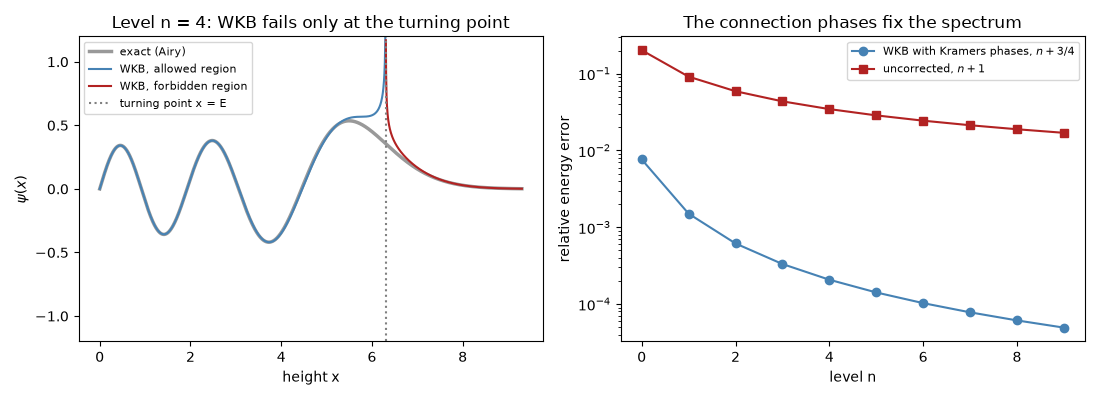
Between the floor and the turning point \(x=E\), the action is \(\int_0^E p\,dx = \tfrac{2\sqrt2}{3}E^{3/2}\). With a hard wall (\(\pi/2\)) and a soft turning point (\(\pi/4\)), the quantization condition is \(\int_0^E p\,dx = (n + \tfrac34)\pi\). The uncorrected rule, ignoring both phases, would be \((n+1)\pi\).
n = np.arange(n_levels)
E_wkb = (3 * np.pi * (n + 0.75) / (2 * np.sqrt(2))) ** (2 / 3)
E_naive = (3 * np.pi * (n + 1.0) / (2 * np.sqrt(2))) ** (2 / 3)

check = wkb_action(E_wkb[3], V, 1.0, 0.0, E_wkb[3]) / np.pi
print(f"numerical action / pi at the n=3 WKB level: {check:.4f}  (n + 3/4 = 3.75)")
print(f"{'n':>2s} {'exact':>8s} {'WKB n+3/4':>10s} {'rel. err':>9s} {'naive n+1':>10s} {'rel. err':>9s}")
for k in range(n_levels):
    print(f"{k:2d} {E_exact[k]:8.4f} {E_wkb[k]:10.4f} {abs(E_wkb[k] / E_exact[k] - 1):9.1e} {E_naive[k]:10.4f} {abs(E_naive[k] / E_exact[k] - 1):9.1e}")
numerical action / pi at the n=3 WKB level: 3.7500  (n + 3/4 = 3.75)
 n    exact  WKB n+3/4  rel. err  naive n+1  rel. err
 0   1.8558     1.8416   7.6e-03     2.2309   2.0e-01
 1   3.2446     3.2397   1.5e-03     3.5414   9.1e-02
 2   4.3817     4.3790   6.2e-04     4.6405   5.9e-02
 3   5.3866     5.3848   3.3e-04     5.6216   4.4e-02
 4   6.3053     6.3040   2.1e-04     6.5233   3.5e-02
 5   7.1613     7.1603   1.4e-04     7.3663   2.9e-02
 6   7.9689     7.9681   1.0e-04     8.1636   2.4e-02
 7   8.7375     8.7368   7.8e-05     8.9237   2.1e-02
 8   9.4736     9.4730   6.1e-05     9.6526   1.9e-02
 9  10.1822    10.1817   4.9e-05    10.3550   1.7e-02
The wavefunction and the turning point#
In the allowed region the WKB wave matches the exact Airy function almost perfectly, but its \(1/\sqrt p\) amplitude blows up at \(x = E\). Beyond it, the WKB form is the decaying exponential \(e^{-\int\kappa\,dx}/\sqrt\kappa\), again good away from the turning point. The Airy function joins the two smoothly; matching both WKB forms to it is what fixes the \(\pi/4\).
level = 4
E = E_wkb[level]
x = np.linspace(1e-4, E + 3.0, 2000)
psi_exact = airy(2 ** (1 / 3) * (x - E_exact[level]))[0]
inside, outside = x < E, x > E
p = classical_momentum(E, V, x[inside], m=1.0)
phase = np.array([wkb_action(E, V, 1.0, 0.0, xi) for xi in x[inside]])
psi_in = np.sin(phase) / np.sqrt(p)
kappa = np.sqrt(2 * (x[outside] - E))
decay = (2 * np.sqrt(2) / 3) * (x[outside] - E) ** 1.5
psi_out = 0.5 * np.exp(-decay) / np.sqrt(kappa) * (-1) ** level

scale = np.max(np.abs(psi_exact[x < 0.6 * E])) / np.max(np.abs(psi_in[x[inside] < 0.6 * E]))
fig, (ax1, ax2) = plt.subplots(1, 2, figsize=(11, 4))
ax1.plot(x, psi_exact, color="k", lw=2.5, alpha=0.4, label="exact (Airy)")
ax1.plot(x[inside], scale * psi_in, color="steelblue", label=r"WKB, allowed region")
ax1.plot(x[outside], scale * psi_out, color="firebrick", label=r"WKB, forbidden region")
ax1.axvline(E, color="0.5", ls=":", label="turning point x = E")
ax1.set_ylim(-1.2, 1.2)
ax1.set_xlabel("height x")
ax1.set_ylabel(r"$\psi(x)$")
ax1.set_title(f"Level n = {level}: WKB fails only at the turning point")
ax1.legend(fontsize=8)
ax2.semilogy(n, np.abs(E_wkb / E_exact - 1), "o-", color="steelblue", label=r"WKB with Kramers phases, $n+3/4$")
ax2.semilogy(n, np.abs(E_naive / E_exact - 1), "s-", color="firebrick", label=r"uncorrected, $n+1$")
ax2.set_xlabel("level n")
ax2.set_ylabel("relative energy error")
ax2.set_title("The connection phases fix the spectrum")
ax2.legend(fontsize=8)
fig.tight_layout()

plt.show()
Check#
With the Maslov phases (1/4 at the soft turning point, 1/2 at the hard floor) WKB is within 1% even for the ground state, the error falls with n, and it is ten times smaller than the uncorrected rule’s.
Total running time of the script: (0 minutes 0.305 seconds)