
Note
Go to the end to download the full example code.
Einstein’s Brownian motion: diffusion equals mobility times temperature#
Einstein’s 1905 paper made two separate claims about a suspended particle. First, its random wandering spreads as \(\langle\Delta x^2\rangle = 2Dt\). Second, the diffusion coefficient is not a free parameter: it equals the particle’s mobility \(\mu\), the drift speed per unit applied force, times the temperature,
Einstein got this by balancing the diffusion current against the drift caused by a force, such as gravity acting on sedimenting particles. The relation ties a fluctuation (the spread) to a response (the drift). Perrin used it with Stokes’ \(\mu = 1/6\pi\eta a\) to count molecules.
This example simulates overdamped Brownian particles with
BrownianMotion. It measures \(D\) from
the spread and \(\mu\) from the drift under a pull, for several
frictions and temperatures, and checks that \(D/(\mu k_BT) = 1\) in
every case. Units have \(k_B = 1\).
import matplotlib.pyplot as plt
import numpy as np

from physicskit.statphys import BrownianMotion, stokes_einstein_diffusion_coefficient
Spread and drift of one driven ensemble#
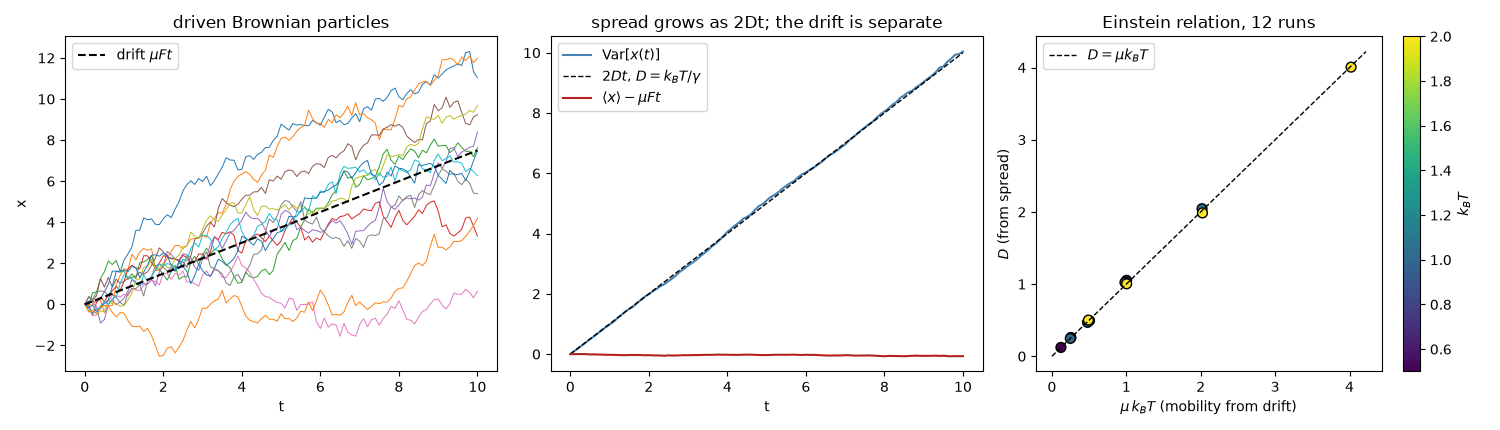
A constant force \(F\) moves the cloud’s center at \(\mu F\). The cloud’s width still grows as \(2Dt\), exactly as without the force.
gamma, kT, F = 2.0, 1.0, 1.5
bm = BrownianMotion(n_particles=4000, dim=1, gamma=gamma, kT=kT, force=F, seed=1905)
t, x = bm.run(t_max=10.0, dt=0.01, n_frames=100)
center = x[:, :, 0].mean(axis=1)
spread = x[:, :, 0].var(axis=1)
print(f"mobility: measured {bm.measured_mobility():.4f}, 1/gamma = {1 / gamma:.4f}")
print(f"diffusion: measured {bm.measured_diffusion_coefficient():.4f}, kT/gamma = {kT / gamma:.4f}")
mobility: measured 0.4953, 1/gamma = 0.5000
diffusion: measured 0.5024, kT/gamma = 0.5000
The Einstein relation across frictions and temperatures#
Changing the friction changes \(D\) and \(\mu\) together. Changing the temperature changes only \(D\). Their ratio is always \(k_BT\).
rows = []
for g in (0.5, 1.0, 2.0, 4.0):
    for T in (0.5, 1.0, 2.0):
        run = BrownianMotion(n_particles=3000, gamma=g, kT=T, force=1.0, seed=int(100 * g + 10 * T))
        run.run(t_max=5.0, dt=0.01, n_frames=25)
        rows.append((g, T, run.measured_diffusion_coefficient(), run.measured_mobility()))
rows = np.array(rows)
ratio = rows[:, 2] / (rows[:, 3] * rows[:, 1])
print(f"D / (mu kT) over {len(rows)} runs: mean {ratio.mean():.3f}, spread {ratio.std():.3f}")
D / (mu kT) over 12 runs: mean 1.007, spread 0.022
Perrin’s numbers#
For a 0.5 micron bead in water at 20 C, the Stokes-Einstein coefficient is a fraction of a square micron per second, so it takes seconds to wander a micron: exactly the scale Perrin followed under his microscope.
D_bead = stokes_einstein_diffusion_coefficient(1.380649e-23 * 293.15, 1.0e-3, 0.5e-6)
print(f"Stokes-Einstein D for a 0.5 um bead in water: {D_bead * 1e12:.3f} um^2/s")

fig, axes = plt.subplots(1, 3, figsize=(15, 4.3))
for i in range(12):
    axes[0].plot(t, x[:, i, 0], lw=0.7)
axes[0].plot(t, F / gamma * t, "k--", lw=1.5, label=r"drift $\mu F t$")
axes[0].set_xlabel("t")
axes[0].set_ylabel("x")
axes[0].set_title("driven Brownian particles")
axes[0].legend()

axes[1].plot(t, spread, color="steelblue", label=r"Var$[x(t)]$")
axes[1].plot(t, 2 * kT / gamma * t, "k--", lw=1, label=r"$2Dt$, $D = k_BT/\gamma$")
axes[1].plot(t, center - F / gamma * t, color="firebrick", label=r"$\langle x\rangle - \mu F t$")
axes[1].set_xlabel("t")
axes[1].set_title("spread grows as 2Dt; the drift is separate")
axes[1].legend()

sc = axes[2].scatter(rows[:, 3] * rows[:, 1], rows[:, 2], c=rows[:, 1], cmap="viridis", s=50, edgecolors="k")
line = np.linspace(0, (rows[:, 3] * rows[:, 1]).max() * 1.05, 10)
axes[2].plot(line, line, "k--", lw=1, label=r"$D = \mu k_BT$")
axes[2].set_xlabel(r"$\mu\,k_BT$ (mobility from drift)")
axes[2].set_ylabel(r"$D$ (from spread)")
axes[2].set_title("Einstein relation, 12 runs")
fig.colorbar(sc, ax=axes[2], label=r"$k_BT$")
axes[2].legend()
fig.tight_layout()
plt.show()
Stokes-Einstein D for a 0.5 um bead in water: 0.429 um^2/s
Check#
mu = 1/gamma, D = kT/gamma, so D = mu kT for every friction and temperature (Einstein 1905); Stokes-Einstein for a 0.5 um bead in water.
Total running time of the script: (0 minutes 0.462 seconds)