
Note
Go to the end to download the full example code.
Extreme Sensitivity: a Slightly Truncated Circle#
A billiard particle moves in a straight line and reflects specularly off
its boundary, \(\mathbf{v}' = \mathbf{v} - 2(\mathbf{v}\cdot\mathbf{n})
\,\mathbf{n}\). The circular billiard (boundary \(x^2+y^2=r^2\)) is
exactly integrable: \(\sin\phi\) – the sine of the angle of incidence
at each bounce – is conserved forever, so two rays launched a hair’s
breadth apart stay a hair’s breadth apart forever too. Slicing off even a
tiny flat chord (turning it into a TruncatedCircleBilliard
of boundary parameter cut) destroys this completely. This example
launches two rays \(10^{-8}\) radians apart into a circle truncated by a
chord just 5% of the radius deep – barely different from a perfect circle
by eye – and watches them track each other indistinguishably for dozens of
bounces before a single grazing hit near the chord sends them down
completely different paths.
import matplotlib.pyplot as plt

from physicskit.chaos.systems.billiards import CircleBilliard, TruncatedCircleBilliard
from physicskit.chaos.visualizers import (
    animate_billiard_divergence,
    billiard_trajectory_divergence,
    plot_billiard_divergence,
)
A perfect circle never diverges#
As a baseline, launch the same pair of nearly-identical rays into an
untruncated circle: because sin(phi) is exactly conserved, their
separation is exactly preserved too, bounce after bounce – no exponential
growth, no sensitivity, because there is no chaos to be sensitive to.
circle = CircleBilliard(radius=1.0)
_, separation_circle = billiard_trajectory_divergence(circle, pos=circle.sample_interior_point(), vel=(0.2, 0.0), delta_0=1e-8, n_bounces=100)
print(f"Perfect circle: separation after 100 bounces = {separation_circle[-1]:.3e} (started at 1e-08)")
Perfect circle: separation after 100 bounces = 1.000e-08 (started at 1e-08)
Animation: two rays, one tiny chord#
Watch the reference (blue) and perturbed (red) rays bounce together, overlapping so closely they look like a single ray, until they don’t.
billiard = TruncatedCircleBilliard(radius=1.0, cut=0.001)
pos = billiard.sample_interior_point()
vel = (0.2, 0.0)

anim = animate_billiard_divergence(billiard, pos, vel, delta_0=1e-8, n_bounces=100, trail=25)

plt.show()
To save the animation to a file instead of (or in addition to) displaying it interactively, use e.g.:
anim.save("extreme_sensitivity_animation.gif", writer="pillow", fps=25)
Quantifying it: exponential divergence#
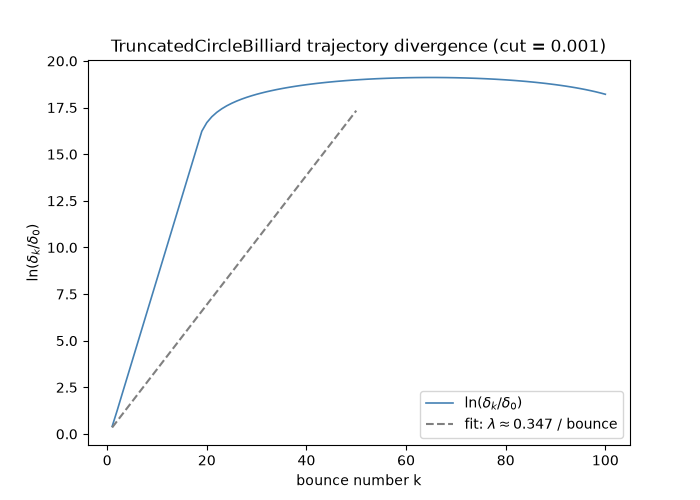
ln(separation / delta_0) climbs in a distinctive staircase – flat
stretches where both rays are still circling together far from the chord,
punctuated by jumps each time one (and then, soon after, the other) ray
grazes it – before saturating once the two rays are effectively
uncorrelated, at the scale of the table itself.
fig, ax, lam = plot_billiard_divergence(billiard, pos, vel, delta_0=1e-8, n_bounces=100)
ax.set_title(f"{ax.get_title()} (cut = {billiard.cut})")

plt.show()
Check#
In the integrable circle a perturbation does not grow exponentially; a 0.1% flat cut makes the billiard chaotic, with a positive Lyapunov exponent.
assert separation_circle[-1] < 1e-6
assert lam > 0
Total running time of the script: (0 minutes 5.969 seconds)