
Note
Go to the end to download the full example code.
Angular momentum: a different conservation law from energy#
physicskit.classical.utils.conservation has more than just energy-drift helpers.
angular_momentum_2d and angular_momentum_drift track the planar
angular momentum
which is conserved whenever a system’s dynamics are rotationally symmetric about the origin (a central force, \(V = V(r)\)) – regardless of whether energy-conserving perturbations also happen to break other symmetries. This contrasts two systems:
KeplerSystem, even with a post-Newtonian perturbation that makes the Laplace-Runge-Lenz vector precess (a genuine physical effect: the perturbation breaks the extra, non-obvious SO(4) symmetry special to the exact 1/r potential), still exactly conserves angular momentum – because it is still a central force, and central forces exert no torque about their center regardless of their radial profile.
ProjectileMotion, a uniform gravitational field, is not a central force from the origin at all: gravity exerts a real torque there, so L changes – growing steadily as the projectile falls.
import matplotlib.pyplot as plt
import numpy as np

from physicskit.classical.systems.newtonian import KeplerSystem, ProjectileMotion
from physicskit.classical.utils.conservation import angular_momentum_2d, angular_momentum_drift, relative_energy_drift
Kepler, with a precession-causing perturbation: L still conserved#
kepler = KeplerSystem.from_orbital_elements(a=1.0, e=0.5, c_pn=0.02)
result_k = kepler.integrate((0, 100), dt=1e-3, method="yoshida4")
L_drift_k = angular_momentum_drift(result_k.q, result_k.p)
E_drift_k = relative_energy_drift(result_k.energy)
print(f"perturbed Kepler: max |L(t)-L(0)| = {L_drift_k.max():.2e}, max relative energy drift = {E_drift_k.max():.2e}")
perturbed Kepler: max |L(t)-L(0)| = 2.94e-14, max relative energy drift = 1.41e-11
Projectile motion: uniform gravity is not a central force, L drifts#
proj = ProjectileMotion.from_launch(speed=20.0, angle_deg=45.0, g=9.81)
result_p = proj.integrate((0, 2.9), dt=1e-3, method="yoshida4")
L_p = angular_momentum_2d(result_p.q, result_p.p)
print(f"projectile motion: L(0) = {L_p[0]:.3f}, L(end) = {L_p[-1]:.3f} (steadily changing, as expected)")

fig, axes = plt.subplots(1, 2, figsize=(10, 4.3))
axes[0].plot(result_k.t, L_drift_k, color="steelblue")
axes[0].set_xlabel("t")
axes[0].set_ylabel(r"$|L(t) - L(0)|$")
axes[0].set_title("Perturbed KeplerSystem:\nangular momentum exactly conserved")

axes[1].plot(result_p.t, L_p, color="firebrick")
axes[1].set_xlabel("t")
axes[1].set_ylabel("L(t)")
axes[1].set_title("ProjectileMotion:\nnot a central force, so L is not conserved")
fig.suptitle("Angular momentum conservation depends on rotational symmetry, not on energy conservation", fontsize=12)
fig.tight_layout(rect=[0, 0, 1, 0.90])
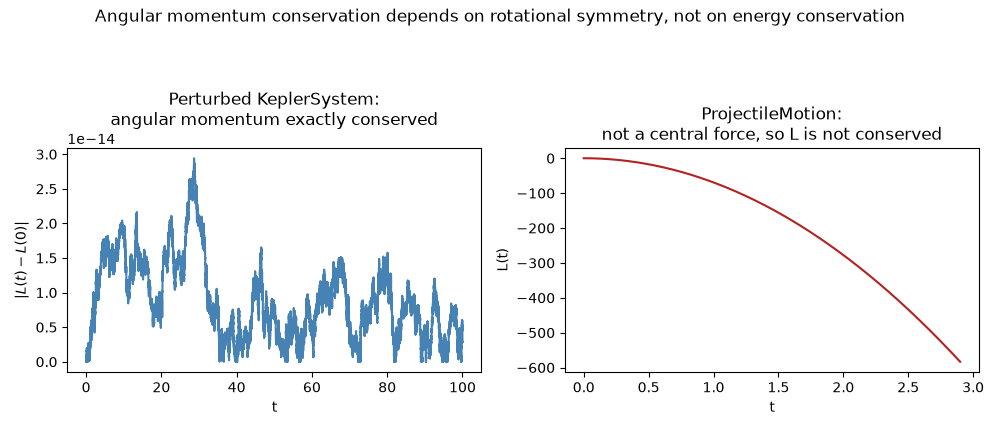
projectile motion: L(0) = 0.000, L(end) = -583.378 (steadily changing, as expected)
This is the practical content of Noether’s theorem: energy conservation comes from time-translation symmetry, angular momentum conservation from rotational symmetry, and the two can be switched on or off independently, as shown here.
plt.show()
Check#
A central force conserves L even when perturbed; gravity on a projectile torques it: L_z(t) = -m v_x g t^2 / 2 about the launch point.
assert L_drift_k.max() < 1e-12 and E_drift_k.max() < 1e-9
v_x = 20.0 * np.cos(np.radians(45.0))
np.testing.assert_allclose(L_p, -v_x * 9.81 * result_p.t**2 / 2, atol=1e-8)
Total running time of the script: (0 minutes 0.657 seconds)