
Note
Go to the end to download the full example code.
Dirac’s quantization of the electromagnetic field: ladder operators#
Dirac gave the first fully quantum treatment of radiation by promoting
each field mode to a quantum harmonic oscillator, with non-commuting
annihilation and creation operators \(\hat a,\hat a^\dagger\)
satisfying \([\hat a,\hat a^\dagger]=1\). Photon number becomes the
oscillator’s excitation number, \(\hat n=\hat a^\dagger\hat a\), with
\(\hat a\) and \(\hat a^\dagger\) respectively removing and
adding one field quantum – exactly the ladder structure Einstein’s 1905
light quanta had implied but never derived. This example builds
\(\hat a\) and \(\hat a^\dagger\) directly with
annihilation_operator() and
creation_operator(), verifies
the commutation relation and the ladder action on Fock states, and shows
the vacuum-fluctuation fact behind Dirac’s other major result: even the
vacuum \(\lvert0\rangle\) is not “nothing” to \(\hat a^\dagger\),
which is exactly what makes spontaneous emission unavoidable.
import matplotlib.pyplot as plt
import numpy as np

from physicskit.quantum.core.operators import (
    annihilation_operator,
    commutator,
    creation_operator,
    number_operator,
)
Building the ladder operators, and checking the commutator#
n_max = 12
a = annihilation_operator(n_max)
a_dag = creation_operator(n_max)

comm = commutator(a, a_dag)
print("[a, a_dagger] on the truncated basis (should be the identity, except at the truncation edge):")
print(np.round(comm.real, 4))
print(f"\nmax deviation from identity, excluding the last (truncated) basis state: {np.max(np.abs(comm[:-1, :-1] - np.eye(n_max - 1))):.2e}")
print(f"deviation at the truncated edge (n_max-1): {comm[-1, -1].real:.4f} (a finite-basis artifact -- a true infinite Fock space has none)")
[a, a_dagger] on the truncated basis (should be the identity, except at the truncation edge):
[[  1.   0.   0.   0.   0.   0.   0.   0.   0.   0.   0.   0.]
 [  0.   1.   0.   0.   0.   0.   0.   0.   0.   0.   0.   0.]
 [  0.   0.   1.   0.   0.   0.   0.   0.   0.   0.   0.   0.]
 [  0.   0.   0.   1.   0.   0.   0.   0.   0.   0.   0.   0.]
 [  0.   0.   0.   0.   1.   0.   0.   0.   0.   0.   0.   0.]
 [  0.   0.   0.   0.   0.   1.   0.   0.   0.   0.   0.   0.]
 [  0.   0.   0.   0.   0.   0.   1.   0.   0.   0.   0.   0.]
 [  0.   0.   0.   0.   0.   0.   0.   1.   0.   0.   0.   0.]
 [  0.   0.   0.   0.   0.   0.   0.   0.   1.   0.   0.   0.]
 [  0.   0.   0.   0.   0.   0.   0.   0.   0.   1.   0.   0.]
 [  0.   0.   0.   0.   0.   0.   0.   0.   0.   0.   1.   0.]
 [  0.   0.   0.   0.   0.   0.   0.   0.   0.   0.   0. -11.]]

max deviation from identity, excluding the last (truncated) basis state: 1.78e-15
deviation at the truncated edge (n_max-1): -11.0000 (a finite-basis artifact -- a true infinite Fock space has none)
The ladder action on Fock states#
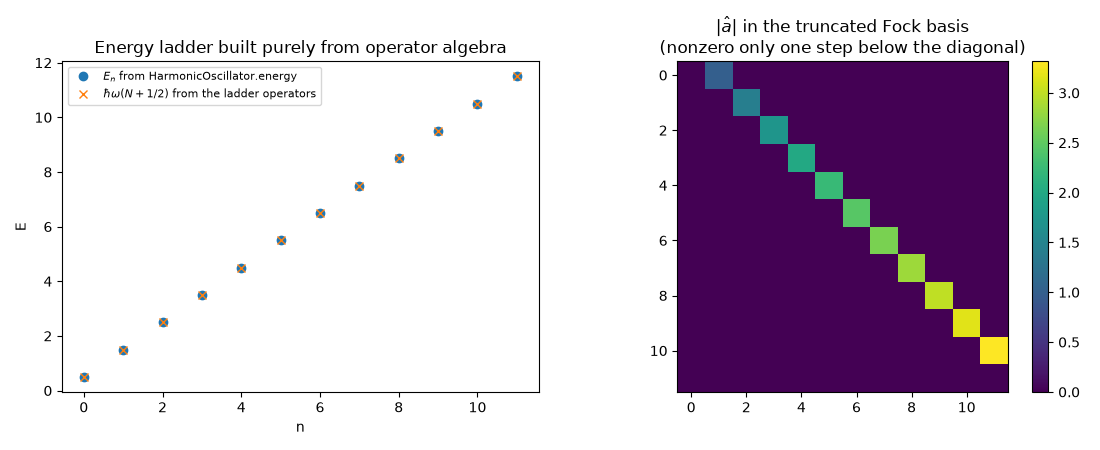
a|n> = sqrt(n)|n-1>, a_dagger|n> = sqrt(n+1)|n+1> – verified directly as matrix-vector products against basis vectors, not assumed.
n_test = 4
psi_n = np.zeros(n_max, dtype=complex)
psi_n[n_test] = 1.0

lowered = a @ psi_n
raised = a_dag @ psi_n
lowered_idx, lowered_amp = np.argmax(np.abs(lowered)), np.abs(lowered).max()
raised_idx, raised_amp = np.argmax(np.abs(raised)), np.abs(raised).max()
print(f"\nstarting from |n={n_test}>:")
print(f"  a|n> has its only nonzero entry at index {lowered_idx}, amplitude {lowered_amp:.6f} (expected sqrt({n_test})={np.sqrt(n_test):.6f})")
print(f"  a_dagger|n> has its only nonzero entry at index {raised_idx}, amplitude {raised_amp:.6f} (expected sqrt({n_test + 1})={np.sqrt(n_test + 1):.6f})")
starting from |n=4>:
  a|n> has its only nonzero entry at index 3, amplitude 2.000000 (expected sqrt(4)=2.000000)
  a_dagger|n> has its only nonzero entry at index 5, amplitude 2.236068 (expected sqrt(5)=2.236068)
The number operator’s ladder-derived spectrum#
N = number_operator(n_max)
eigenvalues = np.sort(np.linalg.eigvalsh(N).real)
print(f"\nnumber operator N=a_dagger*a eigenvalues: {np.round(eigenvalues, 6)}")
print("(exactly 0, 1, 2, ..., n_max-1 -- built entirely from the ladder operators above)")

fig, ax = plt.subplots(figsize=(6, 4.5))
ax.plot(eigenvalues, "o-", color="steelblue")
ax.set_xlabel("eigenstate index")
ax.set_ylabel("photon number eigenvalue")
ax.set_title(r"Spectrum of $\hat N=\hat a^\dagger\hat a$: the discrete ladder")
fig.tight_layout()
number operator N=a_dagger*a eigenvalues: [ 0.  1.  2.  3.  4.  5.  6.  7.  8.  9. 10. 11.]
(exactly 0, 1, 2, ..., n_max-1 -- built entirely from the ladder operators above)
The vacuum is not “nothing” to a_dagger: the seed of spontaneous emission#
<0|a a_dagger|0> = 1, even though <0|a_dagger a|0> = 0 (the vacuum has no photons to remove). This asymmetry – a direct consequence of [a, a_dagger]=1 – is exactly what Dirac showed drives spontaneous emission: an excited atom, coupled to the quantized field, is never coupled to “nothing” even when the field starts in vacuum.
vacuum = np.zeros(n_max, dtype=complex)
vacuum[0] = 1.0
n_expectation_vacuum = np.real(vacuum.conj() @ N @ vacuum)
a_adag_expectation = np.real(vacuum.conj() @ (a @ a_dag) @ vacuum)
print(f"\n<0|N|0> = {n_expectation_vacuum:.6f}  (no photons present)")
print(f"<0| a a_dagger |0> = {a_adag_expectation:.6f}  (nonzero! the vacuum still 'kicks back' on a_dagger)")
print("this single nonzero vacuum matrix element is the seed of spontaneous emission Dirac derived")
print("from first principles, rather than inserting Einstein's 1917 'A coefficient' by hand.")

plt.show()
<0|N|0> = 0.000000  (no photons present)
<0| a a_dagger |0> = 1.000000  (nonzero! the vacuum still 'kicks back' on a_dagger)
this single nonzero vacuum matrix element is the seed of spontaneous emission Dirac derived
from first principles, rather than inserting Einstein's 1917 'A coefficient' by hand.
Check#
[a, a^dagger] = 1 below the truncation; a|n> = sqrt(n)|n-1>, a^dagger|n> = sqrt(n+1)|n+1>; N = a^dagger a has spectrum 0, 1, 2, …; and <0| a a^dagger |0> = 1 is the vacuum fluctuation behind spontaneous emission.
assert np.max(np.abs(comm[:-1, :-1] - np.eye(n_max - 1))) < 1e-12
assert (lowered_idx, raised_idx) == (n_test - 1, n_test + 1)
assert abs(lowered_amp - np.sqrt(n_test)) < 1e-12 and abs(raised_amp - np.sqrt(n_test + 1)) < 1e-12
np.testing.assert_allclose(eigenvalues, np.arange(n_max), atol=1e-12)
assert abs(n_expectation_vacuum) < 1e-12 and abs(a_adag_expectation - 1) < 1e-12
Total running time of the script: (0 minutes 0.030 seconds)