
Note
Go to the end to download the full example code.
CDF and D0: discovery of the top quark#
The top quark, found at Fermilab’s Tevatron in 1995, is so heavy (about 173 GeV) that it decays before it can form a hadron, almost always as \(t\to bW\). In the “lepton + jets” channel one top’s \(W\) decays to a lepton and neutrino and the other’s to two quark jets, so one top is fully visible as three jets: a \(b\) jet plus a jet pair whose mass is \(M_W\).
The hard part is combinatorics. An event has four or more jets and no
label saying which came from which top. This example generates
\(t\to bW\to bq\bar q'\) decays with chained
two_body_decay() and
boost_generic(), adds the other
top’s \(b\) jet, smears jet energies by 10%, and reconstructs
the three-jet mass with
invariant_mass(). It uses the
\(W\)-mass constraint and a \(b\) tag to choose between
assignments, and compares with a W+jets background that has no top at
all.
import matplotlib.pyplot as plt
import numpy as np

from physicskit.particle.decays import two_body_decay
from physicskit.particle.kinematics import FourVector, boost_generic, invariant_mass

M_t, M_W, m_b = 172.5, 80.4, 4.8
rng = np.random.default_rng(1995)


def iso():
    return rng.uniform(-1, 1), rng.uniform(0, 2 * np.pi)


def jet(q, resolution=0.10):
    """Massless jet with a smeared energy."""
    E = q.E * (1 + resolution * rng.standard_normal())
    d = q.p_vec / q.p_mag
    return FourVector(E, *(E * d))


def boost_random(fv, speed_scale=0.4):
    beta = rng.normal(0, speed_scale, 3)
    beta *= min(1.0, 0.8 / np.linalg.norm(beta))
    return boost_generic(fv, beta), beta


def top_event():
    """Jets from t -> b W(-> q q'), plus the b jet from the other (leptonic) top."""
    b, W = two_body_decay(M_t, m_b, M_W, *iso())
    q1, q2 = two_body_decay(M_W, 0.0, 0.0, *iso())
    beta_W = W.p_vec / W.E
    q1, q2 = boost_generic(q1, beta_W), boost_generic(q2, beta_W)
    parts = []
    _, beta_t = boost_random(b)
    for p in (b, q1, q2):
        parts.append(boost_generic(p, beta_t))
    b_other, _ = two_body_decay(M_t, m_b, M_W, *iso())
    b_other, _ = boost_random(b_other)
    return [jet(p) for p in parts], jet(b_other)


def reconstruct(b_jets, light_jets):
    """Pick the light-jet pair closest to M_W, then the b jet giving the larger three-jet pT."""
    pairs = [(i, j) for i in range(len(light_jets)) for j in range(i + 1, len(light_jets))]
    i, j = min(pairs, key=lambda ij: abs(invariant_mass([light_jets[ij[0]], light_jets[ij[1]]]) - M_W))
    W_cand = light_jets[i] + light_jets[j]
    candidates = [W_cand + b for b in b_jets]
    best = max(candidates, key=lambda c: np.hypot(c.px, c.py))
    return invariant_mass([best]), invariant_mass([light_jets[i], light_jets[j]])
Signal: top pairs#
Both \(b\) jets are tagged, but the tag doesn’t say which top each came from, so the reconstruction must choose.
m3_sig, mjj_sig = [], []
for _ in range(4000):
    (b, q1, q2), b_other = top_event()
    m3, mjj = reconstruct([b, b_other], [q1, q2])
    m3_sig.append(m3)
    mjj_sig.append(mjj)
m3_sig = np.array(m3_sig)
print(f"signal: median three-jet mass {np.median(m3_sig):.1f} GeV (input M_t = {M_t})")
print(f"signal: dijet mass {np.median(mjj_sig):.1f} GeV (the W inside the top)")
signal: median three-jet mass 169.1 GeV (input M_t = 172.5)
signal: dijet mass 80.2 GeV (the W inside the top)
Background: W + jets with no top#
Jets with a falling energy spectrum and random directions; the same reconstruction produces a broad, featureless three-jet mass.
m3_bkg = []
for _ in range(4000):
    jets = []
    for _ in range(4):
        E = 20 + rng.exponential(35)
        d = rng.normal(size=3)
        d /= np.linalg.norm(d)
        jets.append(FourVector(E, *(E * d)))
    m3_bkg.append(reconstruct(jets[:2], jets[2:])[0])
m3_bkg = np.array(m3_bkg)

in_window = lambda m: np.mean(np.abs(m - M_t) < 20)  # noqa: E731
print(f"fraction within 20 GeV of M_t: signal {in_window(m3_sig):.2f}, background {in_window(m3_bkg):.2f}")

fig, (ax1, ax2) = plt.subplots(1, 2, figsize=(11, 4))
bins = np.linspace(50, 350, 61)
ax1.hist(m3_bkg, bins=bins, color="0.7", label="W + jets background")
ax1.hist(m3_sig, bins=bins, color="firebrick", alpha=0.7, label=r"$t\bar t$ signal")
ax1.axvline(M_t, color="k", ls="--", label=f"$M_t$ = {M_t} GeV")
ax1.set_xlabel("reconstructed three-jet mass [GeV]")
ax1.set_ylabel("events")
ax1.set_title("Top-quark mass from b + two jets")
ax1.legend(fontsize=8)
ax2.hist(mjj_sig, bins=np.linspace(40, 120, 41), color="steelblue", alpha=0.85)
ax2.axvline(M_W, color="k", ls="--", label=f"$M_W$ = {M_W} GeV")
ax2.set_xlabel("dijet mass [GeV]")
ax2.set_title("The W inside the top")
ax2.legend(fontsize=8)
fig.tight_layout()

plt.show()
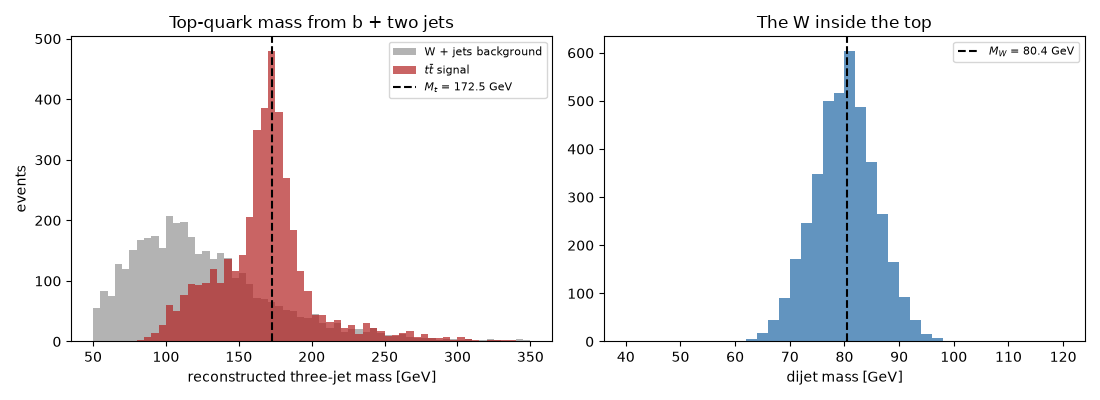
fraction within 20 GeV of M_t: signal 0.60, background 0.13
Check#
The b + two-jet mass reconstructs M_t, with the W inside it, and stands well above the W + jets background.
Total running time of the script: (0 minutes 0.355 seconds)