
Note
Go to the end to download the full example code.
Pauli’s neutrino: the missing energy in beta decay#
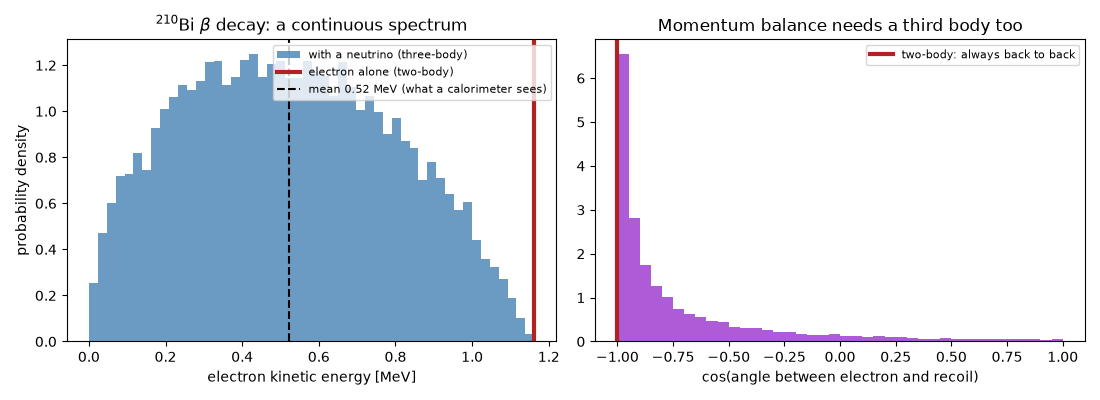
By 1930 beta decay looked like it broke energy conservation. If a nucleus emits only an electron, \(A\to B + e^-\), two-body kinematics gives the electron a single, fixed energy, essentially the whole \(Q\)-value. Instead, electrons come out with every energy from zero up to \(Q\). Ellis and Wooster (1927) caught the decays of radium E (210Bi, \(Q=1.16\) MeV) in a calorimeter and found the heat per decay matched the spectrum’s mean, about a third of \(Q\), not its endpoint. The rest of the energy was not being deposited at all.
Pauli’s “desperate remedy” (1930) was a third, neutral, nearly massless
particle carrying off the difference. This example generates three-body
decays \(A\to B+e^-+\bar\nu\) from pure phase space, built from two
chained two_body_decay() calls, and
checks with invariant_mass() that
energy and momentum balance only once the invisible particle is counted.
import matplotlib.pyplot as plt
import numpy as np

from physicskit.particle.decays import two_body_decay, two_body_decay_momentum
from physicskit.particle.kinematics import boost_generic, invariant_mass

U = 931.494  # MeV
m_e = 0.511
m_B = 209.9829 * U - 84 * m_e  # Po-210 nucleus
Q = 1.162
M_A = m_B + m_e + Q  # Bi-210 nucleus, fixed by the Q-value
If only the electron were emitted#
two-body hypothesis: every electron has T = 1.1620 MeV (Q = 1.162 MeV)
Three-body phase space with a neutrino#
Pick the invariant mass \(m_{e\nu}\) of the electron-neutrino pair, accept it with the phase-space weight \(p^*_1 p^*_2\), decay the nucleus to \(B + (e\nu)\), then decay the pair isotropically in its own rest frame and boost back. Pure phase space ignores the nuclear Coulomb field and radium E’s unusual (forbidden) spectrum shape, so its mean electron energy is higher than the measured 0.34 MeV. The point stands: the electron gets a variable share, and the neutrino takes the rest. (Residuals of order 1e-6 MeV are floating-point rounding on nuclear masses near 2e5 MeV.)
rng = np.random.default_rng(1930)


def iso(rng):
    return rng.uniform(-1, 1), rng.uniform(0, 2 * np.pi)


w_max = two_body_decay_momentum(M_A, m_B, m_e) * two_body_decay_momentum(m_e + Q, m_e, 0.0)
events = []
while len(events) < 20000:
    m12 = rng.uniform(m_e, m_e + Q)
    w = two_body_decay_momentum(M_A, m_B, m12) * two_body_decay_momentum(m12, m_e, 0.0)
    if rng.uniform(0, w_max) > w:
        continue
    p_B, p_pair = two_body_decay(M_A, m_B, m12, *iso(rng))
    p_e, p_nu = two_body_decay(m12, m_e, 0.0, *iso(rng))
    beta = p_pair.p_vec / p_pair.E
    events.append((p_B, boost_generic(p_e, beta), boost_generic(p_nu, beta)))

T_e = np.array([e.E - m_e for _, e, _ in events])
E_nu = np.array([nu.E for _, _, nu in events])
T_B = np.array([B.E - m_B for B, _, _ in events])
print(f"\nthree-body: electron T from {T_e.min():.3f} to {T_e.max():.3f} MeV, mean {T_e.mean():.3f} MeV")
print(f"energy per decay seen by a calorimeter (electron + recoil): {np.mean(T_e + T_B):.3f} MeV")
print(f"energy carried off by the neutrino, on average:             {E_nu.mean():.3f} MeV")
print(f"electron + recoil + neutrino, every event: {np.max(np.abs(T_e + T_B + E_nu - Q)):.1e} MeV from Q")
three-body: electron T from 0.001 to 1.157 MeV, mean 0.523 MeV
energy per decay seen by a calorimeter (electron + recoil): 0.523 MeV
energy carried off by the neutrino, on average:             0.639 MeV
electron + recoil + neutrino, every event: 6.7e-07 MeV from Q
The books balance only with the neutrino#
Without the neutrino the visible products don’t reconstruct the parent mass, and the electron and recoil nucleus aren’t back to back as a two-body decay requires.
B0, e0, nu0 = events[0]
print(f"\ninvariant mass of B + e      = M_A - {M_A - invariant_mass([B0, e0]):.4f} MeV")
print(f"invariant mass of B + e + nu = M_A - {M_A - invariant_mass([B0, e0, nu0]):.1e} MeV")
cos_eB = np.array([np.dot(e.p_vec, B.p_vec) / (e.p_mag * B.p_mag) for B, e, _ in events])

fig, (ax1, ax2) = plt.subplots(1, 2, figsize=(11, 4))
ax1.hist(T_e, bins=50, range=(0, Q), density=True, color="steelblue", alpha=0.8, label="with a neutrino (three-body)")
ax1.axvline(T_two, color="firebrick", lw=3, label="electron alone (two-body)")
ax1.axvline(T_e.mean(), color="k", ls="--", label=f"mean {T_e.mean():.2f} MeV (what a calorimeter sees)")
ax1.set_xlabel("electron kinetic energy [MeV]")
ax1.set_ylabel("probability density")
ax1.set_title(r"$^{210}$Bi $\beta$ decay: a continuous spectrum")
ax1.legend(fontsize=8)
ax2.hist(cos_eB, bins=40, range=(-1, 1), density=True, color="darkorchid", alpha=0.8)
ax2.axvline(-1, color="firebrick", lw=3, label="two-body: always back to back")
ax2.set_xlabel(r"cos(angle between electron and recoil)")
ax2.set_title("Momentum balance needs a third body too")
ax2.legend(fontsize=8)
fig.tight_layout()

plt.show()
invariant mass of B + e      = M_A - 0.7545 MeV
invariant mass of B + e + nu = M_A - 6.7e-07 MeV
Check#
A two-body decay would give every electron T ~ Q; with Pauli’s neutrino the spectrum is continuous, energy and momentum balance in every event, and on average the neutrino carries the missing energy.
Total running time of the script: (0 minutes 0.518 seconds)