Note
Go to the end to download the full example code.
Frame dragging and the ergosphere of a Kerr black hole#
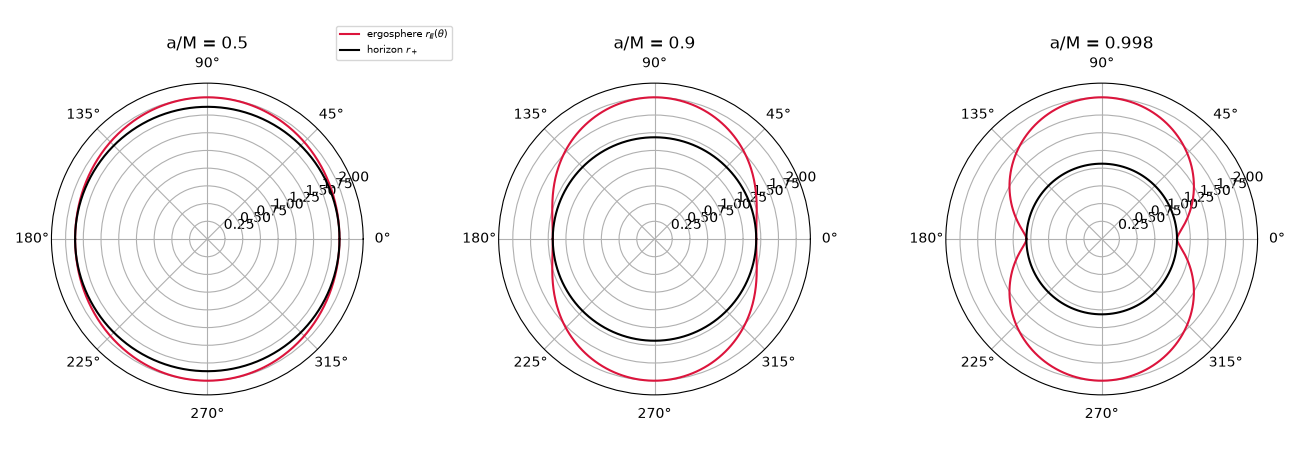
A rotating (Kerr) black hole of mass \(M\) and spin parameter \(a = J/M \in [0, M)\), found by Roy Kerr in 1963, drags spacetime itself around with it. Outside the horizon \(r_+ = M + \sqrt{M^2-a^2}\), in the ergosphere
this dragging is so severe that no observer can stay at fixed spatial coordinates – everyone is swept around in the direction of rotation, no matter how they fire their rockets. This example traces out the ergosphere and horizon as spin increases, the Lense-Thirring frame-dragging angular velocity of a zero-angular-momentum observer, and how the innermost stable circular orbit (ISCO) shrinks (prograde) or grows (retrograde) with spin. The ergosphere is also what makes the Penrose energy-extraction process possible – see The Penrose process: extracting a black hole’s rotational energy.
import matplotlib.pyplot as plt
import numpy as np

from physicskit.relativity.chapters.kerr import KerrBlackHole
The ergosphere and horizons, as spin increases#
The event horizon \(r_+ = M + \sqrt{M^2-a^2}\) shrinks as spin increases, while the ergosphere \(r_E(\theta)\) (widest at the equator, where \(r_E = 2M\), and touching the horizon at the poles) bulges out further beyond it – the region between the two curves is where no observer can remain at fixed \((r,\theta,\phi)\).
theta = np.linspace(0, np.pi, 200)
fig, axes = plt.subplots(1, 3, figsize=(13, 4.5), subplot_kw={"projection": "polar"})
for ax, a in zip(axes, [0.5, 0.9, 0.998]):
    bh = KerrBlackHole(M=1.0, a=a)
    r_ergo = bh.ergosphere_radius(theta)
    ax.plot(theta, r_ergo, color="crimson", label="ergosphere $r_E(\\theta)$")
    ax.plot(theta, np.full_like(theta, bh.outer_horizon_radius), color="black", label="horizon $r_+$")
    ax.plot(-theta, r_ergo, color="crimson")
    ax.plot(-theta, np.full_like(theta, bh.outer_horizon_radius), color="black")
    ax.set_title(f"a/M = {a}")
    ax.set_ylim(0, 2.2)
axes[0].legend(loc="upper right", fontsize=7, bbox_to_anchor=(1.3, 1.2))
plt.tight_layout()
Frame dragging: the ZAMO angular velocity rises sharply near the horizon#
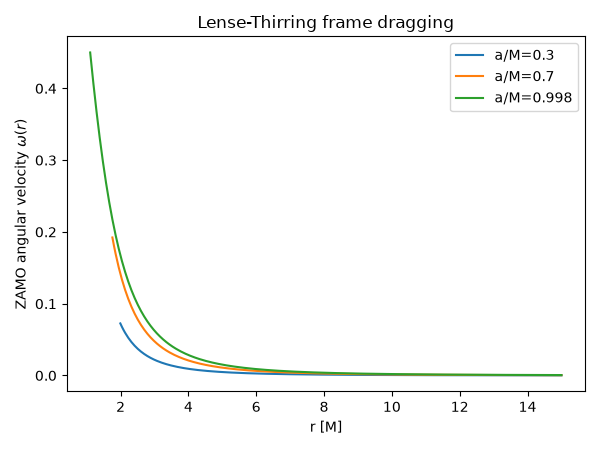
A zero-angular-momentum observer (ZAMO) – one who carries no orbital angular momentum of their own, yet is still swept around in \(\phi\) purely by the geometry – rotates at
which falls off as the classic Lense-Thirring rate \(2Ma/r^3\) at large \(r\), but rises sharply approaching the ergosphere.
fig, ax = plt.subplots(figsize=(6, 4.5))
r = np.linspace(1.01, 15.0, 300)
for a in [0.3, 0.7, 0.998]:
    bh = KerrBlackHole(M=1.0, a=a)
    r_valid = r[r > bh.outer_horizon_radius]
    omega = bh.frame_dragging_angular_velocity(r_valid)
    ax.plot(r_valid, omega, label=f"a/M={a}")
ax.set_xlabel("r [M]")
ax.set_ylabel(r"ZAMO angular velocity $\omega(r)$")
ax.set_title("Lense-Thirring frame dragging")
ax.legend()
plt.tight_layout()
ISCO shrinks (prograde) or grows (retrograde) with spin#
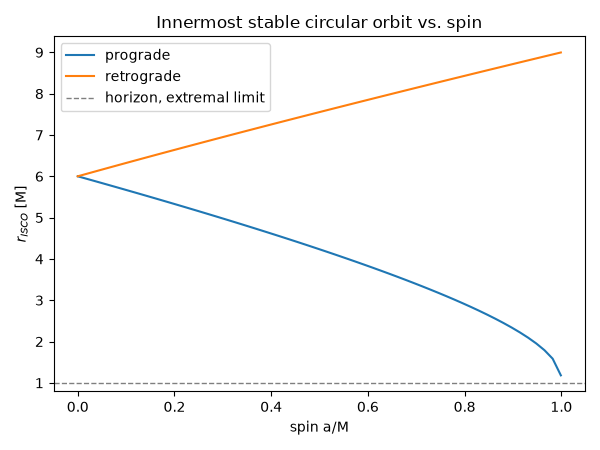
The Bardeen-Press-Teukolsky (1972) innermost stable circular orbit radius,
with \(Z_1 = 1+(1-a_*^2)^{1/3}[(1+a_*)^{1/3}+(1-a_*)^{1/3}]\), \(Z_2=\sqrt{3a_*^2+Z_1^2}\), and \(a_*=a/M\), uses the \(-\) sign for a prograde (co-rotating) orbit and \(+\) for retrograde: prograde ISCOs shrink toward the horizon as spin increases, while retrograde ISCOs grow toward \(9M\).
a_values = np.linspace(0.0, 0.999, 60)
isco_pro = [KerrBlackHole(M=1.0, a=a).isco_radius(prograde=True) for a in a_values]
isco_retro = [KerrBlackHole(M=1.0, a=a).isco_radius(prograde=False) for a in a_values]

fig, ax = plt.subplots(figsize=(6, 4.5))
ax.plot(a_values, isco_pro, label="prograde")
ax.plot(a_values, isco_retro, label="retrograde")
ax.axhline(1.0, color="k", linestyle="--", linewidth=1, alpha=0.5, label="horizon, extremal limit")
ax.set_xlabel("spin a/M")
ax.set_ylabel("$r_{ISCO}$ [M]")
ax.set_title("Innermost stable circular orbit vs. spin")
ax.legend()
plt.tight_layout()
plt.show()
Check#
def isco_bpt(a, prograde=True):
    # Bardeen, Press and Teukolsky (1972), M = 1.
    z1 = 1 + (1 - a**2) ** (1 / 3) * ((1 + a) ** (1 / 3) + (1 - a) ** (1 / 3))
    z2 = np.sqrt(3 * a**2 + z1**2)
    return 3 + z2 - np.sqrt((3 - z1) * (3 + z1 + 2 * z2)) * (1 if prograde else -1)


# r_E(theta) = M + sqrt(M^2 - a^2 cos^2 theta) touches the horizon at the
# poles and reaches 2M at the equator; the ISCO follows Bardeen-Press-Teukolsky
# (6M at a = 0, toward M prograde and 9M retrograde as a -> M).
for a in (0.5, 0.9, 0.998):
    bh = KerrBlackHole(M=1.0, a=a)
    np.testing.assert_allclose(bh.ergosphere_radius(theta), 1 + np.sqrt(1 - a**2 * np.cos(theta) ** 2), atol=1e-12)
    assert abs(bh.outer_horizon_radius - (1 + np.sqrt(1 - a**2))) < 1e-12
np.testing.assert_allclose(isco_pro, [isco_bpt(a) for a in a_values], rtol=1e-6)
np.testing.assert_allclose(isco_retro, [isco_bpt(a, prograde=False) for a in a_values], rtol=1e-6)
assert abs(isco_pro[0] - 6) < 1e-9 and isco_retro[-1] > 8.9
Total running time of the script: (0 minutes 0.186 seconds)