
Note
Go to the end to download the full example code.
The Penrose process: extracting a black hole’s rotational energy#
Roger Penrose realized in 1969 that the ergosphere of a rotating (Kerr)
black hole – see Frame dragging and the ergosphere of a Kerr black hole – is not just a
region where no observer can sit still, but a genuine energy resource.
Inside it, the t-Killing vector associated with time-translation
symmetry becomes spacelike, so a particle there can have negative energy
as measured by an observer at infinity. If a particle entering the
ergosphere splits in two, with one negative-energy fragment falling into
the horizon, energy conservation forces the escaping fragment to carry
away more energy than the original particle had – extracting
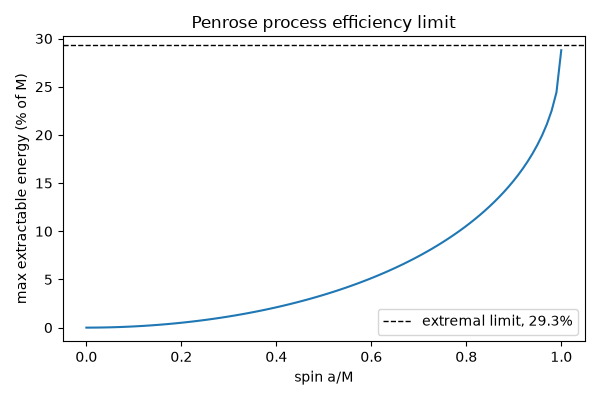
rotational energy from the black hole itself. The process is capped by
Hawking’s area theorem: the hole’s irreducible mass can never decrease,
limiting the maximum extractable fraction to
which rises from 0 at \(a=0\) to \(1 - 1/\sqrt{2} \approx 29.3\%\) for a maximally (extremal) spinning hole.
import matplotlib.pyplot as plt
import numpy as np

from physicskit.relativity.chapters.kerr import KerrBlackHole
Maximum extractable energy fraction vs. spin#
a_values = np.linspace(0.0, 0.9999, 100)
efficiency = [KerrBlackHole(M=1.0, a=a).max_penrose_efficiency() for a in a_values]

plt.figure(figsize=(6, 4))
plt.plot(a_values, np.array(efficiency) * 100.0)
plt.axhline(
    (1.0 - 1.0 / np.sqrt(2.0)) * 100.0,
    color="k",
    linestyle="--",
    linewidth=1,
    label="extremal limit, 29.3%",
)
plt.xlabel("spin a/M")
plt.ylabel("max extractable energy (% of M)")
plt.title("Penrose process efficiency limit")
plt.legend()
plt.tight_layout()
plt.show()
A single split: the escaping fragment gains energy#
bh = KerrBlackHole(M=1.0, a=0.9)
e_out = bh.penrose_energy_gain(initial_energy=1.0, fragment_energy_infalling=-0.1)
print("Particle falls in with E=1.0, splits inside the ergosphere;")
print("one fragment falls in with E=-0.1 (negative energy, only possible there);")
print(f"the escaping fragment carries away E={e_out:.3f} -- more than it started with.")
Particle falls in with E=1.0, splits inside the ergosphere;
one fragment falls in with E=-0.1 (negative energy, only possible there);
the escaping fragment carries away E=1.100 -- more than it started with.
Check#
Maximum efficiency 1 - M_irr / M = 1 - sqrt((1 + sqrt(1 - a^2)) / 2), 29.3% at a = M; a negative-energy fragment lets the escaping one leave with E > E_in.
expected = 1 - np.sqrt((1 + np.sqrt(1 - a_values**2)) / 2)
np.testing.assert_allclose(efficiency, expected, atol=1e-12)
assert abs(e_out - 1.1) < 1e-12
Total running time of the script: (0 minutes 0.032 seconds)