
Note
Go to the end to download the full example code.
The black hole shadow: from the photon sphere to the Event Horizon Telescope#
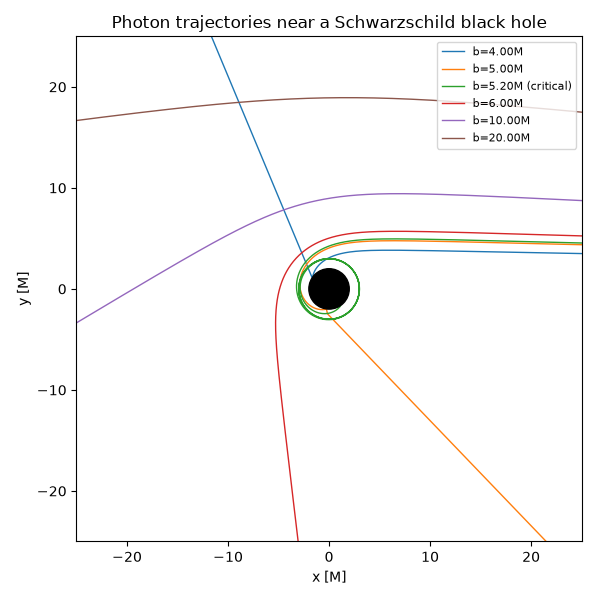
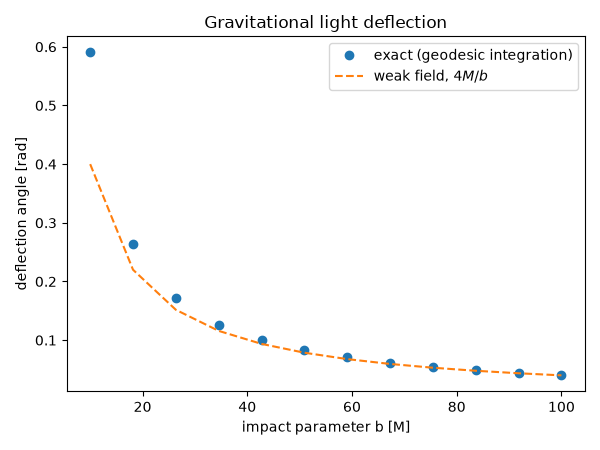
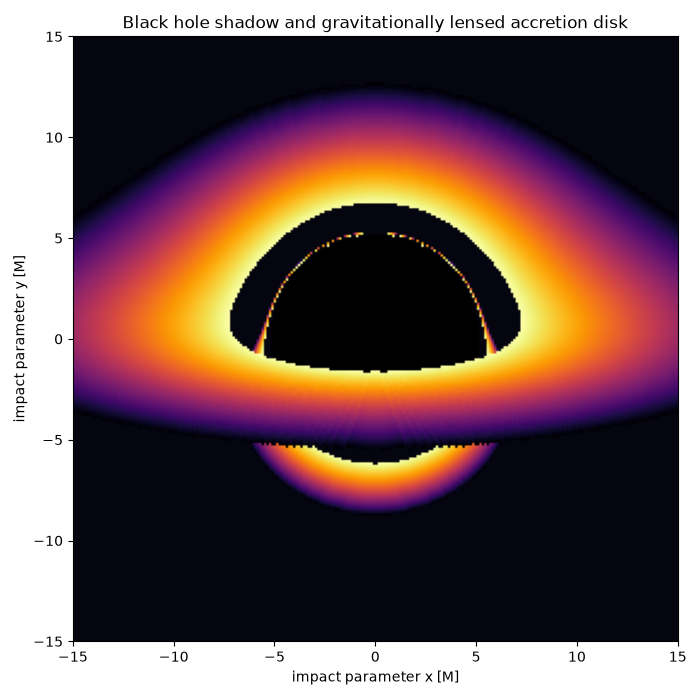
Light passing a black hole at impact parameter \(b\) is bent by \(\delta\phi \approx 4M/b\) far away, but the bending grows without bound as \(b\) falls toward the critical value \(b_c = 3\sqrt{3}M\): photons there circle (unstably) on the photon sphere \(r=3M\), and any ray with \(b < b_c\) is captured. Seen from far away the black hole therefore casts a dark shadow of radius \(b_c\), rimmed by a bright ring of nearly trapped light – what the Event Horizon Telescope imaged around M87* in 2019. This example traces individual light rays at a range of impact parameters, then renders the full shadow silhouette by ray-tracing an entire camera image.
import matplotlib.pyplot as plt
import numpy as np

from physicskit.relativity.chapters.lensing import exact_deflection_angle
from physicskit.relativity.chapters.schwarzschild import SchwarzschildBlackHole
from physicskit.relativity.visualizers.shadow_render import plot_black_hole_shadow, render_black_hole_image
Individual light rays at a range of impact parameters#
bh = SchwarzschildBlackHole(M=1.0)
fig, ax = plt.subplots(figsize=(6, 6))
for b in [4.0, 5.0, bh.critical_impact_parameter, 6.0, 10.0, 20.0]:
    y0 = bh.null_geodesic_initial_state(r0=200.0, impact_parameter=b, ingoing=True)
    traj = bh.integrate_geodesic(y0, dtau=0.05, n_steps=20000)
    x = traj["r"] * np.cos(traj["phi"])
    y = traj["r"] * np.sin(traj["phi"])
    label = f"b={b:.2f}M" + (" (critical)" if np.isclose(b, bh.critical_impact_parameter) else "")
    ax.plot(x, y, linewidth=1, label=label)
circle = plt.Circle((0, 0), bh.horizon_radius, color="black", zorder=5)
ax.add_patch(circle)
ax.set_xlim(-25, 25)
ax.set_ylim(-25, 25)
ax.set_aspect("equal")
ax.set_xlabel("x [M]")
ax.set_ylabel("y [M]")
ax.set_title("Photon trajectories near a Schwarzschild black hole")
ax.legend(fontsize=8, loc="upper right")
plt.tight_layout()
Light deflection versus the weak-field 4M/b formula#
impact_params = np.linspace(10.0, 100.0, 12)
measured = np.array([exact_deflection_angle(bh, b) for b in impact_params])

fig, ax = plt.subplots(figsize=(6, 4.5))
ax.plot(impact_params, measured, "o", label="exact (geodesic integration)")
ax.plot(impact_params, bh.light_deflection_angle(impact_params), "--", label="weak field, $4M/b$")
ax.set_xlabel("impact parameter b [M]")
ax.set_ylabel("deflection angle [rad]")
ax.set_title("Gravitational light deflection")
ax.legend()
plt.tight_layout()
The black hole shadow: ray-tracing a full camera image#
Check#
Far out the exact deflection follows 4M/b + 15 pi M^2 / 4b^2 + …, above the weak-field value everywhere; rays with b < 3 sqrt(3) M are captured, so every captured pixel lies inside that radius and every pixel well inside it is dark (captured, or the disk in front of the hole).
far_b = impact_params >= 40
series = 4 / impact_params + 15 * np.pi / (4 * impact_params**2) + 128 / (3 * impact_params**3) + 3465 * np.pi / (64 * impact_params**4)
assert np.all(np.abs(measured[far_b] / series[far_b] - 1) < 2e-4)
assert np.all(measured > bh.light_deflection_angle(impact_params))
b_c = bh.critical_impact_parameter
assert abs(b_c - 3 * np.sqrt(3)) < 1e-12
half_width, n_pix = 15.0, 250
centres = -half_width + (np.arange(n_pix) + 0.5) * 2 * half_width / n_pix
radius = np.hypot(*np.meshgrid(centres, centres))
pixel = 2 * half_width / n_pix
assert not np.any(np.isin(result["outcomes"], (1, 2)) & (radius > b_c + 2 * pixel))
assert not np.any((result["outcomes"] == 0) & (radius < b_c - 2 * pixel))
Total running time of the script: (0 minutes 1.560 seconds)