
Note
Go to the end to download the full example code.
The Langevin equation: friction and noise must balance#
Langevin’s 1908 equation for a Brownian particle,
contains a drag and a random kick with the same \(\gamma\) in both. This is not a modeling convenience. It is the fluctuation-dissipation balance: the drag drains energy at a rate proportional to \(\gamma\), the noise pumps it in at a rate proportional to its variance, and they cancel only at \(\langle v^2\rangle = k_BT/m\).
This example integrates the equation for particles in a harmonic trap
with LangevinDynamics, which uses the BAOAB
splitting (baoab_integrate()) so that even
weak friction does not let the time step heat the particles. The same temperature
comes out for frictions spanning two decades, and every quadratic degree
of freedom carries \(k_BT/2\) (equipartition). It then breaks the
balance by integrating the equation with noise that is too weak, using the
shared euler_maruyama_integrate() directly,
and the particles settle at the wrong temperature.
One temperature, any friction#
Particles start at rest at the trap’s edge. Light friction lets them ring for many periods and heavy friction makes them creep, yet all settle at \(m\langle v^2\rangle = k\langle x^2\rangle = k_BT\). We average over \(t > 60\), many relaxation times \(m/\gamma\) even for the lightest friction.
results = {}
equipartition = {}
for gamma in (0.1, 1.0, 10.0):
    ld = LangevinDynamics(n_particles=4000, mass=m, gamma=gamma, kT=kT, stiffness=k, seed=int(10 * gamma))
    t, x, v = ld.run(t_max=80.0, dt=0.002, n_frames=400, x0=np.full(4000, 1.0))
    results[gamma] = (t, x[:, :, 0], v[:, :, 0])
    late = t > 60
    equipartition[gamma] = (m * np.mean(v[late] ** 2), k * np.mean(x[late] ** 2))
    print(f"gamma = {gamma:5.1f}: m<v^2> = {m * np.mean(v[late] ** 2):.3f}, k<x^2> = {k * np.mean(x[late] ** 2):.3f}   (kT = {kT})")
gamma =   0.1: m<v^2> = 0.499, k<x^2> = 0.500   (kT = 0.5)
gamma =   1.0: m<v^2> = 0.498, k<x^2> = 0.496   (kT = 0.5)
gamma =  10.0: m<v^2> = 0.500, k<x^2> = 0.497   (kT = 0.5)
Breaking the balance#
Keep the friction at \(\gamma = 1\) but give the kicks only half the fluctuation-dissipation variance, \(\gamma k_BT\) instead of \(2\gamma k_BT\). The particles cool to half the bath temperature.
@njit
def trap_drift(s, t, p):
    n = s.shape[0] // 2
    out = np.empty_like(s)
    out[:n] = s[n:]
    out[n:] = (-p[0] * s[:n] - p[1] * s[n:]) / p[2]
    return out


@njit
def weak_noise(s, t, p):
    n = s.shape[0] // 2
    out = np.zeros_like(s)
    out[n:] = np.sqrt(p[3]) / p[2]
    return out


n, dt, chunk = 4000, 0.002, 100
gamma = 1.0
weak_params = np.array([k, gamma, m, gamma * kT])
rng = np.random.default_rng(1908)
state = np.concatenate([np.full(n, 1.0), np.zeros(n)])
t_w, s_w = [0.0], [state]
for i in range(400):  # 400 chunks of 100 steps: t = 0 .. 80
    dW = wiener_increments(chunk, 2 * n, dt, rng=rng)
    _, traj = euler_maruyama_integrate(trap_drift, weak_noise, state, i * chunk * dt, dt, dW, weak_params, chunk)
    state = traj[-1]
    t_w.append((i + 1) * chunk * dt)
    s_w.append(state)
t_w, s_w = np.array(t_w), np.array(s_w)
T_weak = m * np.mean(s_w[t_w > 60, n:] ** 2)
print(f"half-strength noise: m<v^2> = {T_weak:.3f}, not kT = {kT}")

fig, axes = plt.subplots(1, 3, figsize=(15, 4.3))
colors = {0.1: "tab:blue", 1.0: "tab:orange", 10.0: "tab:green"}
for gamma, (t, x, v) in results.items():
    axes[0].plot(t, x[:, 0], lw=0.7, color=colors[gamma], label=rf"$\gamma = {gamma}$")
    axes[1].plot(t, m * np.mean(v**2, axis=1), color=colors[gamma], label=rf"$\gamma = {gamma}$")
axes[1].plot(t_w, m * np.mean(s_w[:, n:] ** 2, axis=1), color="gray", label="half-strength noise")
axes[1].axhline(kT, color="k", ls="--", lw=1)
axes[1].axhline(kT / 2, color="gray", ls=":", lw=1)
axes[0].set_xlabel("t")
axes[0].set_ylabel("x")
axes[0].set_title("one particle per friction")
axes[0].legend(fontsize=8)
axes[1].set_xlabel("t")
axes[1].set_ylabel(r"$m\langle v^2\rangle$")
axes[1].set_title("kinetic temperature")
axes[1].legend(fontsize=8)

t, x, v = results[1.0]
late = t > 60
xs = np.linspace(-1.5, 1.5, 200)
axes[2].hist(x[late].ravel(), bins=80, density=True, alpha=0.6, label="positions, t > 60")
axes[2].plot(xs, np.sqrt(k / (2 * np.pi * kT)) * np.exp(-k * xs**2 / (2 * kT)), "k--", label=r"Boltzmann $e^{-kx^2/2k_BT}$")
axes[2].set_xlabel("x")
axes[2].set_title(r"equilibrium in the trap ($\gamma = 1$)")
axes[2].legend(fontsize=8)
fig.tight_layout()
plt.show()
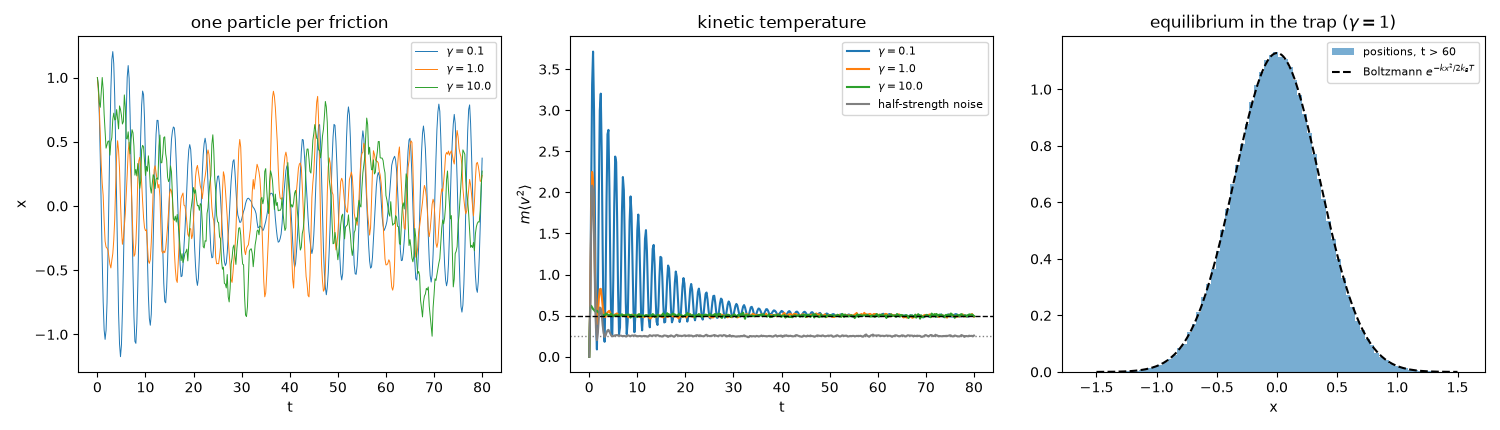
half-strength noise: m<v^2> = 0.253, not kT = 0.5
Check#
With noise strength 2 gamma kT every friction thermalizes to equipartition, m<v^2> = k<x^2> = kT; halving the noise halves the temperature.
Total running time of the script: (0 minutes 6.262 seconds)