
Note
Go to the end to download the full example code or to run this example in your browser via JupyterLite.
Hamming’s single-error-correcting code#
Frustrated by weekend computer runs aborted by a single bad relay, Richard
Hamming (1950) designed codes that correct errors rather than merely
detect them. In the (7,4) code three parity bits sit at positions 1, 2 and 4.
When one bit flips, the failing parity checks, read as a binary number, give
its position (hamming74_encode(),
hamming74_decode()). Any two codewords
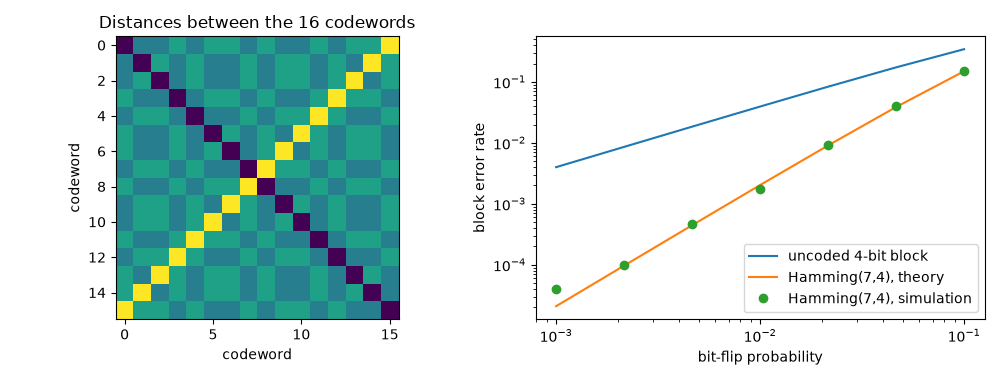
differ in at least three places (hamming_distance()),
which is what makes single-error correction possible.
import matplotlib.pyplot as plt
import numpy as np

from engineeringkit.communications import hamming74_decode, hamming74_encode, hamming_distance
The syndrome points at the error#
word = hamming74_encode([1, 0, 1, 1])
print("codeword:", word.tolist())
for position in range(7):
    corrupted = word.copy()
    corrupted[position] ^= 1
    result = hamming74_decode(corrupted)
    print(f"flip bit {position + 1}: syndrome {result.syndromes[0]} -> data {result.data.tolist()}")
    assert result.syndromes[0] == position + 1 and result.data.tolist() == [1, 0, 1, 1]

codebook = [hamming74_encode([(k >> i) & 1 for i in range(4)]) for k in range(16)]
distances = np.array([[hamming_distance(a, b) for b in codebook] for a in codebook])
print("minimum distance:", distances[~np.eye(16, dtype=bool)].min())
codeword: [0, 1, 1, 0, 0, 1, 1]
flip bit 1: syndrome 1 -> data [1, 0, 1, 1]
flip bit 2: syndrome 2 -> data [1, 0, 1, 1]
flip bit 3: syndrome 3 -> data [1, 0, 1, 1]
flip bit 4: syndrome 4 -> data [1, 0, 1, 1]
flip bit 5: syndrome 5 -> data [1, 0, 1, 1]
flip bit 6: syndrome 6 -> data [1, 0, 1, 1]
flip bit 7: syndrome 7 -> data [1, 0, 1, 1]
minimum distance: 3
Coded versus uncoded error rate on a bit-flipping channel#
A block fails only if two or more of its seven bits flip: \(1 - (1-p)^7 - 7p(1-p)^6\), compared with \(1-(1-p)^4\) uncoded.
rng = np.random.default_rng(1950)
p = np.logspace(-3, -1, 7)
simulated = []
for flip in p:
    data = rng.integers(0, 2, 4 * 50_000)
    received = hamming74_encode(data) ^ (rng.random(7 * 50_000) < flip)
    blocks_wrong = np.any((hamming74_decode(received).data != data).reshape(-1, 4), axis=1)
    simulated.append(blocks_wrong.mean())
coded = 1 - (1 - p) ** 7 - 7 * p * (1 - p) ** 6
assert np.allclose(simulated[3:], coded[3:], rtol=0.15)
fig, axes = plt.subplots(1, 2, figsize=(10, 3.8))
axes[0].imshow(distances, cmap="viridis")
axes[0].set(title="Distances between the 16 codewords", xlabel="codeword", ylabel="codeword")
axes[1].loglog(p, 1 - (1 - p) ** 4, label="uncoded 4-bit block")
axes[1].loglog(p, coded, label="Hamming(7,4), theory")
axes[1].loglog(p, np.maximum(simulated, 1e-6), "o", label="Hamming(7,4), simulation")
axes[1].set(xlabel="bit-flip probability", ylabel="block error rate")
axes[1].legend()
fig.tight_layout()

plt.show()
Total running time of the script: (0 minutes 0.362 seconds)
