
Note
Go to the end to download the full example code or to run this example in your browser via JupyterLite.
Viterbi’s decoding algorithm (1967)#
Decoding a convolutional code by brute force means comparing the received
sequence with all \(2^L\) possible codewords. Andrew Viterbi saw that
two paths entering the same encoder state at the same time have the same
future, so only the better of them, the survivor, need be kept. The work
then grows linearly with \(L\)
(viterbi_decode(), returning a
ViterbiDecodeResult). Viterbi
introduced the algorithm as a device for proving error bounds. Jim Omura
and David Forney showed in the early 1970s that it is maximum-likelihood
decoding, and it became the decoder of deep-space links, GSM telephones and
dial-up modems. Soft decisions, the received values before slicing, gain
about 2 dB over hard bits.
import matplotlib.pyplot as plt
import numpy as np

from engineeringkit.communications import ber_bpsk_awgn, bpsk, convolutional_encode, from_db, viterbi_decode
Viterbi equals brute-force maximum likelihood#
rng = np.random.default_rng(1967)
codebook = np.array([convolutional_encode([(k >> i) & 1 for i in range(10)]) for k in range(1024)])
for _ in range(20):
    received = rng.integers(0, 2, codebook.shape[1])
    best = np.min(np.count_nonzero(codebook != received, axis=1))
    assert viterbi_decode(received).path_metric == best
print("20 random words: the survivor metric always equals the exhaustive minimum over 1024 codewords")
20 random words: the survivor metric always equals the exhaustive minimum over 1024 codewords
Coding gain of the K = 7 code in white Gaussian noise#
generators = (0o171, 0o133)
ebn0_db = np.arange(0, 7.5, 1.0)
hard, soft = [], []
data = rng.integers(0, 2, 20_000)
code = convolutional_encode(data, generators)
for g in from_db(ebn0_db):
    sigma = np.sqrt(1 / (2 * 0.5 * g))  # unit symbol energy, rate 1/2
    y = bpsk(code) + sigma * rng.standard_normal(code.size)
    hard.append(np.mean(viterbi_decode((y > 0).astype(int), generators).data != data))
    soft.append(np.mean(viterbi_decode(y, generators, soft=True).data != data))
hard, soft = np.array(hard), np.array(soft)
for e, h, s in zip(ebn0_db, hard, soft):
    print(f"Eb/N0 {e:.0f} dB: uncoded {ber_bpsk_awgn(from_db(e)):.1e}, hard {h:.1e}, soft {s:.1e}")
at4 = list(ebn0_db).index(4.0)
assert soft[at4] < hard[at4] < ber_bpsk_awgn(from_db(4.0))

fig, ax = plt.subplots(figsize=(6.5, 4))
fine = np.linspace(0, 10, 101)
ax.semilogy(fine, ber_bpsk_awgn(from_db(fine)), label="uncoded BPSK")
ax.semilogy(ebn0_db[hard > 0], hard[hard > 0], "o-", label="K = 7, hard decisions")
ax.semilogy(ebn0_db[soft > 0], soft[soft > 0], "s-", label="K = 7, soft decisions")
ax.set(xlabel="$E_b/N_0$ [dB]", ylabel="bit-error rate", ylim=(1e-5, 0.5))
ax.grid(True, which="both", alpha=0.3)
ax.legend()
fig.tight_layout()

plt.show()
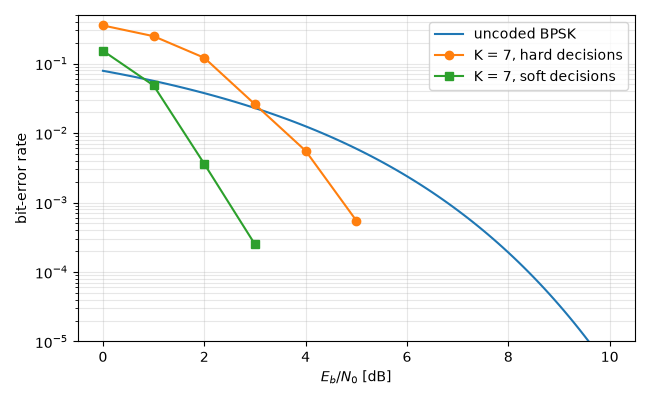
Eb/N0 0 dB: uncoded 7.9e-02, hard 3.5e-01, soft 1.5e-01
Eb/N0 1 dB: uncoded 5.6e-02, hard 2.5e-01, soft 4.8e-02
Eb/N0 2 dB: uncoded 3.8e-02, hard 1.2e-01, soft 3.6e-03
Eb/N0 3 dB: uncoded 2.3e-02, hard 2.6e-02, soft 2.5e-04
Eb/N0 4 dB: uncoded 1.3e-02, hard 5.6e-03, soft 0.0e+00
Eb/N0 5 dB: uncoded 6.0e-03, hard 5.5e-04, soft 0.0e+00
Eb/N0 6 dB: uncoded 2.4e-03, hard 0.0e+00, soft 0.0e+00
Eb/N0 7 dB: uncoded 7.7e-04, hard 0.0e+00, soft 0.0e+00
Total running time of the script: (0 minutes 3.742 seconds)
