
Note
Go to the end to download the full example code or to run this example in your browser via JupyterLite.
Carnot’s Réflexions: no engine beats the reversible one (1824)#
Sadi Carnot (1824) argued that a heat engine’s work comes from heat falling
from a hot body to a cold one, as a water wheel’s comes from falling water,
and that a reversible engine between two temperatures is the best possible.
If some engine did better, it could drive the reversible engine backwards
as a heat pump and, with no work left over, move heat from cold to hot. In
modern form the bound is \(\eta_C = 1 - T_c/T_h\)
(carnot_efficiency()), with absolute
temperatures. The example runs Carnot’s argument with numbers and shows how
the bound rises with the boiler temperature.
import matplotlib.pyplot as plt
import numpy as np

from engineeringkit.thermodynamics import carnot_efficiency, heat_engine_work
Carnot’s argument with numbers#
A claimed “super engine” between 600 K and 300 K takes 1000 J and delivers 600 J of work, more than the reversible 500 J. Use all of that work to run a reversible engine backwards: as a heat pump it delivers \(W/\eta_C\) to the hot reservoir.
T_hot, T_cold = 600.0, 300.0
eta_C = carnot_efficiency(T_hot, T_cold)
Q_in, W_super = 1000.0, 600.0
Q_out_super = Q_in - W_super
assert np.isclose(heat_engine_work(Q_in, Q_out_super), W_super)

Q_hot_pumped = W_super / eta_C
Q_cold_pumped = Q_hot_pumped - W_super
net_to_hot = Q_hot_pumped - Q_in
net_from_cold = Q_cold_pumped - Q_out_super
print(f"Carnot efficiency {eta_C:.2f}; super engine {W_super / Q_in:.2f}")
print(f"net heat into the hot reservoir {net_to_hot:.0f} J, taken from the cold one {net_from_cold:.0f} J, net work 0 J")
assert np.isclose(net_to_hot, net_from_cold) and net_to_hot > 0
Carnot efficiency 0.50; super engine 0.60
net heat into the hot reservoir 200 J, taken from the cold one 200 J, net work 0 J
The combined machine moves 200 J from cold to hot with no outside work, which never happens. So no engine beats \(\eta_C\), and all reversible engines between the same temperatures have the same efficiency, whatever the working fluid.
The bound against boiler temperature#
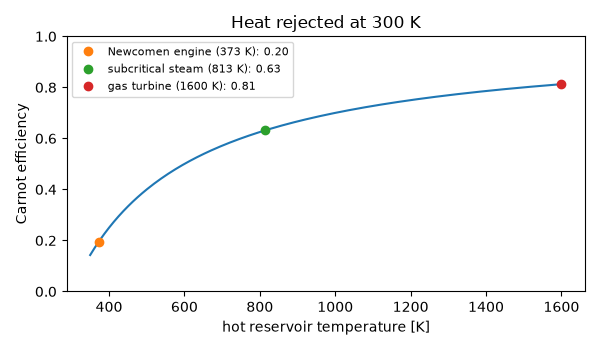
With heat rejected at 300 K, raising the source temperature helps less and less. Carnot’s own conclusion was that steam engines should work over the widest possible temperature range, which is why boiler temperatures and pressures have been rising ever since.
T_h = np.linspace(350, 1600, 200)
eta = np.array([carnot_efficiency(T, T_cold) for T in T_h])
plants = {"Newcomen engine (373 K)": 373.0, "subcritical steam (813 K)": 813.0, "gas turbine (1600 K)": 1600.0}
fig, ax = plt.subplots(figsize=(6, 3.5))
ax.plot(T_h, eta)
for name, T in plants.items():
    ax.plot(T, carnot_efficiency(T, T_cold), "o", label=f"{name}: {carnot_efficiency(T, T_cold):.2f}")
ax.set(xlabel="hot reservoir temperature [K]", ylabel="Carnot efficiency", title="Heat rejected at 300 K", ylim=(0, 1))
ax.legend(fontsize=8)
fig.tight_layout()
assert np.all(np.diff(eta) > 0) and np.all(np.diff(eta, 2) < 0)

plt.show()
Total running time of the script: (0 minutes 0.035 seconds)
