
Note
Go to the end to download the full example code or to run this example in your browser via JupyterLite.
Joule and the first law (1843-1850)#
James Prescott Joule spent the 1840s showing that a given amount of work,
however it is done, always produces the same amount of heat. In his best
known experiment (published 1850) falling weights turned a paddle wheel in
an insulated can of water, and he measured the temperature rise to a
hundredth of a degree. His result, 772 foot-pounds per British thermal
unit, made heat and work two forms of one conserved quantity, energy:
\(Q = \Delta U + W\)
(first_law_heat()). The example redoes
the paddle-wheel balance, converts Joule’s number to SI, and checks the
ideal-gas energy functions.
import matplotlib.pyplot as plt
import numpy as np

from engineeringkit.thermodynamics import first_law_heat, specific_enthalpy_ideal_gas, specific_internal_energy_ideal_gas
The paddle wheel#
The can is insulated, so \(Q = 0\), and the weights do work on the water, \(W = -mgh\) per drop. The first law gives \(\Delta U = -W\), and with \(c = 4186\) J/(kg K) the rise in temperature. The weights and drop height here are illustrative.
g, c_water = 9.80665, 4186.0
m_weights, drop, n_drops, m_water = 2 * 13.0, 1.6, 20, 6.0
work_on_water = m_weights * g * drop * n_drops
delta_u = work_on_water
delta_T = delta_u / (m_water * c_water)
print(f"work on the water {work_on_water:.0f} J, temperature rise {delta_T:.3f} K")
assert first_law_heat(delta_u, -work_on_water) == 0

drops = np.arange(n_drops + 1)
fig, ax = plt.subplots(figsize=(6, 3.2))
ax.plot(drops, 15.0 + drops * m_weights * g * drop / (m_water * c_water), "o-")
ax.set(xlabel="number of drops", ylabel="water temperature [°C]", title="An adiabatic paddle wheel")
fig.tight_layout()
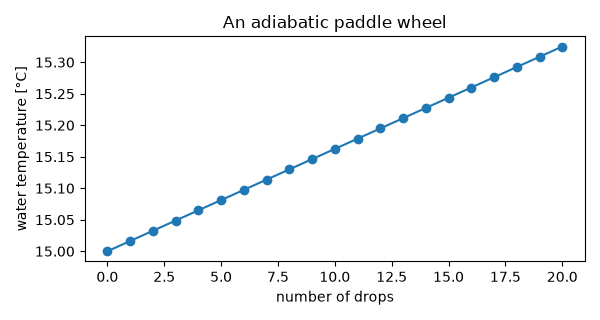
work on the water 8159 J, temperature rise 0.325 K
Joule’s mechanical equivalent of heat#
772.692 foot-pounds raised one pound of water by one degree Fahrenheit. In SI that is joules per calorie (one gram, one kelvin):
ft_lbf, lb, degF = 1.3558179483, 0.45359237, 5 / 9
J_per_cal = 772.692 * ft_lbf / (lb * 1e3 * degF)
print(f"Joule 1850: {J_per_cal:.3f} J/cal; the thermochemical calorie is defined as 4.184 J")
assert abs(J_per_cal - 4.184) / 4.184 < 0.01
Joule 1850: 4.157 J/cal; the thermochemical calorie is defined as 4.184 J
Energy functions of an ideal gas#
Joule’s free-expansion experiment (1845) found no temperature change when a gas expanded into a vacuum, so the internal energy of an ideal gas depends on temperature alone. Enthalpy \(h = u + pv = u + RT\) follows, and \(c_p - c_v = R\).
R, cv, cp, T = 287.0, 718.0, 1005.0, np.linspace(250, 1500, 6)
u = specific_internal_energy_ideal_gas(T, cv)
h = specific_enthalpy_ideal_gas(T, cp)
np.testing.assert_allclose(h - u, R * T)
print(f"h - u at 300 K: {specific_enthalpy_ideal_gas(300, cp) - specific_internal_energy_ideal_gas(300, cv):.0f} J/kg = R T")

plt.show()
h - u at 300 K: 86100 J/kg = R T
Total running time of the script: (0 minutes 0.047 seconds)
