
Note
Go to the end to download the full example code or to run this example in your browser via JupyterLite.
Clapeyron’s ideal gas law (1834)#
Boyle (1662) and Mariotte found that at fixed temperature a gas’s pressure
times its volume stays constant. Gay-Lussac (1802) found that at fixed
pressure every gas expands by the same fraction of its volume at 0 °C,
about 1/267 per degree. In his 1834 memoir on Carnot’s theory, Émile
Clapeyron combined the two as \(pv = R(267 + t)\). Regnault’s better
measurements moved the 267 to 273, and with absolute temperature and the
amount of gas the law reads \(pV = nRT\)
(ideal_gas_pressure(),
ideal_gas_temperature()). The example
rebuilds the absolute zero from a gas thermometer.
import matplotlib.pyplot as plt
import numpy as np

from engineeringkit.thermodynamics import R_UNIVERSAL, ideal_gas_pressure, ideal_gas_temperature
Boyle’s isotherms#
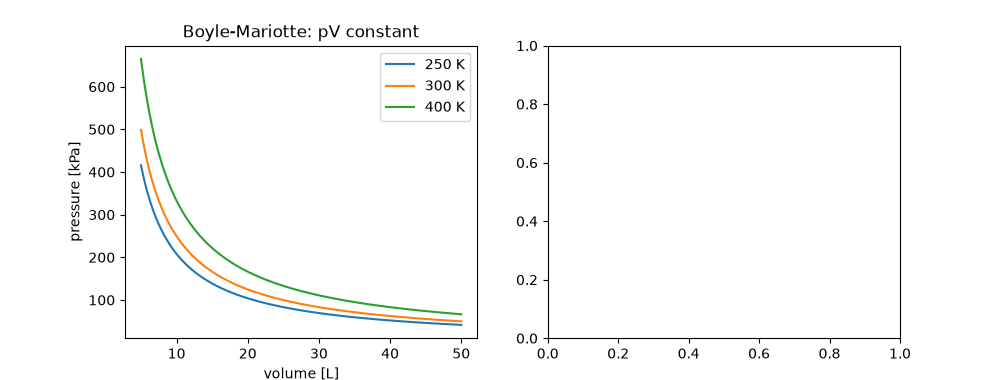
One mole in a cylinder: halving the volume doubles the pressure, and a hotter isotherm lies above a colder one.
n = 1.0
V = np.linspace(0.005, 0.05, 200)
fig, axes = plt.subplots(1, 2, figsize=(10, 3.8))
for T in (250.0, 300.0, 400.0):
    p = ideal_gas_pressure(n, T, V)
    np.testing.assert_allclose(p * V, n * R_UNIVERSAL * T)
    axes[0].plot(V * 1e3, p / 1e3, label=f"{T:.0f} K")
axes[0].set(xlabel="volume [L]", ylabel="pressure [kPa]", title="Boyle-Mariotte: pV constant")
axes[0].legend()
<matplotlib.legend.Legend object at 0x111108550>
A constant-volume gas thermometer#
A bulb is sealed at the ice point at 80 kPa and heated to the steam point. The pressure rises linearly with Celsius temperature. Extrapolating the line to zero pressure gives the temperature at which the gas would exert no pressure at all: the absolute zero.
V_bulb, p_ice = 1e-3, 80e3
n_bulb = p_ice * V_bulb / (R_UNIVERSAL * 273.15)
t_celsius = np.array([0.0, 25.0, 50.0, 75.0, 100.0])
p_read = ideal_gas_pressure(n_bulb, t_celsius + 273.15, V_bulb)
slope, intercept = np.polyfit(t_celsius, p_read, 1)
t_zero = -intercept / slope
print(f"expansion coefficient {slope / intercept:.6f} per °C = 1/{intercept / slope:.2f}")
print(f"extrapolated zero of pressure: {t_zero:.2f} °C (Gay-Lussac's 1/267 would give -267 °C)")
assert np.isclose(t_zero, -273.15)
assert np.isclose(ideal_gas_temperature(p_read[-1], V_bulb, n_bulb), 373.15)

t_line = np.linspace(-280, 110, 50)
axes[1].plot(t_line, (slope * t_line + intercept) / 1e3, "--", color="gray", label="extrapolation")
axes[1].plot(t_celsius, p_read / 1e3, "o", label="readings")
axes[1].axvline(-273.15, color="C3", lw=0.8)
axes[1].set(xlabel="temperature [°C]", ylabel="bulb pressure [kPa]", title="Absolute zero at -273.15 °C", ylim=(0, None))
axes[1].legend()
fig.tight_layout()
expansion coefficient 0.003661 per °C = 1/273.15
extrapolated zero of pressure: -273.15 °C (Gay-Lussac's 1/267 would give -267 °C)
The molar volume#
At 0 °C and one standard atmosphere one mole of any ideal gas fills 22.414 litres, Avogadro’s hypothesis in Clapeyron’s form.
V_molar = n * R_UNIVERSAL * 273.15 / 101325.0
print(f"molar volume at 0 °C and 1 atm: {V_molar * 1e3:.3f} L")
assert np.isclose(ideal_gas_pressure(1.0, 273.15, V_molar), 101325.0)
assert round(V_molar * 1e3, 3) == 22.414

plt.show()
molar volume at 0 °C and 1 atm: 22.414 L
Total running time of the script: (0 minutes 0.041 seconds)
