
Note
Go to the end to download the full example code or to run this example in your browser via JupyterLite.
The NACA four-digit airfoil family#
In NACA Report 460 (1933) Eastman Jacobs and colleagues tested 78 related
sections in the variable-density tunnel. Each is defined by a single
thickness polynomial wrapped around a two-parabola camber line, so four digits
specify the whole shape: 2412 has 2% camber at 40% chord and is 12% thick.
naca4_airfoil() builds the coordinates;
summary() recovers the digits from
the geometry.
import matplotlib.pyplot as plt

from engineeringkit.aerodynamics import naca4_airfoil
from engineeringkit.aerodynamics.visualizers import plot_airfoil
Four members of the family#
fig, axes = plt.subplots(4, 1, figsize=(7, 7.5), sharex=True)
for ax, designation in zip(axes, ["0012", "2412", "4412", "6409"], strict=True):
    foil = naca4_airfoil(designation, n=201)
    plot_airfoil(foil, ax=ax)
    s = foil.summary()
    print(
        f"{s['name']}: max thickness {s['max_thickness']:.3f} at x/c = {s['max_thickness_at']:.2f}, "
        f"max camber {s['max_camber']:.3f} at x/c = {s['max_camber_at']:.2f}"
    )
    assert abs(s["max_thickness"] - int(designation[2:]) / 100) < 1e-3
    ax.set_xlabel("")
axes[-1].set_xlabel("x / c")
fig.tight_layout()

plt.show()
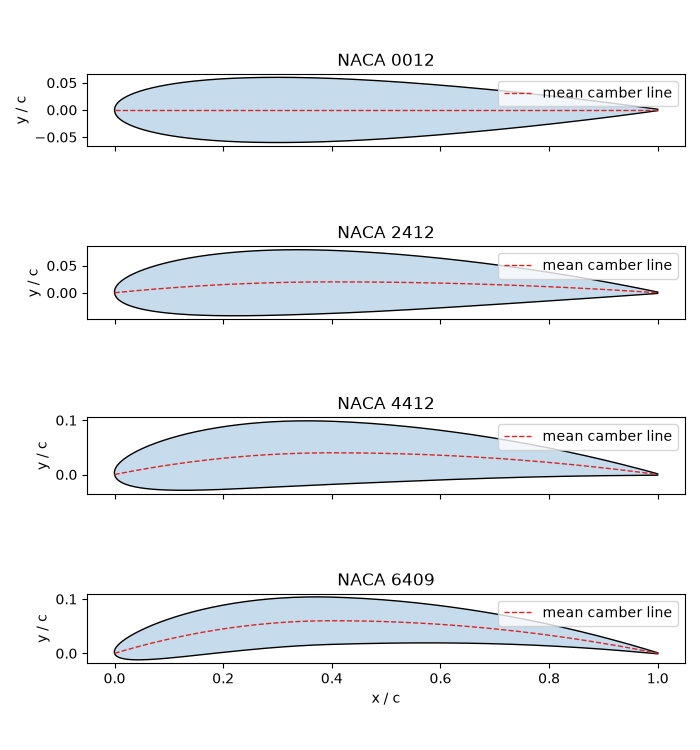
NACA 0012: max thickness 0.120 at x/c = 0.30, max camber 0.000 at x/c = 0.00
NACA 2412: max thickness 0.120 at x/c = 0.30, max camber 0.020 at x/c = 0.40
NACA 4412: max thickness 0.120 at x/c = 0.30, max camber 0.040 at x/c = 0.40
NACA 6409: max thickness 0.090 at x/c = 0.30, max camber 0.060 at x/c = 0.40
Total running time of the script: (0 minutes 0.303 seconds)
