
Note
Go to the end to download the full example code or to run this example in your browser via JupyterLite.
Glauert’s Fourier solution of the lifting line for any planform (1926)#
Prandtl’s lifting-line equation is an integro-differential equation for the
spanwise circulation. In The Elements of Aerofoil and Airscrew Theory
(1926) Hermann Glauert solved it for any planform. He wrote the circulation
as a Fourier sine series in \(\theta\), with
\(y = -\tfrac b2\cos\theta\), and enforced the equation at as many
stations as there are terms (lifting_line()).
The first coefficient fixes the lift and the others add induced drag, so the
span efficiency is \(e = 1/(1 + \delta)\) with
\(\delta = \sum_{n>1} nA_n^2/A_1^2\). This example recovers the elliptic
optimum exactly, then sweeps the taper ratio of straight wings to reproduce
Glauert’s induced-drag factor \(\delta\).
import matplotlib.pyplot as plt
import numpy as np

from engineeringkit.aerodynamics import finite_wing_cl, lifting_line

b, alpha = 10.0, np.radians(5.0)
The elliptic wing has uniform downwash and e = 1#
elliptic = lifting_line(b, lambda y: 1.2 * np.sqrt(1 - (2 * y / b) ** 2), alpha)
print(f"elliptic: AR = {elliptic.aspect_ratio:.2f}, CL = {elliptic.CL:.4f}, e = {elliptic.span_efficiency:.6f}")
assert np.isclose(elliptic.span_efficiency, 1.0)
assert np.isclose(elliptic.CL, finite_wing_cl(alpha, elliptic.aspect_ratio))
elliptic: AR = 10.61, CL = 0.4613, e = 1.000000
Taper ratio and Glauert’s delta#
For a fixed aspect ratio of 8, a straight tapered wing with tip-to-root chord ratio \(\lambda\) near 0.4 loads almost elliptically. A rectangular wing (\(\lambda = 1\)) wastes about 6% and a pointed one (\(\lambda = 0\)) far more.
AR = 8.0
taper = np.linspace(0.0, 1.0, 41)
delta = []
for lam in taper:
    root = 2 * b / (AR * (1 + lam))
    wing = lifting_line(b, lambda y, r=root, t=lam: r * (1 - (1 - t) * np.abs(2 * y / b)), alpha, n_terms=60)
    delta.append(1 / wing.span_efficiency - 1)
delta = np.array(delta)
best = taper[np.argmin(delta)]
print(f"AR = 8: delta = {delta[-1]:.4f} rectangular, minimum {delta.min():.4f} at taper ratio {best:.3f}")
assert 0.25 < best < 0.45 and delta.min() < 0.02

fig, axes = plt.subplots(1, 2, figsize=(10, 4))
axes[0].plot(taper, delta)
axes[0].set(xlabel=r"taper ratio $\lambda = c_t/c_r$", ylabel=r"induced-drag factor $\delta$", title="AR = 8 straight wings")
for lam in (1.0, 0.35, 0.0):
    root = 2 * b / (AR * (1 + lam))
    wing = lifting_line(b, lambda y, r=root, t=lam: r * (1 - (1 - t) * np.abs(2 * y / b)), alpha, n_terms=60)
    axes[1].plot(2 * wing.y / b, wing.cl / wing.CL, label=rf"$\lambda$ = {lam:g}")
axes[1].axhline(1, color="gray", ls="--", lw=0.8)
axes[1].set(xlabel="$2y/b$", ylabel="$c_l / C_L$", title="Section lift: where each wing stalls first")
axes[1].legend()
fig.tight_layout()

plt.show()
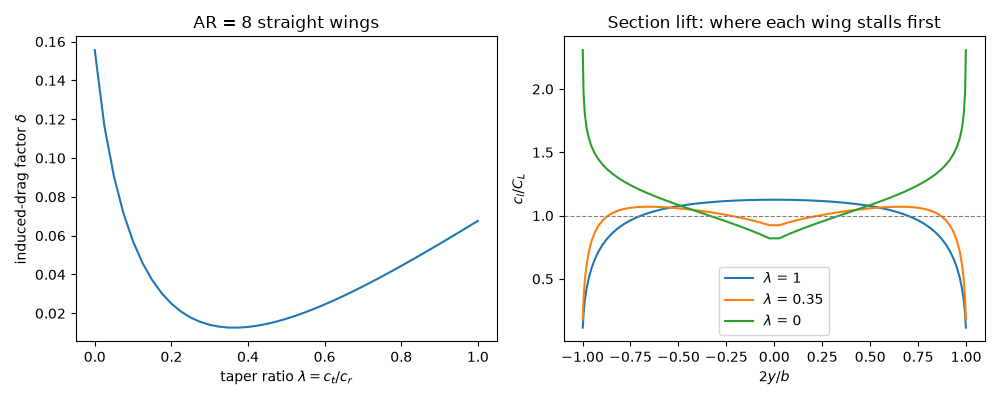
AR = 8: delta = 0.0676 rectangular, minimum 0.0126 at taper ratio 0.375
Total running time of the script: (0 minutes 0.212 seconds)
