
Note
Go to the end to download the full example code or to run this example in your browser via JupyterLite.
Bennett’s quantization noise (1948)#
Pulse-code modulation, worked out at Bell Laboratories during the Second
World War, rounds every sample to one of \(2^N\) levels
(quantize()). W. R. Bennett asked
what that rounding does to the signal. For a signal that is busy compared
with the step \(q\)
(quantization_step()), the error is
spread evenly over \([-q/2, q/2]\), so it behaves like added white noise
of power \(q^2/12\). For a full-scale sine this gives the rule every ADC
data sheet quotes, \(\mathrm{SNR} = 6.02N + 1.76\) dB: each extra bit
buys 6 dB.
import matplotlib.pyplot as plt
import numpy as np

from engineeringkit.signal_processing import quantization_step, quantize, rms, snr_db
The error is uniform with power q^2/12#
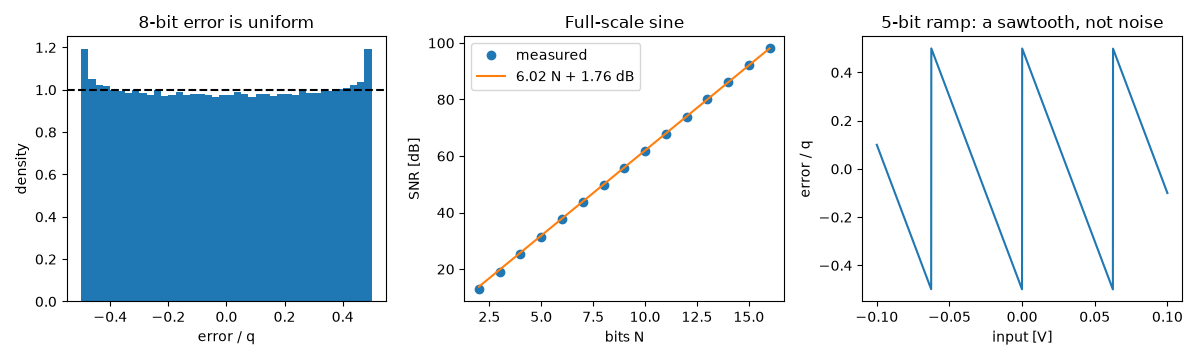
A full-scale sine at an irrational fraction of the sampling rate, so the samples do not repeat, quantized to 8 bits over [-1, 1] V. The model is an approximation: here it is about 1.5% low in rms (0.14 dB).
n = np.arange(200_000)
x = np.sin(2 * np.pi * n * (np.sqrt(2) - 1) / 10) * (1 - 1e-9)
bits = 8
q = quantization_step(-1.0, 1.0, bits)
error = quantize(x, -1.0, 1.0, bits) - x
print(f"q = {q * 1e3:.3f} mV; rms error {rms(error) * 1e3:.4f} mV, q/sqrt(12) = {q / np.sqrt(12) * 1e3:.4f} mV")
assert np.abs(error).max() <= q / 2 + 1e-15
assert np.isclose(rms(error), q / np.sqrt(12), rtol=0.03)
q = 7.812 mV; rms error 2.2914 mV, q/sqrt(12) = 2.2553 mV
Six decibels per bit#
The rule is a large-N result: with only a few levels the error is not yet uniform, and the measured SNR falls short.
resolutions = np.arange(2, 17)
measured = [snr_db(x, quantize(x, -1.0, 1.0, int(b)) - x) for b in resolutions]
rule = 6.02 * resolutions + 1.76
for b, m in zip(resolutions[::4], measured[::4]):
    print(f"{b:2d} bits: SNR {m:6.2f} dB, 6.02N + 1.76 = {6.02 * b + 1.76:6.2f} dB")
assert np.allclose(measured[4:], rule[4:], atol=0.3)
assert measured[0] < rule[0] - 0.5
 2 bits: SNR  12.81 dB, 6.02N + 1.76 =  13.80 dB
 6 bits: SNR  37.61 dB, 6.02N + 1.76 =  37.88 dB
10 bits: SNR  61.90 dB, 6.02N + 1.76 =  61.96 dB
14 bits: SNR  86.03 dB, 6.02N + 1.76 =  86.04 dB
When the signal is not busy#
A slow ramp spanning only a few steps gives a sawtooth error, correlated with the signal: Bennett’s noise model needs many levels crossed.
ramp = np.linspace(-0.1, 0.1, 2000)
ramp_error = quantize(ramp, -1.0, 1.0, 5) - ramp

fig, axes = plt.subplots(1, 3, figsize=(12, 3.6))
axes[0].hist(error / q, bins=40, density=True)
axes[0].axhline(1.0, color="k", ls="--")
axes[0].set(xlabel="error / q", ylabel="density", title="8-bit error is uniform")
axes[1].plot(resolutions, measured, "o", label="measured")
axes[1].plot(resolutions, rule, label="6.02 N + 1.76 dB")
axes[1].set(xlabel="bits N", ylabel="SNR [dB]", title="Full-scale sine")
axes[1].legend()
axes[2].plot(ramp, ramp_error / quantization_step(-1.0, 1.0, 5))
axes[2].set(xlabel="input [V]", ylabel="error / q", title="5-bit ramp: a sawtooth, not noise")
fig.tight_layout()

plt.show()
Total running time of the script: (0 minutes 0.081 seconds)
