
Note
Go to the end to download the full example code or to run this example in your browser via JupyterLite.
Perkins’s vapour-compression refrigerator (1834)#
In 1834 Jacob Perkins, an American engineer in London, patented a machine
that evaporated ether at low pressure to absorb heat, compressed the vapour
with a hand pump, and condensed it again under pressure. It was the first
closed vapour-compression cycle, the cycle of nearly every refrigerator and
air conditioner since. Its figure of merit is the coefficient of performance,
the heat removed per unit of work,
\(\mathrm{COP}_R = Q_c/W\)
(refrigeration_cop()), and the second
law bounds it by \(T_c/(T_h - T_c)\)
(carnot_cop_refrigerator()). The example
runs the ideal cycle with water as the refrigerant (R718, used today in some
large chillers), because IAPWS-IF97 gives its properties.
import matplotlib.pyplot as plt
import numpy as np

from engineeringkit.thermodynamics import carnot_cop_refrigerator, refrigeration_cop, saturation_pressure, steam_properties
from engineeringkit.thermodynamics.visualizers import plot_ts_diagram


def cycle(T_evap, T_cond):
    """States 1-4: compressor inlet, compressor outlet, condenser outlet, evaporator inlet."""
    p_low, p_high = float(saturation_pressure(T_evap)), float(saturation_pressure(T_cond))
    s1 = steam_properties(p_low, x=1.0)  # saturated vapour leaves the evaporator
    s2 = steam_properties(p_high, s=s1.s)  # isentropic compression
    s3 = steam_properties(p_high, x=0.0)  # saturated liquid leaves the condenser
    s4 = steam_properties(p_low, h=s3.h)  # the expansion valve throttles at constant enthalpy
    return s1, s2, s3, s4
A chiller at 5 °C rejecting heat at 35 °C#
s1, s2, s3, s4 = cycle(278.15, 308.15)
q_cold, work = s1.h - s4.h, s2.h - s1.h
cop = refrigeration_cop(q_cold, work)
cop_carnot = carnot_cop_refrigerator(308.15, 278.15)
print(f"evaporator {s1.p:.0f} Pa, condenser {s2.p:.0f} Pa; compressor outlet {s2.T - 273.15:.0f} °C")
print(f"refrigeration effect {q_cold / 1e3:.0f} kJ/kg, compressor work {work / 1e3:.0f} kJ/kg, quality after the valve {s4.x:.3f}")
print(f"COP {cop:.2f}, Carnot COP {cop_carnot:.2f}, ratio {cop / cop_carnot:.2f}")
print(f"vapour volume at the compressor inlet {s1.v:.0f} m³/kg: {q_cold / s1.v / 1e3:.1f} kJ of cooling per m³ swept")
assert np.isclose(s4.h, s3.h) and 0 < s4.x < 0.1
assert 0.8 < cop / cop_carnot < 1  # throttling and superheat cost a little
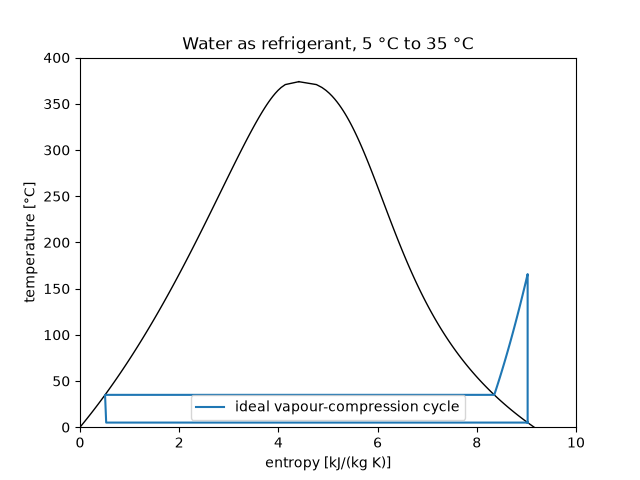
evaporator 873 Pa, condenser 5629 Pa; compressor outlet 166 °C
refrigeration effect 2363 kJ/kg, compressor work 303 kJ/kg, quality after the valve 0.050
COP 7.79, Carnot COP 9.27, ratio 0.84
vapour volume at the compressor inlet 147 m³/kg: 16.1 kJ of cooling per m³ swept
The cycle stays below Carnot for two reasons. The valve throttles instead of recovering work from an expander, and the compressed vapour leaves far hotter than the condenser. Water’s real handicap is its huge vapour volume at low pressure: at 5 °C a compressor must sweep about 150 m³ per kilogram, against about 0.24 m³ for ammonia, which gives more than 200 times as much cooling per cubic metre swept. That is why practical machines used ether, then ammonia, and later fluorocarbons.
s_path = [s1.s, s2.s] + [st.s for st in (steam_properties(s2.p, T) for T in np.linspace(s2.T, s3.T + 0.01, 30))]
T_path = [s1.T, s2.T] + list(np.linspace(s2.T, s3.T + 0.01, 30))
s_path += [s3.s, s4.s, s1.s]
T_path += [s3.T, s4.T, s1.T]
ax = plot_ts_diagram(s_path, T_path, label="ideal vapour-compression cycle")
ax.set(xlim=(0, 10), ylim=(0, 400), title="Water as refrigerant, 5 °C to 35 °C")
[(0.0, 10.0), (0.0, 400.0), Text(0.5, 1.0, 'Water as refrigerant, 5 °C to 35 °C')]
A warmer condenser costs efficiency#
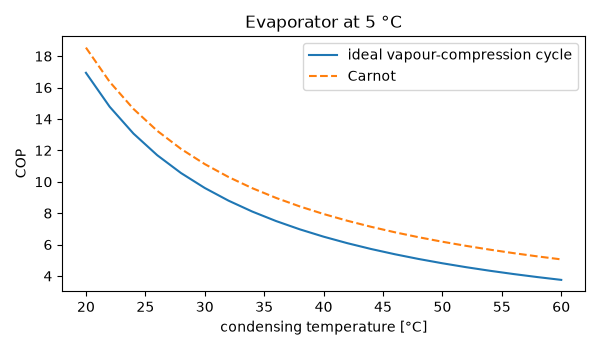
Each kelvin of lift between evaporator and condenser lowers the COP, which is why refrigerators work harder in a hot kitchen.
T_cond = np.linspace(293.15, 333.15, 21)
cops = []
for T in T_cond:
    a, b, c, d = cycle(278.15, T)
    cops.append(refrigeration_cop(a.h - d.h, b.h - a.h))
fig, ax = plt.subplots(figsize=(6, 3.5))
ax.plot(T_cond - 273.15, cops, label="ideal vapour-compression cycle")
ax.plot(T_cond - 273.15, [carnot_cop_refrigerator(T, 278.15) for T in T_cond], "--", label="Carnot")
ax.set(xlabel="condensing temperature [°C]", ylabel="COP", title="Evaporator at 5 °C")
ax.legend()
fig.tight_layout()
assert np.all(np.diff(cops) < 0)

plt.show()
Total running time of the script: (0 minutes 0.290 seconds)
