
Note
Go to the end to download the full example code or to run this example in your browser via JupyterLite.
Minorsky’s PID controller for ship steering#
Nicolas Minorsky (1922) watched helmsmen on the battleship New Mexico and
noticed they reacted to the heading error, to how fast it was changing, and
to any error that persisted. His three-term controller,
\(\delta = K_p e + K_i \int e\,dt + K_d \dot e\), is the
PID. Using Nomoto’s ship model
\(\psi/\delta = K/(s(Ts + 1))\) and a steady wind moment, proportional
plus derivative action leaves a constant heading offset \(d/K_p\);
adding integral action removes it.
import matplotlib.pyplot as plt
import numpy as np

from engineeringkit.control_systems import PID, feedback, poles, step_response, transfer_function

K, T = 0.5, 10.0  # rudder gain [1/s], yaw time constant [s]
ship = transfer_function([K], [T, 1, 0])
wind = 0.05  # equivalent steady rudder offset [rad]
Heading error caused by a steady wind#
t = np.linspace(0, 400, 4001)
controllers = {"PD": PID(2.0, 0.0, 20.0), "PID": PID(2.0, 0.1, 20.0)}
fig, ax = plt.subplots()
for name, pid in controllers.items():
    disturbance_to_heading = feedback(ship, pid.transfer_function())
    assert np.all(poles(disturbance_to_heading).real < 0)
    _, psi = step_response(disturbance_to_heading, t)
    ax.plot(t, np.degrees(wind * psi), label=name)
    print(f"{name}: final heading error {np.degrees(wind * psi[-1]):.3f} deg")
    expected = wind / pid.kp if pid.ki == 0 else 0.0
    assert np.isclose(wind * psi[-1], expected, atol=2e-4)
ax.axhline(np.degrees(wind / 2.0), color="gray", ls=":", label="$d/K_p$")
ax.set(xlabel="time [s]", ylabel="heading error [deg]", title="Nomoto ship model with a steady wind moment")
ax.legend()

plt.show()
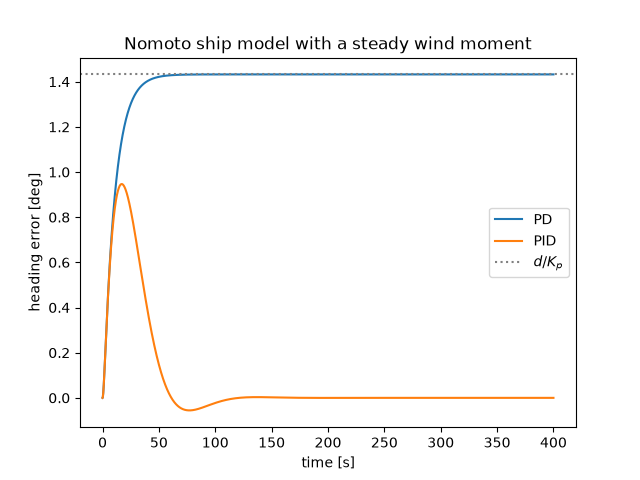
PD: final heading error 1.432 deg
PID: final heading error 0.000 deg
Total running time of the script: (0 minutes 0.159 seconds)
