
Examples#
This gallery walks through physicskit.astro’s worked examples: orbital
mechanics, N-body dynamics, stellar structure, galactic dynamics and dark
matter, cosmic-web structure formation, and the stellar dynamo – one
section per corresponding subpackage module.
See also the narrative tutorials:
Each script in this gallery is self-contained and can be run directly with
python examples/astro/<section>/<script>.py. Every script also carries
an RST module docstring as its title/description and uses # %% markers
to split narrative text from code, which is exactly what Sphinx-Gallery
renders into the pages below – the script is the source of truth for what
you see, not a copy of it.
Sections#
orbital_mechanics – Kepler’s laws, Newton’s inverse-square gravity, Gauss’s orbit-determination problem, and the Hohmann transfer.
nbody – Poincare’s sensitive dependence in the three-body problem, the figure-eight choreography, the virial theorem, and long-term symplectic stability.
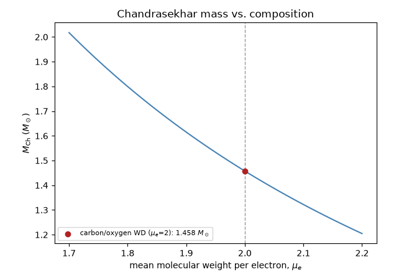
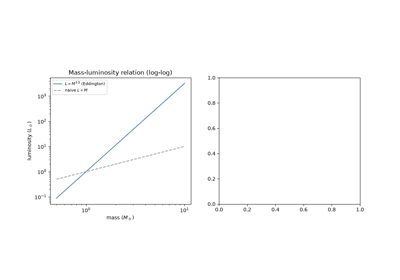
stellar_structure – Lane-Emden polytropes, the Chandrasekhar mass limit, the Eddington mass-luminosity relation, and the pp-chain/CNO-cycle energy release behind stellar nucleosynthesis.
galactic_dynamics – Oort’s constants, flat rotation curves and the dark-matter mass discrepancy, the NFW halo profile, and Chandrasekhar’s dynamical friction.
cosmic_web – the Zel’dovich approximation: a uniform particle grid collapsing into the filaments, sheets, and nodes of the cosmic web.
hydrodynamics – smoothed-particle hydrodynamics: Sod’s shock tube with particles that follow the mass.
stellar_atmospheres – grey radiative transfer: the Eddington approximation, the exact Hopf solution and solar limb darkening.
stellar_dynamo – 2D Boussinesq convective rolls, and the linearized alpha-omega mean-field dynamo wave that reproduces the solar butterfly diagram.
Cosmic-web formation#
The Zel’dovich (1970) approximation: how an initially uniform grid of matter collapses into the filaments, sheets, and nodes of the cosmic web.
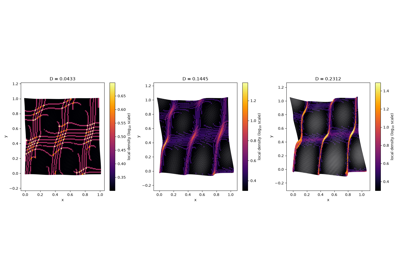
Cosmic-web formation: the Zel’dovich approximation
Galactic dynamics#
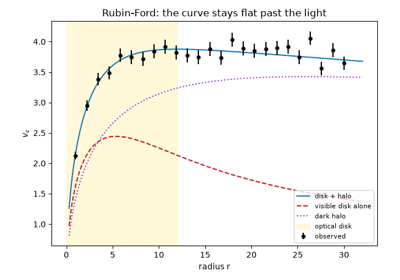
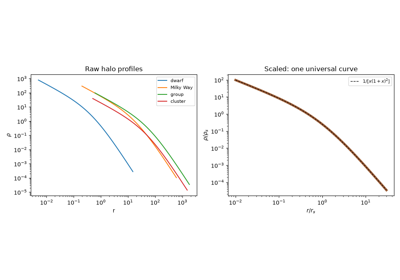
Oort and Lindblad’s differential rotation, Oort’s and Zwicky’s missing
mass from velocity dispersions, Rubin and Ford’s flat rotation
curves, the Navarro-Frenk-White halo profile, and Chandrasekhar’s dynamical
friction – the rotation-curve and dark-matter machinery in
physicskit.astro.galactic_dynamics.
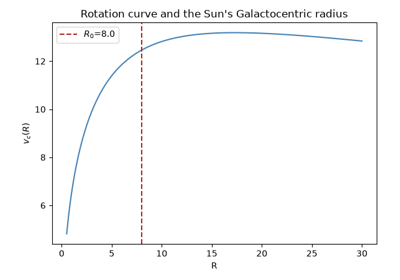
Oort and Lindblad’s differential rotation: the Oort constants
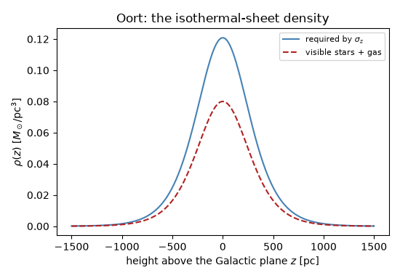
Oort and Zwicky: missing mass from velocity dispersions
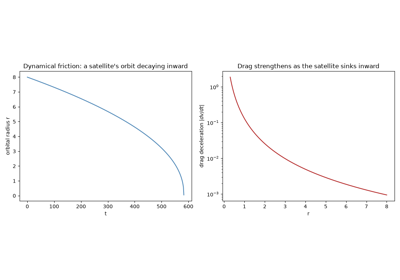
Chandrasekhar’s dynamical friction: a satellite spiraling inward
Hydrodynamics#
Smoothed-particle hydrodynamics in physicskit.astro.sph: a gas
represented by particles that carry its mass, tested on Sod’s shock tube.
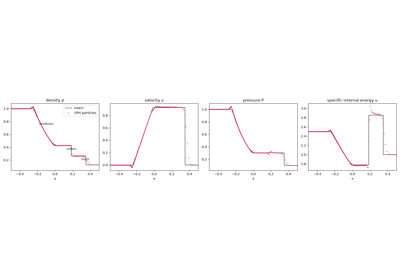
Smoothed-particle hydrodynamics: Sod’s shock tube with particles
N-body dynamics#
Direct-summation gravity in physicskit.astro.nbody: the sensitive
dependence on initial conditions Poincare discovered in the three-body
problem, the figure-eight choreography, the virial theorem, and the
long-term stability that symplectic integration buys N-body simulation.
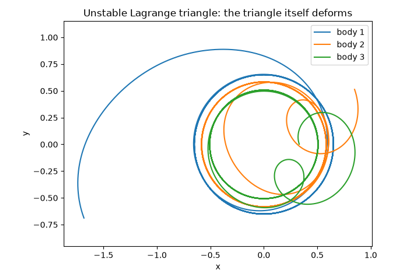
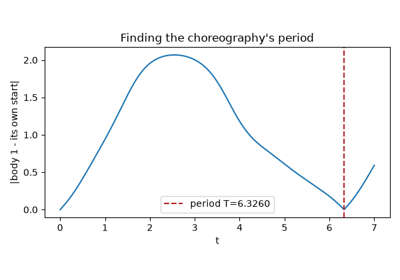
Poincare’s discovery: sensitive dependence in the three-body problem
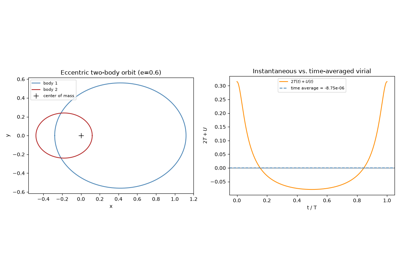
Clausius’s virial theorem for a bound gravitational orbit
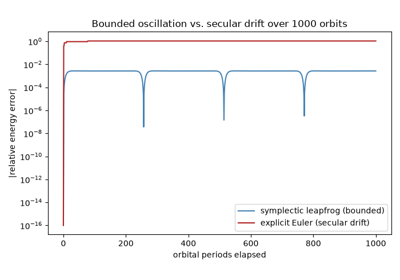
Symplectic integration and long-term N-body stability
Orbital mechanics#
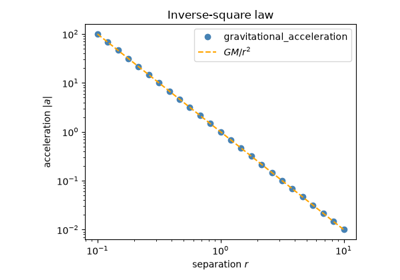
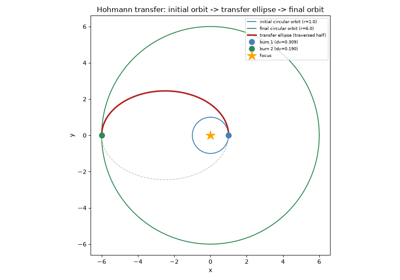
Kepler’s laws, Newton’s inverse-square gravity, Gauss’s orbit-determination
problem, and Hohmann’s minimum-energy transfer – the two-body machinery in
physicskit.astro.orbital_mechanics.
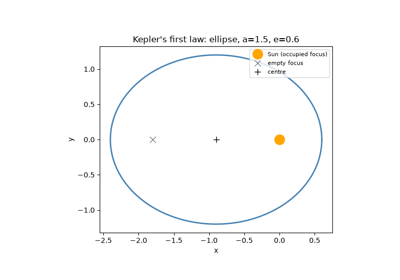
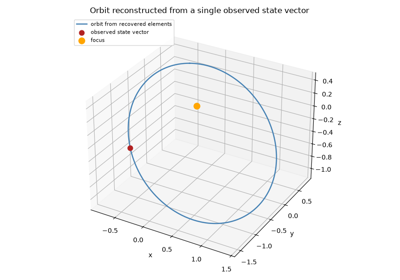
Gauss’s problem: recovering orbital elements from a state vector
Stellar atmospheres#
Grey radiative transfer in physicskit.astro.radiative_transfer: the
temperature structure and limb darkening of a plane-parallel atmosphere,
in the Eddington approximation and exactly.
Grey radiative transfer: the Eddington approximation and limb darkening
Stellar convection and the magnetic dynamo#
2D convective rolls, and the alpha-omega mean-field dynamo wave behind the solar butterfly diagram.
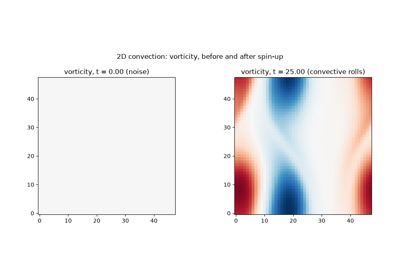
Stellar convection and the alpha-omega magnetic dynamo
Stellar structure#
Polytropic gas spheres, the Chandrasekhar mass limit, the mass-luminosity
relation, and the nuclear reactions that power a star, from
physicskit.astro.stellar_structure (and, for nucleosynthesis,
physicskit.particle.nuclear).
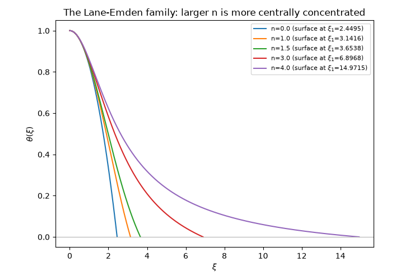
Lane-Emden polytropes: Lane, Ritter, and Emden’s gas spheres
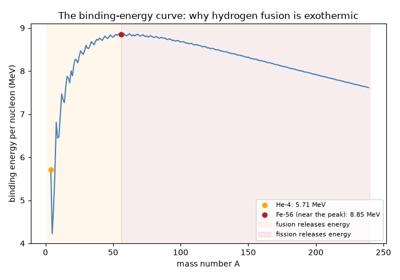
Bethe’s pp-chain and CNO cycle: the energy source of stars