Note
Go to the end to download the full example code or to run this example in your browser via JupyterLite.
Dalton’s partial pressures (1802)#
John Dalton found that each gas in a mixture exerts the pressure it would
exert alone, and that the total is the sum. Water vapour in air is then an
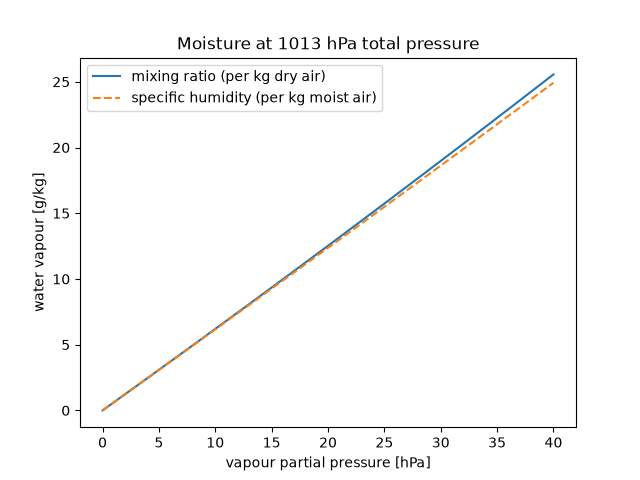
ideal gas with its own partial pressure e. The mixing ratio is the ratio
of the two partial densities, epsilon e / (p - e), and the specific
humidity is the vapour fraction of the total mass.
import matplotlib.pyplot as plt
import numpy as np

from earthsciencekit.atmosphere import mixing_ratio, specific_humidity
from earthsciencekit.constants import R_DRY_AIR, R_VAPOR

pressure, temperature = 101325.0, 293.15
vapor = np.linspace(0, 4000, 201)
w = mixing_ratio(vapor, pressure)
q = specific_humidity(w)
vapor_density = vapor / (R_VAPOR * temperature)
dry_density = (pressure - vapor) / (R_DRY_AIR * temperature)
np.testing.assert_allclose(w, vapor_density / dry_density)
np.testing.assert_allclose(q, vapor_density / (vapor_density + dry_density))

fig, ax = plt.subplots()
ax.plot(vapor / 100, w * 1000, label="mixing ratio (per kg dry air)")
ax.plot(vapor / 100, q * 1000, ls="--", label="specific humidity (per kg moist air)")
ax.set(xlabel="vapour partial pressure [hPa]", ylabel="water vapour [g/kg]", title=f"Moisture at {pressure / 100:.0f} hPa total pressure")
ax.legend()

plt.show()
Total running time of the script: (0 minutes 0.087 seconds)
