Note
Go to the end to download the full example code or to run this example in your browser via JupyterLite.
Nicolaysen’s isochron (1961)#
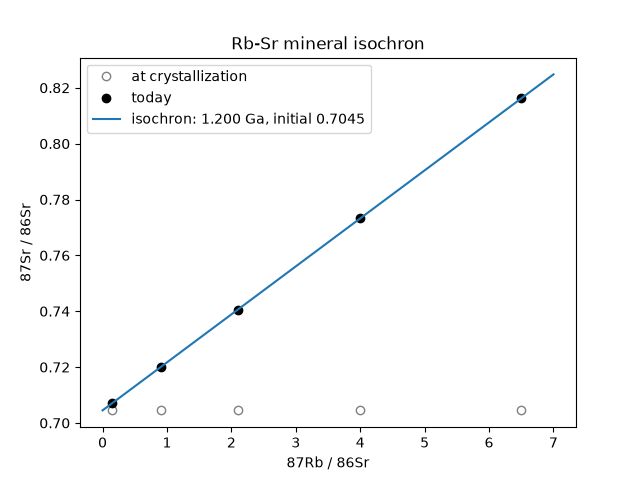
Louis Nicolaysen showed how to date a rock without knowing how much daughter it started with. Minerals that crystallized together share the initial 87Sr/86Sr but take up different amounts of rubidium. As 87Rb decays they move along lines of slope one, so at any time they lie on a straight isochron whose slope gives the age and whose intercept gives the initial ratio.
import matplotlib.pyplot as plt
import numpy as np

from earthsciencekit.units import convert
from earthsciencekit.volcanology import isochron_fit

rate = 1.42e-11 / convert(1, "year", "s")  # 87Rb decay constant, 1/s
age, initial = convert(1.2, "Ga", "s"), 0.7045
rubidium = np.array([0.15, 0.9, 2.1, 4.0, 6.5])
scatter = np.array([2, -3, 1, 3, -2]) * 1e-5  # deterministic analytical noise
strontium = initial + rubidium * np.expm1(rate * age) + scatter
fit_age, fit_initial = isochron_fit(rubidium, strontium, rate)
assert np.isclose(convert(fit_age, "s", "Ga"), 1.2, rtol=2e-3) and np.isclose(fit_initial, initial, atol=1e-4)

fig, ax = plt.subplots()
ax.plot(rubidium, np.full_like(rubidium, initial), "o", mfc="none", color="0.5", label="at crystallization")
ax.plot(rubidium, strontium, "ko", label="today")
line = np.array([0, 7.0])
ax.plot(
    line,
    fit_initial + line * np.expm1(rate * fit_age),
    label=f"isochron: {convert(fit_age, 's', 'Ga'):.3f} Ga, initial {fit_initial:.4f}",
)
ax.set(xlabel="87Rb / 86Sr", ylabel="87Sr / 86Sr", title="Rb-Sr mineral isochron")
ax.legend()

plt.show()
Total running time of the script: (0 minutes 0.089 seconds)
