Note
Go to the end to download the full example code or to run this example in your browser via JupyterLite.
Matuyama’s reversed epoch (1929)#
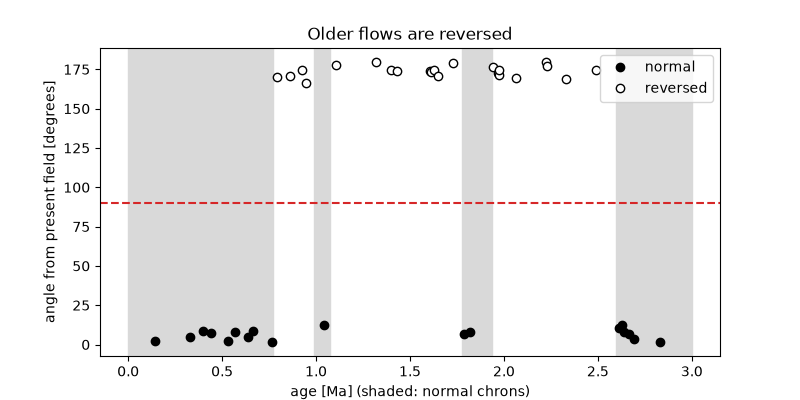
Motonori Matuyama measured the magnetization of basalts from Japan, Korea and Manchuria. The youngest flows were magnetized along today’s field, but older, early Quaternary flows pointed the opposite way. He concluded that the field had been reversed for a long time before the present one, the interval now called the Matuyama chron. A flow is reversed when its direction lies more than 90 degrees from the present axial dipole field at the site.
import matplotlib.pyplot as plt
import numpy as np

from earthsciencekit.geophysics import dipole_inclination, direction_angle
from earthsciencekit.units import convert

normal_chrons = [(0.0, 0.773), (0.988, 1.072), (1.775, 1.934), (2.595, 3.0)]  # Ma: Brunhes, Jaramillo, Olduvai, Gauss
rng = np.random.default_rng(1929)
age = np.sort(rng.uniform(0.05, 2.9, 40))
normal = np.array([any(start <= t < end for start, end in normal_chrons) for t in age])
site = np.radians(35.0)
present = dipole_inclination(site)
declination = np.where(normal, 0, np.pi) + rng.normal(0, 0.15, age.size)
inclination = np.where(normal, present, -present) + rng.normal(0, 0.1, age.size)
angle = direction_angle(declination, inclination, 0, present)
assert np.array_equal(angle > np.pi / 2, ~normal)
assert np.all(angle[age < 0.773] < np.pi / 2)

fig, ax = plt.subplots(figsize=(8, 4))
for start, end in normal_chrons:
    ax.axvspan(start, end, color="0.85")
ax.plot(age[normal], convert(angle[normal], "rad", "degree"), "ko", mfc="k", label="normal")
ax.plot(age[~normal], convert(angle[~normal], "rad", "degree"), "ko", mfc="w", label="reversed")
ax.axhline(90, color="C3", ls="--")
ax.set(xlabel="age [Ma] (shaded: normal chrons)", ylabel="angle from present field [degrees]", title="Older flows are reversed")
ax.legend()

plt.show()
Total running time of the script: (0 minutes 0.090 seconds)
