Note
Go to the end to download the full example code or to run this example in your browser via JupyterLite.
Fourier’s greenhouse (1824)#
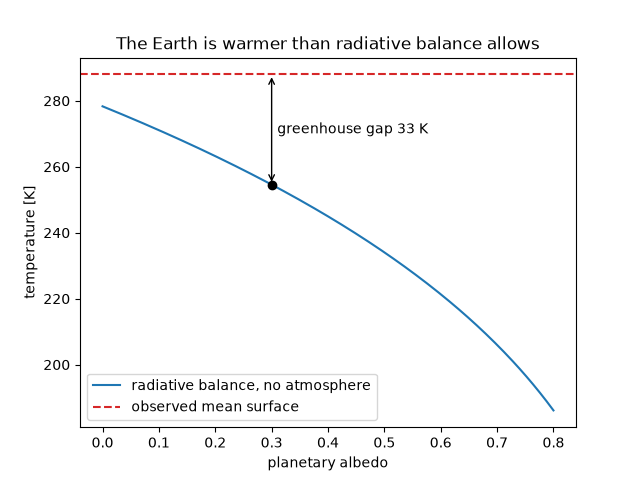
Joseph Fourier argued that the Earth would be much colder if it simply radiated away the sunlight it absorbs, and that the atmosphere must hold heat in. A planet in radiative balance emits what it absorbs, which for the present albedo of about 0.3 gives an effective temperature near 255 K. The measured mean surface temperature of about 288 K is 33 K warmer; that gap is the greenhouse effect.
import matplotlib.pyplot as plt
import numpy as np

from earthsciencekit.climate import absorbed_solar, effective_temperature, outgoing_longwave

albedo = np.linspace(0, 0.8, 201)
flux = absorbed_solar(1361, albedo)
temperature = effective_temperature(flux, 1)
np.testing.assert_allclose(outgoing_longwave(temperature, 1), flux, rtol=1e-14)
earth = float(effective_temperature(absorbed_solar(1361, 0.3), 1))
assert np.isclose(earth, 254.6, atol=0.1)

fig, ax = plt.subplots()
ax.plot(albedo, temperature, label="radiative balance, no atmosphere")
ax.axhline(288, color="tab:red", ls="--", label="observed mean surface")
ax.annotate("", xy=(0.3, 288), xytext=(0.3, earth), arrowprops={"arrowstyle": "<->"})
ax.text(0.31, (288 + earth) / 2, f"greenhouse gap {288 - earth:.0f} K", va="center")
ax.plot(0.3, earth, "ko")
ax.set(xlabel="planetary albedo", ylabel="temperature [K]", title="The Earth is warmer than radiative balance allows")
ax.legend(loc="lower left")

plt.show()
Total running time of the script: (0 minutes 0.092 seconds)
