Note
Go to the end to download the full example code or to run this example in your browser via JupyterLite.
Budyko and Sellers’s ice-albedo feedback (1969)#
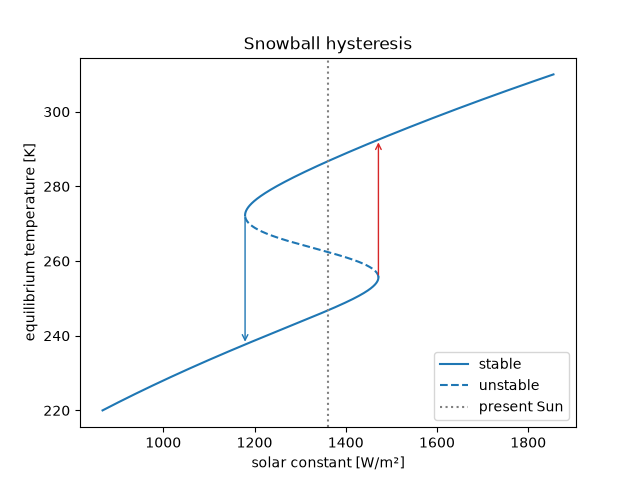
Mikhail Budyko and William Sellers independently built energy-balance models in which ice reflects more sunlight than ocean or land. Colder climates grow more ice and absorb less, which cools them further. Both found that a drop of a few percent in sunlight could freeze the whole planet, and that a frozen Earth would stay frozen until the Sun grew far brighter: a hysteresis loop. Inverting the energy balance gives the solar constant that holds each temperature, which traces every equilibrium at once.
import matplotlib.pyplot as plt
import numpy as np

from earthsciencekit.climate import equilibrium_solar_constant

parameters = (0.62, 0.62, 0.3, 265.0, 8.0)
temperature = np.linspace(220, 310, 2001)
solar = equilibrium_solar_constant(temperature, *parameters)
slope = np.diff(solar)
folds = np.where(np.sign(slope[1:]) != np.sign(slope[:-1]))[0] + 1
escape, collapse = solar[folds]
assert escape > 1361 > collapse
crossings = np.where(np.diff(np.sign(solar - 1361)))[0]
assert crossings.size == 3

stable = np.r_[slope > 0, True]
fig, ax = plt.subplots()
ax.plot(np.where(stable, solar, np.nan), temperature, "C0", label="stable")
ax.plot(np.where(~stable, solar, np.nan), temperature, "C0--", label="unstable")
cold, warm = slice(None, folds[0]), slice(folds[1], None)
freeze = temperature[cold][np.argmin(abs(solar[cold] - collapse))]
thaw = temperature[warm][np.argmin(abs(solar[warm] - escape))]
ax.annotate("", xy=(collapse, freeze), xytext=(collapse, temperature[folds[1]]), arrowprops={"arrowstyle": "->", "color": "tab:blue"})
ax.annotate("", xy=(escape, thaw), xytext=(escape, temperature[folds[0]]), arrowprops={"arrowstyle": "->", "color": "tab:red"})
ax.axvline(1361, color="0.5", ls=":", label="present Sun")
ax.set(xlabel="solar constant [W/m²]", ylabel="equilibrium temperature [K]", title="Snowball hysteresis")
ax.legend(loc="lower right")

plt.show()
Total running time of the script: (0 minutes 0.079 seconds)
