Note
Go to the end to download the full example code or to run this example in your browser via JupyterLite.
Goldschmidt’s geochemical rules (1937)#
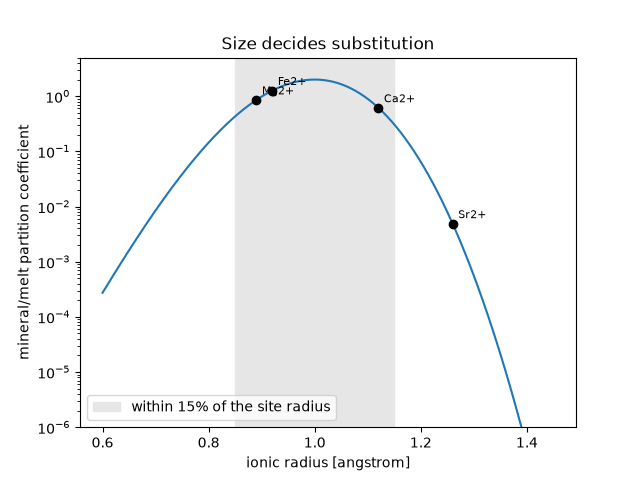
Victor Goldschmidt classified the elements by where they go in the Earth and stated the rules for which ions replace one another in a crystal: ions of the same charge whose radii differ by less than about 15% substitute freely. Blundy and Wood (1994) made the rule quantitative: the partition coefficient falls off on both sides of the radius that fits the site, as the strain energy of the lattice grows.
import matplotlib.pyplot as plt
import numpy as np

from earthsciencekit.volcanology import lattice_strain_partition

optimal, peak, modulus, temperature = 1.0e-10, 2.0, 250e9, 1500  # a clinopyroxene M2-like site
radius = np.linspace(0.6e-10, 1.45e-10, 400)
ions = {"Mg2+": 0.89e-10, "Fe2+": 0.92e-10, "Ca2+": 1.12e-10, "Sr2+": 1.26e-10, "Ba2+": 1.42e-10}  # 8-fold radii
partition = lattice_strain_partition(radius, optimal, peak, modulus, temperature)
assert np.isclose(partition.max(), peak, rtol=1e-4)
assert lattice_strain_partition(ions["Ba2+"], optimal, peak, modulus, temperature) < 1e-3 * peak

fig, ax = plt.subplots()
ax.semilogy(radius * 1e10, partition)
ax.axvspan(0.85, 1.15, color="0.9", label="within 15% of the site radius")
for name, value in ions.items():
    d = lattice_strain_partition(value, optimal, peak, modulus, temperature)
    ax.plot(value * 1e10, d, "ko")
    ax.annotate(name, (value * 1e10, d), textcoords="offset points", xytext=(4, 4), fontsize=8)
ax.set(xlabel="ionic radius [angstrom]", ylabel="mineral/melt partition coefficient", title="Size decides substitution", ylim=(1e-6, 5))
ax.legend()

plt.show()
Total running time of the script: (0 minutes 0.191 seconds)
