

Note
Go to the end to download the full example code.
Discrete Optics in Waveguide Arrays#
Light guided by parallel waveguides leaks from one to the next through their evanescent tails. In coupled-mode theory the field amplitudes obey a Tight-Binding Schrödinger equation in which the propagation distance \(z\) plays the role of time,
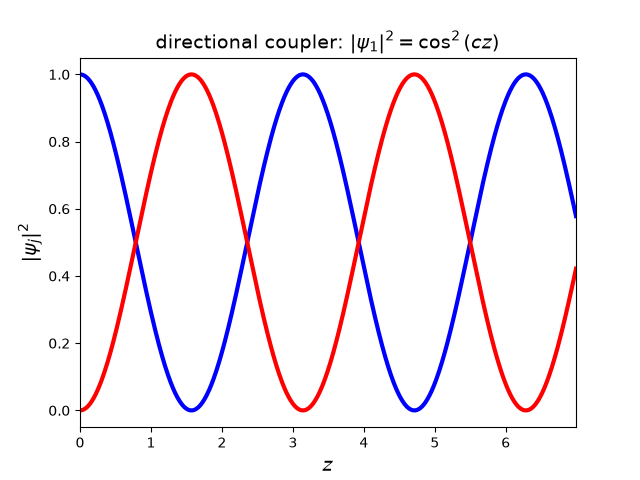
with the coupling constant \(c\) as the hopping. Two waveguides form a directional coupler (Jones, 1965; Somekh et al., 1973): the power swaps between them as \(\cos^2(cz)\). Light launched into one guide of an array undergoes discrete diffraction (Jones, 1965), with the intensity \(|J_n(2cz)|^2\) concentrated in two outer lobes instead of the single Gaussian spot of a continuous medium. Its rate depends on the phase difference \(k\) between neighbouring guides, \(\epsilon''(k) = -2c\cos k\), and vanishes at \(k = \pi/2\) (diffraction management, Eisenberg et al., 2000). Waveguide arrays turned into a laboratory for lattice physics with discrete solitons (Christodoulides and Joseph, 1988; Eisenberg et al., 1998) and optical Bloch oscillations (Pertsch et al.; Morandotti et al., 1999), reviewed by Christodoulides, Lederer and Silberberg (2003).
Propagation integrates this equation along
\(z\) (get_propagation), and plt_prop_dimer draws the coupler.
import numpy as np
import matplotlib.pyplot as plt
from scipy.special import jv

from tbkit.lattice import Lattice
from tbkit.plot import Plot
from tbkit.system import System
from tbkit.propagation import Propagation

c = 1.
dz = 0.01


def array(n):
    '''n identical waveguides, coupling c between neighbours.'''
    lat = Lattice(unit_cell=[{'tag': 'a', 'r0': (0., 0.)}], prim_vec=[(1., 0.)])
    lat.get_lattice(n1=n)
    sys = System(lat)
    sys.set_hopping([{'n': 1, 't': c}])
    sys.set_onsite({'a': 0.})
    sys.get_ham()
    return sys
The lattice#
Each waveguide is one site, and evanescent coupling between neighbouring guides is a nearest-neighbour hopping \(c\): an array of guides is a Tight-Binding chain, with the propagation distance \(z\) as time.
fig_lat = Plot(array(9)).lattice(plt_hop=True, ms=12, figsize=(7, 1.2))

The directional coupler#
All the light returns to the first guide after the beat length \(\pi/c\), having crossed to the second at \(\pi/2c\).
coupler = array(2)
prop_coupler = Propagation(coupler.lat)
prop_coupler.get_propagation(coupler.ham, np.array([1., 0.], dtype='c16'), steps=700, dz=dz)
z = dz * np.arange(700)
assert np.allclose(np.abs(prop_coupler.prop[0]) ** 2, np.cos(c * z) ** 2, atol=1e-4)
print('Coupler: |psi_1|^2 = cos^2(cz) to 1e-4; full transfer at z = pi/2c = {:.4f}.'.format(np.pi / (2 * c)))
fig_coupler = prop_coupler.plt_prop_dimer(lw=3, fs=14)
fig_coupler.axes[0].set_title(r'directional coupler: $|\psi_1|^2 = \cos^2(cz)$', fontsize=14)
Coupler: |psi_1|^2 = cos^2(cz) to 1e-4; full transfer at z = pi/2c = 1.5708.

Text(0.5, 1.0, 'directional coupler: $|\\psi_1|^2 = \\cos^2(cz)$')
Discrete diffraction from a single guide#
n = 161
centre = n // 2
sites = np.arange(n) - centre
guides = array(n)
psi0 = np.zeros(n, dtype='c16')
psi0[centre] = 1.
steps = 1501
prop = Propagation(guides.lat)
prop.get_propagation(guides.ham, psi0, steps=steps, dz=dz)
z = dz * np.arange(steps)
intensity = np.abs(prop.prop) ** 2
bessel = jv(sites[:, None], 2 * c * z[None]) ** 2
print('Largest deviation from |J_n(2cz)|^2: {:.1e}'.format(np.max(np.abs(intensity - bessel))))
assert np.allclose(intensity, bessel, atol=1e-4)
# the width grows linearly (ballistically): <n^2> = 2 c^2 z^2
second_moment = np.sum(sites[:, None] ** 2 * intensity, axis=0)
assert np.allclose(second_moment, 2 * c ** 2 * z ** 2, rtol=1e-3, atol=1e-6)
Largest deviation from |J_n(2cz)|^2: 2.7e-05
Diffraction management#
A broad beam tilted by a phase \(k\) per guide spreads at a rate set by the band curvature: fastest at \(k = 0\), not at all, to second order, at \(k = \pi/2\), where it drifts sideways at the largest group velocity, \(2c\), without broadening.
def beam_width(k, z_end=20.):
    psi = (np.exp(-sites ** 2 / (4 * 2.5 ** 2)) * np.exp(1j * k * sites)).astype('c16')
    psi /= np.linalg.norm(psi)
    beam = Propagation(guides.lat)
    beam.get_propagation(guides.ham, psi, steps=int(z_end / dz) + 1, dz=dz)
    weight = np.abs(beam.prop) ** 2
    mean = sites @ weight
    return np.sqrt(np.sum(sites[:, None] ** 2 * weight, axis=0) - mean ** 2), beam


width_0, _ = beam_width(0.)
width_half, beam_half = beam_width(np.pi / 2)
print('Beam width after z = 20: {:.2f} at k = 0, {:.2f} at k = pi/2 (initially {:.2f}).'
          .format(width_0[-1], width_half[-1], width_0[0]))
assert width_0[-1] > 3 * width_0[0] and width_half[-1] < 1.2 * width_half[0]

fig, axes = plt.subplots(1, 3, figsize=(14, 4.2))
window = slice(centre - 30, centre + 31)
axes[0].imshow(intensity[window], aspect='auto', origin='lower', cmap='magma',
                   extent=[0, z[-1], sites[window][0], sites[window][-1]])
axes[0].set_xlabel('$z$')
axes[0].set_ylabel('waveguide $n$')
axes[0].set_title('discrete diffraction from one guide')
axes[1].plot(sites, intensity[:, -1], 'o', ms=4, label='tbkit')
axes[1].plot(sites, bessel[:, -1], 'k', lw=1, label=r'$|J_n(2cz)|^2$')
axes[1].set_xlim(-30, 30)
axes[1].set_xlabel('waveguide $n$')
axes[1].set_title(r'intensity at $z = {:.0f}$'.format(z[-1]))
axes[1].legend(fontsize=8)
axes[2].plot(dz * np.arange(len(width_0)), width_0, label='$k = 0$')
axes[2].plot(dz * np.arange(len(width_half)), width_half, label=r'$k = \pi/2$')
axes[2].set_xlabel('$z$')
axes[2].set_ylabel('beam width (guides)')
axes[2].set_title('diffraction management')
axes[2].legend(fontsize=8)
fig.set_layout_engine('tight')
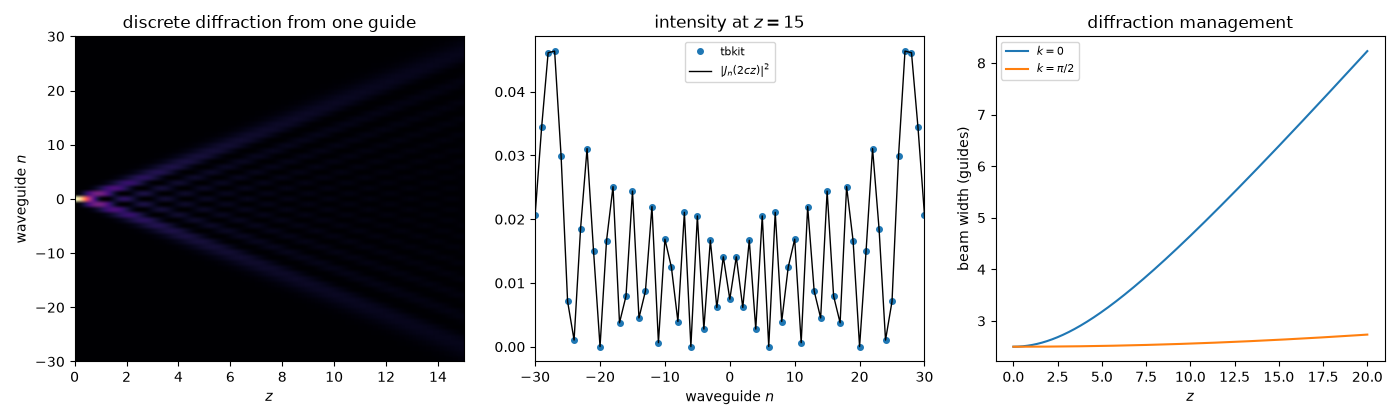
Beam width after z = 20: 8.23 at k = 0, 2.74 at k = pi/2 (initially 2.50).
Total running time of the script: (0 minutes 0.330 seconds)