

Note
Go to the end to download the full example code.
Löwdin Orthogonalization and Non-Orthogonal Tight Binding#
Atomic orbitals on neighbouring atoms overlap: \(s = \langle\phi_i|\phi_j\rangle \neq 0\). In such a basis the Schrödinger equation is the generalized eigenproblem \(H\mathbf{c} = ES\mathbf{c}\), with \(S\) the overlap matrix. P.-O. Löwdin (1950) removed \(S\) with the symmetric orthogonalization \(|\psi\rangle = S^{-1/2}|\phi\rangle\). Among all orthonormal sets, it is the one closest to the original orbitals, and it treats every orbital alike, so the new basis keeps the symmetry of the crystal. In that basis the problem is an ordinary eigenproblem for \(S^{-1/2}HS^{-1/2}\), with the same bands. The cost is range: the orthogonalized orbitals have tails on the neighbours, so the hoppings between them reach further than those of \(H\). An orthogonal tight-binding model with a few hoppings is a truncation of this exact one.
tbkit.kspace.KSpace.set_overlap() keeps the overlap and solves the
generalized problem. This example uses a chain with nearest-neighbour
hopping \(t\) and overlap \(s\), whose band is
and checks the generalized solution against it, the Löwdin form, the exponential decay of the orthogonalized hoppings and the closest-orbitals property on a ring.
import numpy as np
import matplotlib.pyplot as plt
from scipy.linalg import sqrtm

import tbkit.lattices as lattices
from tbkit.kspace import KSpace
from tbkit.plot import Plot
from tbkit.system import System


eps, t, s = 0., -1., 0.2      # onsite energy, hopping, overlap (|s| < 1/2)
k = np.linspace(-np.pi, np.pi, 401)
exact = (eps + 2 * t * np.cos(k)) / (1 + 2 * s * np.cos(k))
The lattice#
The chain: one orbital per site, and between nearest neighbours both a hopping \(t\) and an overlap \(s\) – the orbitals of neighbouring sites are not orthogonal.

The generalized eigenproblem#
set_overlap takes the overlaps in the format of set_hopping.
The band is no longer symmetric: the overlap pushes the antibonding
states up more than it pulls the bonding ones down. The orthogonal model
with the same \(t\) (overlap ignored) misses it by up to
\(1.3|t|\) at the top of the band.
chain = KSpace(lattices.chain())
chain.set_hopping([{'i': 0, 'j': 0, 'R': (1,), 't': t}])
chain.set_overlap([{'i': 0, 'j': 0, 'R': (1,), 't': s}])
bands = chain.get_bands(k[:, None])[:, 0]
print('Generalized eigenproblem vs closed form: max error {:.1e}'.format(np.abs(bands - exact).max()))
assert np.allclose(bands, exact, atol=1e-12)
naive = eps + 2 * t * np.cos(k)
print('Overlap ignored: max error {:.3f}'.format(np.abs(naive - exact).max()))
assert np.abs(naive - exact).max() > 1.3
Generalized eigenproblem vs closed form: max error 1.8e-15
Overlap ignored: max error 1.333
The Löwdin form \(S^{-1/2}HS^{-1/2}\) has the same spectrum at every k (here a two-orbital chain, so that the matrices are not numbers).
two = KSpace(lattices.honeycomb())
two.set_hopping([{'n': 1, 't': t}])
two.set_overlap([{'n': 1, 't': 0.12}])
rng = np.random.default_rng(1)
for kpt in rng.uniform(-np.pi, np.pi, size=(20, 2)):
    h, sk = two.get_ham(kpt), two.get_overlap(kpt)
    s_inv_half = np.linalg.inv(sqrtm(sk))
    lowdin = s_inv_half @ h @ s_inv_half
    assert np.allclose(lowdin, lowdin.conj().T)
    assert np.allclose(np.linalg.eigvalsh(lowdin), two.get_bands([kpt])[0])
print('S^-1/2 H S^-1/2 has the generalized eigenvalues at 20 random k-points of overlapping graphene.')
S^-1/2 H S^-1/2 has the generalized eigenvalues at 20 random k-points of overlapping graphene.
The hoppings between Löwdin orbitals#
In the orthogonalized basis the band \(E(k)\) is an ordinary Fourier series, \(E(k) = \sum_R t_L(R)e^{ikR}\). Writing \(E = t/s + (\epsilon - t/s)/(1 + 2s\cos k)\) and expanding the second term gives
every further neighbour is coupled, with a hopping smaller by a factor \(x\) (0.209 at \(s = 0.2\)). Even the nearest-neighbour hopping and the onsite energy change.
n_fft = 256
k_fft = 2 * np.pi * np.arange(n_fft) / n_fft
t_lowdin = np.fft.fft((eps + 2 * t * np.cos(k_fft)) / (1 + 2 * s * np.cos(k_fft))).real / n_fft
x = (1 - np.sqrt(1 - 4 * s ** 2)) / (2 * s)
print('Lowdin onsite {:+.4f}, hoppings t_L(1..5) = {}'.format(
    t_lowdin[0], np.array2string(t_lowdin[1:6], precision=4)))
print('ratios t_L(R+1)/t_L(R) = {}, -x = {:.4f}'.format(
    np.array2string(t_lowdin[2:7] / t_lowdin[1:6], precision=4), -x))
assert np.allclose(t_lowdin[2:10] / t_lowdin[1:9], -x)
Lowdin onsite +0.4554, hoppings t_L(1..5) = [-1.1386  0.2376 -0.0496  0.0104 -0.0022]
ratios t_L(R+1)/t_L(R) = [-0.2087 -0.2087 -0.2087 -0.2087 -0.2087], -x = -0.2087
An orthogonal model that keeps the hoppings \(t_L(R)\) up to range \(R_{max}\) is a truncation of this series. Its error falls by \(x\) with each neighbour added.
ranges = np.arange(1, 8)
errors = []
for r_max in ranges:
    model = KSpace(lattices.chain())
    model.set_onsite({'a': t_lowdin[0]})
    model.set_hopping([{'i': 0, 'j': 0, 'R': (r,), 't': t_lowdin[r]} for r in range(1, r_max + 1)])
    errors.append(np.abs(model.get_bands(k[:, None])[:, 0] - exact).max())
errors = np.array(errors)
print('max band error vs range:', np.array2string(errors, precision=2))
assert np.allclose(errors[1:] / errors[:-1], x, rtol=1e-3)

fig, (ax1, ax2) = plt.subplots(1, 2, figsize=(12, 4.5))
ax1.plot(k, exact, lw=2.5, label=r'$H c = E S c$ (overlap $s=0.2$)')
ax1.plot(k, naive, '--', lw=2, label='overlap ignored')
for r_max in (1, 2):
    model = KSpace(lattices.chain())
    model.set_onsite({'a': t_lowdin[0]})
    model.set_hopping([{'i': 0, 'j': 0, 'R': (r,), 't': t_lowdin[r]} for r in range(1, r_max + 1)])
    ax1.plot(k, model.get_bands(k[:, None])[:, 0], ':', lw=2,
             label=r'Löwdin, $R_{{max}} = {}$'.format(r_max))
ax1.set_xlabel('$ka$')
ax1.set_ylabel('$E/|t|$')
ax1.set_xlim(-np.pi, np.pi)
ax1.legend(fontsize=9)
ax1.set_title('Non-orthogonal chain')
ax2.semilogy(np.arange(1, 9), np.abs(t_lowdin[1:9]), 'o-', label=r'$|t_L(R)|$')
ax2.semilogy(ranges, errors, 's-', label=r'band error at range $R_{max}$')
ax2.semilogy(np.arange(1, 9), np.abs(t_lowdin[1]) * x ** np.arange(8), 'k--', lw=1,
             label=r'$\propto x^{R}$')
ax2.set_xlabel('$R$ (neighbours)')
ax2.legend()
ax2.set_title('Löwdin orbitals: hoppings of every range')
fig.tight_layout()
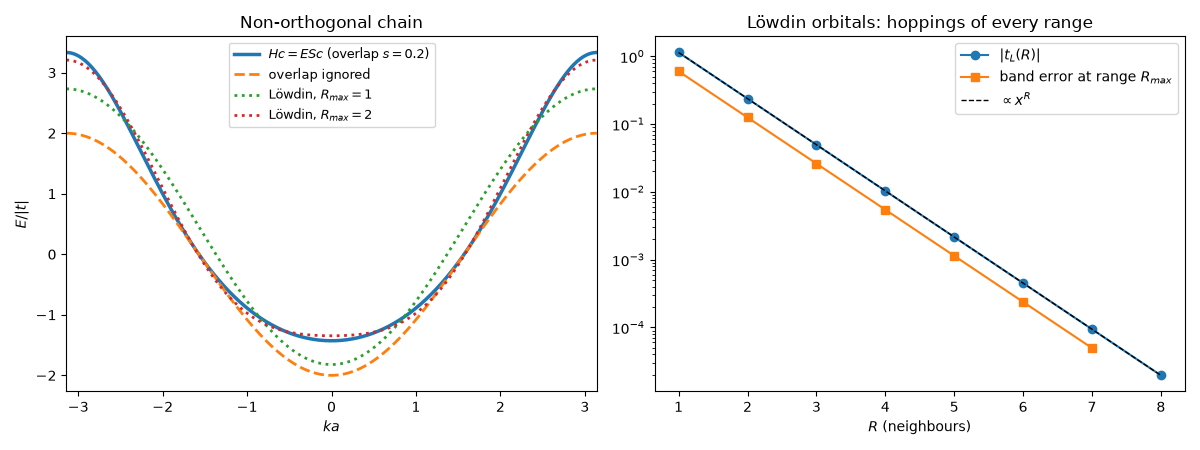
max band error vs range: [6.01e-01 1.25e-01 2.62e-02 5.46e-03 1.14e-03 2.38e-04 4.96e-05]
The closest orthonormal orbitals#
On a ring of 12 sites, an orthonormal set \(|\psi_i\rangle = \sum_j|\phi_j\rangle C_{ji}\) satisfies \(C^\dagger SC = 1\), and its distance to the atomic orbitals is \(\sum_i\||\psi_i\rangle - |\phi_i\rangle\|^2 = \mathrm{Tr}[(C-1)^\dagger S(C-1)]\). Löwdin’s \(C = S^{-1/2}\) moves every orbital by the same amount, the least possible. Gram-Schmidt (\(C = L^{-\dagger}\), with the Cholesky factor \(S = LL^\dagger\)) leaves the first orbital alone and deforms the last one most: it breaks the translation symmetry of the ring and moves the orbitals twice as far in total.
n_ring = 12
shift = np.roll(np.eye(n_ring), 1, axis=1)
s_ring = np.eye(n_ring) + s * (shift + shift.T)
c_lowdin = np.real(np.linalg.inv(sqrtm(s_ring)))
c_gram = np.linalg.inv(np.linalg.cholesky(s_ring).T)
moves = {}
for name, c in (('Lowdin', c_lowdin), ('Gram-Schmidt', c_gram)):
    assert np.allclose(c.T @ s_ring @ c, np.eye(n_ring))
    moves[name] = np.diag((c - np.eye(n_ring)).T @ s_ring @ (c - np.eye(n_ring)))
    print('{:<13} total {:.4f}, per orbital {}'.format(
        name, moves[name].sum(), np.array2string(moves[name][[0, 1, 6, -1]], precision=4)))
assert np.allclose(moves['Lowdin'], moves['Lowdin'][0])          # all orbitals alike
assert moves['Gram-Schmidt'].sum() > 1.9 * moves['Lowdin'].sum()
assert np.isclose(moves['Gram-Schmidt'][0], 0.)                   # the first is untouched

fig_ring, ax = plt.subplots(figsize=(6.5, 4))
sites = np.arange(n_ring)
ax.bar(sites - 0.2, moves['Lowdin'], 0.4, label='Löwdin $S^{-1/2}$')
ax.bar(sites + 0.2, moves['Gram-Schmidt'], 0.4, label='Gram-Schmidt')
ax.set_xlabel('orbital $i$ on the ring')
ax.set_ylabel(r'$\||\psi_i\rangle - |\phi_i\rangle\|^2$')
ax.set_title('How far orthogonalization moves each orbital')
ax.legend()
fig_ring.tight_layout()
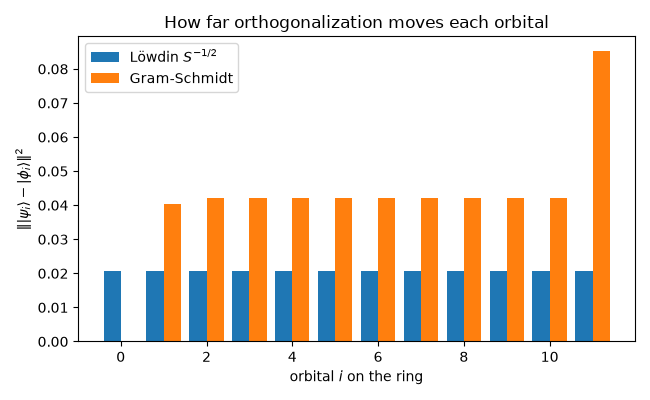
Lowdin        total 0.2497, per orbital [0.0208 0.0208 0.0208 0.0208]
Gram-Schmidt  total 0.5053, per orbital [0.     0.0404 0.0422 0.0853]
Total running time of the script: (0 minutes 0.160 seconds)