

Note
Go to the end to download the full example code.
Disentanglement: Wannier Functions of the π Bands of Graphene#
Maximal localization needs an isolated group of bands. Most bands of interest are not isolated: in graphene with its four valence orbitals \(s, p_x, p_y, p_z\) per carbon, the π bands cross the σ bands, so no set of band indices follows the π bands over the whole Brillouin zone.
I. Souza, N. Marzari and D. Vanderbilt (2001) separated the two steps. At each k, the states of an outer energy window span more than the \(n_W\) Wannier functions need. Among their \(n_W\)-dimensional subspaces, choose the one that varies least from k to k, the one that minimizes the gauge-invariant spread
then localize within it as for an isolated group. The states of an inner frozen window are kept as they are, so the Wannier functions reproduce the bands there exactly.
tbkit.wannier.wannierize() disentangles when it gets more bands than
trial orbitals (here all eight, with two \(p_z\) trial orbitals).
kspace() then returns the
Hamiltonian in the Wannier basis as a two-orbital
KSpace: Wannier interpolation of the π bands.
import numpy as np
import matplotlib.pyplot as plt

import tbkit.lattices as lattices
from tbkit.kspace import high_symmetry_path
from tbkit.lattice import Lattice
from tbkit.plot import Plot
from tbkit.slater_koster import sk_kspace
from tbkit.system import System
from tbkit.wannier import wannierize

# eV; energies relative to the 2p level (Saito, Dresselhaus and Dresselhaus)
orbitals = {'a': ['s', 'px', 'py', 'pz'], 'b': ['s', 'px', 'py', 'pz']}
onsite = {'a': {'s': -8.87}, 'b': {'s': -8.87}}
hopping = {'ss_sigma': -6.77, 'sp_sigma': 5.58, 'pp_sigma': 5.04, 'pp_pi': -3.03}


def graphene(buckling):
    '''sp3 graphene, with sublattice b raised by *buckling* out of the plane.'''
    honeycomb = lattices.honeycomb()
    a, b = (tuple(site['r0']) for site in honeycomb.unit_cell)
    lat = Lattice(unit_cell=[{'tag': 'a', 'r0': a + (0.,)}, {'tag': 'b', 'r0': b + (buckling,)}],
                       prim_vec=[tuple(p) + (0.,) for p in honeycomb.prim_vec])
    return sk_kspace(lat, orbitals, {1: hopping}, onsite=onsite)


flat = graphene(0.)
pz = [n for n, (_, o) in enumerate(flat.sk_orbitals) if o == 'pz']
points, labels = high_symmetry_path(flat.lat)
The lattice#
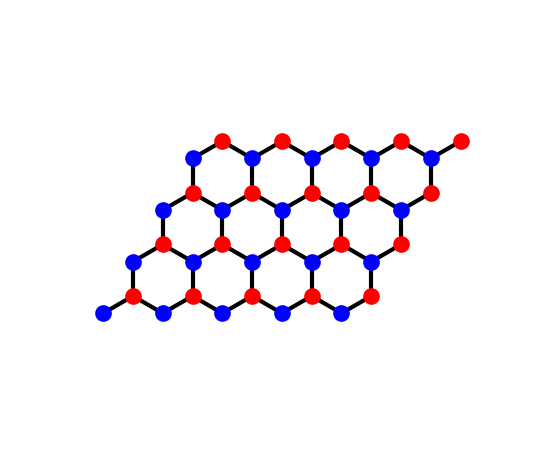
Graphene’s honeycomb lattice, sublattices a and b in two colours,
each atom carrying the four orbitals \(s, p_x, p_y, p_z\) and bonded
to its three nearest neighbours by the Slater-Koster integrals above.
Buckling raises sublattice b out of the plane, along the axis
perpendicular to this view.
patch = lattices.honeycomb()
patch.get_lattice(n1=5, n2=4)
vis = System(patch)
vis.set_hopping([{'n': 1, 't': 1.}])
fig_lat = Plot(vis).lattice(plt_hop=True, ms=12, figsize=(5.5, 4.5))
Flat graphene: the π bands cross the σ bands#
The π band starts 9 eV below the Dirac point at Γ, under the top of the σ bands at -3 eV, and crosses them on its way up to K. Sorted by energy, band 3 is σ near Γ and π near K.
dist, en = flat.k_path(points, 40)
kpath, nodes = flat.ks.copy(), flat.nodes
# the pi bands alone: the pz block of H(k), which flat graphene decouples
pi_bands = np.linalg.eigvalsh(np.array([flat.get_ham(k)[np.ix_(pz, pz)] for k in kpath]))
print('pi band at Gamma: {:.2f} eV, top of the sigma bands: {:.2f} eV'.format(pi_bands[0, 0], en[0, 2]))
assert pi_bands[0, 0] < en[0, 2] - 6.
pi band at Gamma: -9.09 eV, top of the sigma bands: -3.02 eV
The isolated-group recipe fails: band 3 meets the σ band below it on the
mesh, so wannierize() refuses it. Given all eight
bands, the two \(p_z\) trial orbitals, and a frozen window of
\(\pm 2\) eV around the Dirac point (where only π states live), it
disentangles them. In flat graphene, \(p_z\) is odd under the mirror
\(z\to -z\) and the σ orbitals are even, so the smoothest subspace is
exactly the \(p_z\) one: \(\Omega_I = 0\) (point orbitals), the
Wannier functions are the \(p_z\) orbitals, and their model is
Wallace’s, with the single hopping \(V_{pp\pi}\), exact everywhere.
try:
    wannierize(flat, [3, 4], pz, nk=12)
    raise AssertionError('the pi bands are not isolated')
except ValueError as err:
    print('isolated group:', str(err).strip().split(':')[0])

wf = wannierize(flat, list(range(8)), pz, nk=12, frozen=(-2., 2.))
weight = np.abs(wf.functions.reshape(2, -1, flat.norb)) ** 2
print('Omega_I = {:.1e}, weight on pz = {}'.format(wf.omega_i, np.sum(weight[:, :, pz], axis=(1, 2))))
assert abs(wf.omega_i) < 1e-10 and np.allclose(np.sum(weight[:, :, pz], axis=(1, 2)), 1.)
wallace = wf.kspace()
t = np.array([h[3] for h in wallace._hop])
print('Wannier model: |t| = {} (the three bonds and their conjugates)'.format(np.round(np.abs(t), 6)))
assert np.allclose(np.abs(t), 3.03) and np.allclose(wallace.onsite, 0.)
assert np.allclose(wallace.k_path(points, 40)[1], pi_bands, atol=1e-10)
isolated group: The bands [3, 4] touch band 2 on the k-mesh
Omega_I = 7.1e-15, weight on pz = [1. 1.]
Wannier model: |t| = [3.03 3.03 3.03 3.03 3.03 3.03] (the three bonds and their conjugates)
Buckled graphene: the π and σ states mix#
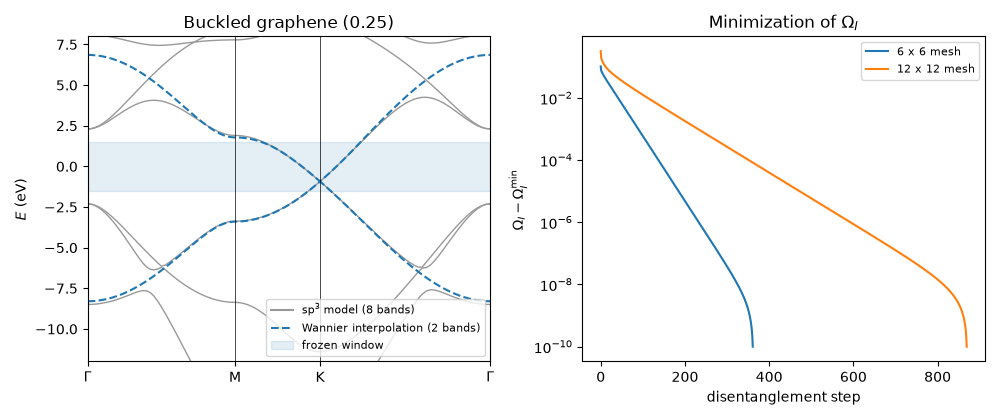
Raising sublattice b by 0.25 out of the plane (as in silicene)
breaks the mirror: the \(p_z\) orbitals now hybridize with the σ
ones, and the π-like subspace is no longer a set of orbitals. The
iteration lowers \(\Omega_I\) from its projected value at every
step. The frozen bands are reproduced exactly on the k-mesh, and
between its points the interpolation converges as the mesh is refined
(the error is largest at the top of the frozen window, where states
leave it).
buckled = graphene(0.25)
_, en_b = buckled.k_path(points, 40)
window = (-1.5, 1.5)
inside = (en_b > window[0]) & (en_b < window[1])
results = {}
for nk in (6, 12):
    wf_b = wannierize(buckled, list(range(8)), pz, nk=nk, frozen=window)
    wk = wf_b.kspace()
    _, mesh = buckled.mesh_grid(nk)
    e_mesh, e_wann = buckled._eigs(mesh), wk._eigs(mesh)
    frozen_mesh = (e_mesh >= window[0]) & (e_mesh <= window[1])
    err_mesh = max(np.abs(e_wann[k][:, None] - e_mesh[k][frozen_mesh[k]][None]).min(axis=0).max()
                          for k in range(len(mesh)) if frozen_mesh[k].any())
    e_path = wk.k_path(points, 40)[1]
    err_path = max(np.abs(e_path[k][:, None] - en_b[k][inside[k]][None]).min(axis=0).max()
                          for k in range(len(kpath)) if inside[k].any())
    results[nk] = wf_b, e_path, err_path
    print('nk = {:2d}: Omega_I {:.4f} -> {:.4f} in {} steps; frozen bands on the mesh to {:.0e}, '
           'on the path to {:.3f} eV'.format(nk, wf_b.dis_history[0], wf_b.omega_i,
                                                   len(wf_b.dis_history) - 1, err_mesh, err_path))
    assert wf_b.dis_converged and np.all(np.diff(wf_b.dis_history) <= 1e-12)
    assert wf_b.omega_i < wf_b.dis_history[0] / 2
    assert err_mesh < 1e-10
assert results[12][2] < 0.05 and results[12][2] < results[6][2] / 4
nk =  6: Omega_I 0.1279 -> 0.0250 in 362 steps; frozen bands on the mesh to 4e-15, on the path to 0.232 eV
nk = 12: Omega_I 0.3809 -> 0.0591 in 870 steps; frozen bands on the mesh to 4e-15, on the path to 0.036 eV
Plots: the buckled bands (grey) with the Wannier-interpolated π bands from the 12 x 12 mesh, and the descent of \(\Omega_I\).
wf_b, e_path, _ = results[12]
fig, (ax1, ax2) = plt.subplots(1, 2, figsize=(10, 4.2))
ax1.plot(dist, en_b, color='0.6', lw=1)
ax1.plot(dist, e_path, '--', color='C0', lw=1.5)
ax1.plot([], [], color='0.6', label='sp$^3$ model (8 bands)')
ax1.plot([], [], '--', color='C0', label='Wannier interpolation (2 bands)')
ax1.axhspan(*window, color='C0', alpha=0.12, label='frozen window')
for x in nodes:
    ax1.axvline(x, color='k', lw=0.5)
ax1.set_xticks(nodes)
ax1.set_xticklabels(labels)
ax1.set_xlim(dist[0], dist[-1])
ax1.set_ylim(-12, 8)
ax1.set_ylabel('$E$ (eV)')
ax1.set_title('Buckled graphene (0.25)')
ax1.legend(fontsize=8, loc='lower right')
for nk, (w, _, _) in results.items():
    ax2.semilogy(w.dis_history[:-1] - w.omega_i, label='{0} x {0} mesh'.format(nk))
ax2.set_xlabel('disentanglement step')
ax2.set_ylabel(r'$\Omega_I - \Omega_I^{\min}$')
ax2.set_title(r'Minimization of $\Omega_I$')
ax2.legend(fontsize=8)
fig.set_layout_engine('tight')
plt.show()
Total running time of the script: (0 minutes 1.225 seconds)