Non-Hermitian lattices#
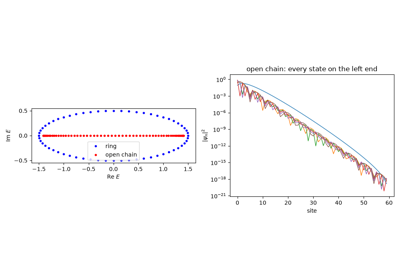
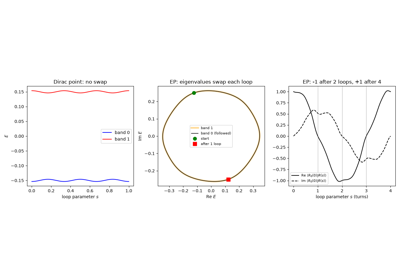
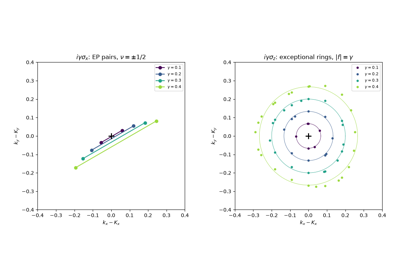
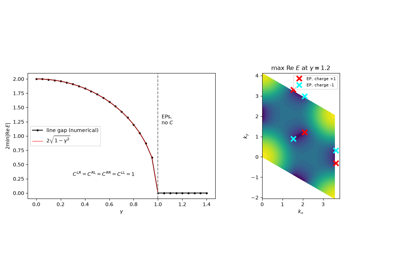
Lattices with balanced gain and loss: PT-symmetric spectra that stay real up to a threshold, the exceptional points at which eigenvalues and eigenvectors coalesce, the Petermann factor that measures how far the eigenbasis has been skewed, and the selective amplification of a topological edge mode. With non-reciprocal hoppings: the non-Hermitian skin effect, its spectral winding number, and the generalized Brillouin zone that restores the bulk-boundary correspondence. In two dimensions: exceptional points in momentum space, their charges (eigenvalue vorticity and discriminant winding), the pair of EPs and the bulk Fermi arc into which a Dirac point splits, exceptional rings, encircling an EP (the state swap and the four-loop return), and the biorthogonal Chern number of a line-gapped band.
Exceptional Points in Momentum Space: Encircling an EP versus a Dirac Point
Exceptional Points in Momentum Space: Vorticity and Exceptional Rings
Exceptional Points in Momentum Space: the Chern Number until the Line Gap Closes
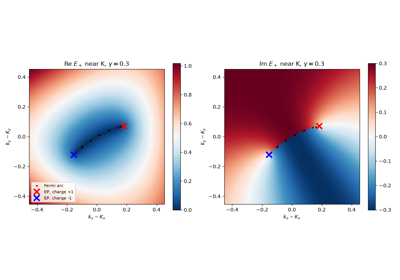
Exceptional Points in Momentum Space: Complex Bands and the Bulk Fermi Arc
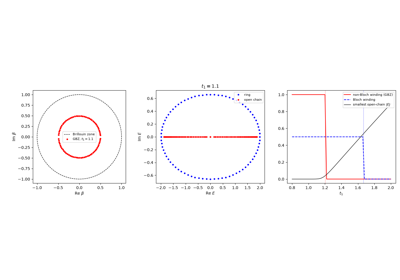
The Generalized Brillouin Zone and Non-Bloch Band Theory
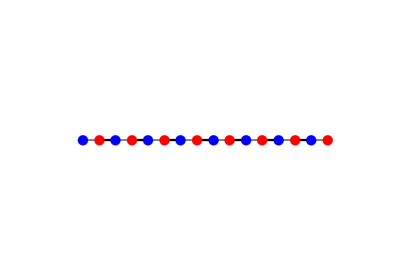
PT Symmetry, Exceptional Points, and a Selectively Amplified Edge Mode