

Note
Go to the end to download the full example code.
Exceptional Points in Momentum Space: the Chern Number until the Line Gap Closes#
A non-Hermitian band has two eigenvectors, a right one \(H|R\rangle = E|R\rangle\) and a left one \(H^\dagger|L\rangle = E^*|L\rangle\), so there are four Berry connections \(i\langle u^\alpha|\nabla u^\beta\rangle\), \(\alpha,\beta\in\{L,R\}\). Shen, Zhen and Fu (Phys. Rev. Lett. 120, 146402 (2018)) showed that their Chern numbers \(C^{LR}, C^{RL}, C^{RR}, C^{LL}\) are one and the same integer, as long as the band stays separated from the others – here by a line gap, a line \(\mathrm{Re}\,E = 0\) that no band crosses. The gap can close only at exceptional points; until then the Chern number cannot change.
Here the Haldane model (\(t_2 = 0.2\), \(\phi = \pi/2\), \(M = 0\), Chern number 1) is given balanced gain and loss \(\pm i\gamma\) on its two sublattices:
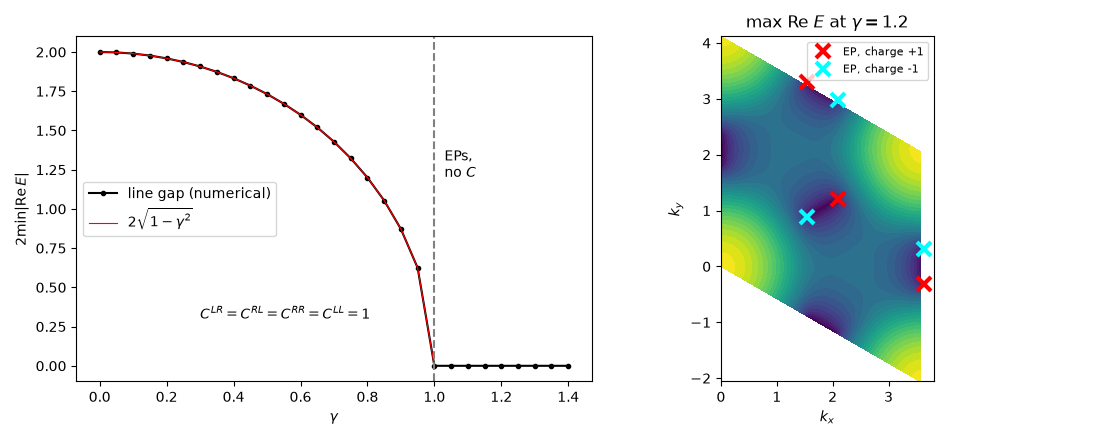
An eigenvalue reaches \(\mathrm{Re}\,E = 0\) only where \(E^2\) is real and negative: \(d_z = 0\) and \(|f| < \gamma\). On the lines \(d_z = 0\) the smallest \(|f|\) is 1 (at the M points), so the real line gap closes at \(\gamma_c = t = 1\), at three pairs of exceptional points born at M.
biorthogonal_chern_number() computes the four
Chern numbers; chern_number() (right
eigenvectors only) agrees with them while the line gap is open, and past it
both refuse to return a number, since the band ordering by real part is no
longer continuous.
import numpy as np
import matplotlib.pyplot as plt

import tbkit.lattices as lattices
from tbkit.bridges import finite_system
from tbkit.kspace import KSpace
from tbkit.plot import Plot
import tbkit.exceptional as ex

KINDS = ('LR', 'RL', 'RR', 'LL')


def haldane(gamma, t2=0.2):
    hal = KSpace(lattices.honeycomb())
    hal.set_hopping([{'i': 0, 'j': 1, 'R': (0, 0), 't': 1.}, {'i': 0, 'j': 1, 'R': (-1, 0), 't': 1.},
                     {'i': 0, 'j': 1, 'R': (0, -1), 't': 1.}])
    nnn = [(0, 1), (-1, 0), (1, -1)]
    hal.set_hopping([{'i': 0, 'j': 0, 'R': R, 't': 1j * t2} for R in nnn]
                    + [{'i': 1, 'j': 1, 'R': R, 't': -1j * t2} for R in nnn])
    hal.set_onsite({'a': 1j * gamma, 'b': -1j * gamma})
    return hal


b1, b2 = (np.array(b) for b in haldane(0.).rec_vec_k)
M_points = [b1 / 2, b2 / 2, (b1 + b2) / 2]
The lattice#
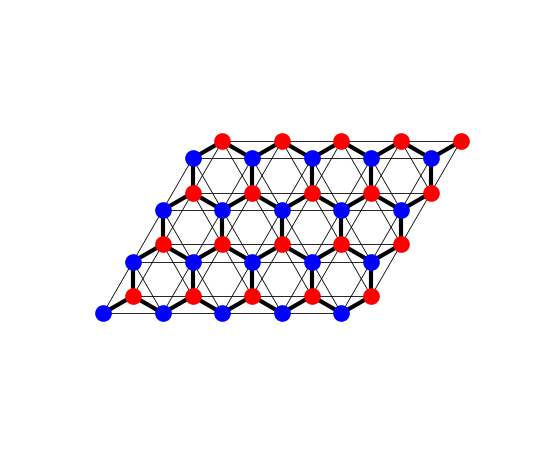
The Haldane model on a patch of \(5\times4\) cells
(finite_system()), bond widths proportional to the
amplitudes: the honeycomb lattice’s two sublattices (‘a’ and ‘b’, in two
colours), the nearest-neighbour hopping (thick) and the complex
second-neighbour hoppings \(\pm it_2\) (thin). The gain and loss
\(\pm i\gamma\) on the two sublattices are onsite terms, not drawn.
fig_lat = Plot(finite_system(haldane(0.), (5, 4))).lattice(plt_hop=True, ms=12, figsize=(5.5, 4.5))
Where the line gap closes#
The real line gap is \(2\min_{\mathbf{k}}|\mathrm{Re}\,E|\). At an M point \(d_z = 0\) and \(|f| = 1\), so \(E = \pm\sqrt{1 - \gamma^2}\) there: the gap closes exactly at \(\gamma = 1\).
hal0 = haldane(0.)
for M in M_points:
    h = hal0.get_ham(M)
    assert abs(h[0, 0] - h[1, 1]) < 1e-12 and np.isclose(abs(h[0, 1]), 1.)
_, ks = hal0.mesh_grid(60)


def line_gap(gamma):
    m = haldane(gamma)
    en = [np.linalg.eigvals(m.get_ham(k)) for k in list(ks) + M_points]
    return 2 * np.min(np.abs(np.real(en)))


gammas = np.linspace(0., 1.4, 29)
gaps = np.array([line_gap(g) for g in gammas])
for g in (0.5, 0.9, 0.99):
    assert np.isclose(line_gap(g), 2 * np.sqrt(1 - g ** 2), rtol=1e-8)
assert line_gap(1.05) < 1e-12
Four Chern numbers, one integer#
print('gamma   C_LR    C_RL    C_RR    C_LL    chern_number')
for gamma in (0., 0.3, 0.6, 0.9):
    m = haldane(gamma)
    chern = [m.biorthogonal_chern_number(0, 24, kind=kind) for kind in KINDS]
    c_right = m.chern_number(0, 24)
    print('{:.1f}  '.format(gamma) + '  '.join('{:+.4f}'.format(c) for c in chern + [c_right]))
    assert np.allclose(chern, 1., atol=1e-8)
    assert np.isclose(c_right, 1., atol=1e-8)
    assert len(ex.find_exceptional_points(m, nk=30).k) == 0
gamma   C_LR    C_RL    C_RR    C_LL    chern_number
0.0  +1.0000  +1.0000  +1.0000  +1.0000  +1.0000
0.3  +1.0000  +1.0000  +1.0000  +1.0000  +1.0000
0.6  +1.0000  +1.0000  +1.0000  +1.0000  +1.0000
0.9  +1.0000  +1.0000  +1.0000  +1.0000  +1.0000
Past gamma_c: exceptional points, and no Chern number#
At \(\gamma = 1.2\) the finder reports three pairs of EPs of opposite charge around the three M points, and neither Chern number is defined any more: both methods raise a ValueError instead of returning a number.
beyond = haldane(1.2)
eps = ex.find_exceptional_points(beyond, nk=40)
print('gamma = 1.2: {} EPs, charges {}, orders {}'
      .format(len(eps.k), eps.charge.tolist(), eps.order.tolist()))
assert len(eps.k) == 6 and eps.total_charge == 0 and np.all(eps.order == 2)
nearest = []
for k in eps.k:
    h = hal0.get_ham(k)  # the Hermitian part: d_z and f
    dist = [min(np.linalg.norm(k - M - m * b1 - n * b2) for m in (-1, 0, 1) for n in (-1, 0, 1))
            for M in M_points]
    nearest.append(int(np.argmin(dist)))
    print('  EP at ({:+.4f}, {:+.4f}): d_z = {:.1e}, |f| = {:.10f}, {:.4f} from M{}'
          .format(*k, abs(h[0, 0] - h[1, 1]) / 2, abs(h[0, 1]), min(dist), nearest[-1] + 1))
    assert abs(h[0, 0] - h[1, 1]) < 1e-8 and abs(abs(h[0, 1]) - 1.2) < 1e-8
assert sorted(nearest) == [0, 0, 1, 1, 2, 2]  # one pair around each M point
for method in (beyond.chern_number, beyond.biorthogonal_chern_number):
    try:
        method(0, 24)
    except ValueError:
        pass
    else:
        raise AssertionError('the Chern number should not be defined past gamma_c')
print('gamma = 1.2: chern_number and biorthogonal_chern_number raise ValueError (no line gap).')
gamma = 1.2: 6 EPs, charges [-1, 1, 1, -1, 1, -1], orders [2, 2, 2, 2, 2, 2]
  EP at (+1.5405, +0.8894): d_z = 5.7e-16, |f| = 1.2000000000, 0.3156 from M3
  EP at (+1.5405, +3.2994): d_z = 5.6e-17, |f| = 1.2000000000, 0.3156 from M1
  EP at (+2.0871, +1.2050): d_z = 9.8e-16, |f| = 1.2000000000, 0.3156 from M3
  EP at (+2.0871, +2.9838): d_z = 1.9e-16, |f| = 1.2000000000, 0.3156 from M1
  EP at (+3.6276, -0.3156): d_z = 5.0e-16, |f| = 1.2000000000, 0.3156 from M2
  EP at (+3.6276, +0.3156): d_z = 5.0e-16, |f| = 1.2000000000, 0.3156 from M2
gamma = 1.2: chern_number and biorthogonal_chern_number raise ValueError (no line gap).
Line gap and exceptional points#
fig, axes = plt.subplots(1, 2, figsize=(11, 4.4))
axes[0].plot(gammas, gaps, 'k.-', label='line gap (numerical)')
axes[0].plot(gammas[gammas <= 1], 2 * np.sqrt(1 - gammas[gammas <= 1] ** 2), 'r-', lw=0.8,
             label=r'$2\sqrt{1-\gamma^2}$')
axes[0].axvline(1., color='gray', ls='--')
axes[0].text(0.3, 0.3, '$C^{LR} = C^{RL} = C^{RR} = C^{LL} = 1$')
axes[0].text(1.03, 1.2, 'EPs,\nno $C$')
axes[0].set_xlabel(r'$\gamma$')
axes[0].set_ylabel(r'$2\min|\mathrm{Re}\,E|$')
axes[0].legend()

en_re = np.array([np.max(np.linalg.eigvals(beyond.get_ham(k)).real) for k in ks])
axes[1].tricontourf(ks[:, 0], ks[:, 1], en_re, 30, cmap='viridis')
for q, color in ((1, 'red'), (-1, 'cyan')):
    pts = eps.k[eps.charge == q]
    axes[1].plot(pts[:, 0], pts[:, 1], 'x', color=color, ms=10, mew=3,
                 label='EP, charge {:+d}'.format(q))
axes[1].set_aspect('equal')
axes[1].set_xlabel('$k_x$')
axes[1].set_ylabel('$k_y$')
axes[1].set_title(r'max Re $E$ at $\gamma = 1.2$')
axes[1].legend(fontsize=8)
fig.tight_layout()
Total running time of the script: (0 minutes 2.923 seconds)