

Note
Go to the end to download the full example code.
The Bulk Photovoltaic Effect: the Shift Current of Gapped Graphene#
A crystal without an inversion centre can turn light into a DC current with no junction: the bulk photovoltaic effect, seen in ferroelectrics since the 1970s (Glass, von der Linde and Negran 1974). Baltz and Kraut (1981), then Sipe and Shkrebtii (2000), traced its main part to a purely quantum-geometric mechanism: when light excites an electron from band \(n\) to band \(m\), the electron’s centre of charge moves by the shift vector
(\(\phi^b_{nm}\) the phase of the interband position \(r^b_{nm}\), \(A\) the Berry connections), and the steady rate of such shifts is a current,
shift_current() evaluates it with the gauge-covariant
derivatives of generalized_derivative() (a sum over
states, with the exact second derivatives of \(H\)). Graphene with a
staggered potential \(\pm m\) (hexagonal boron nitride’s model) has
lost its inversion centre, and has the \(C_{3v}\) symmetry that leaves
one independent component, \(\sigma^{yyy} = -\sigma^{yxx} = -\sigma^{xxy}\),
with \(\sigma^{xxx} = 0\) (mirror \(x\to-x\)).
import numpy as np
import matplotlib.pyplot as plt

import tbkit.lattices as lattices
from tbkit.bridges import finite_system
from tbkit.kspace import KSpace
from tbkit.optics import shift_current, optical_conductivity
from tbkit.plot import Plot


def gapped_graphene(m):
    ks = KSpace(lattices.honeycomb())
    ks.set_hopping([{'i': 0, 'j': 1, 'R': R, 't': -1.} for R in [(0, 0), (-1, 0), (0, -1)]])
    ks.set_onsite({'a': m, 'b': -m})
    return ks


m = 0.5
hbn = gapped_graphene(m)
omega = np.linspace(0.5, 7., 131)
The lattice#
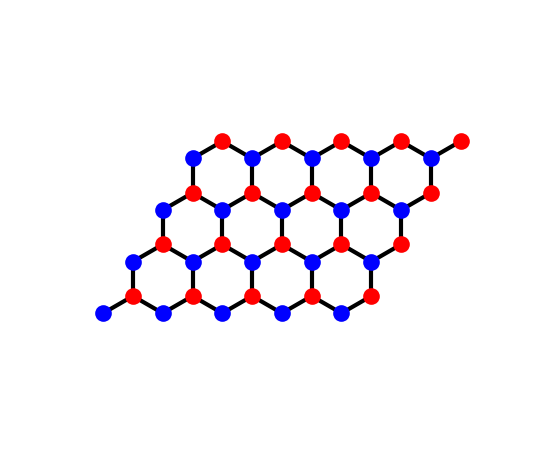
Gapped graphene on a patch of \(5\times4\) cells
(finite_system()): the honeycomb lattice with its
nearest-neighbour bonds, and the onsite energies \(+m\) on sublattice
‘a’ and \(-m\) on ‘b’ (two colours), which break inversion symmetry
as in hexagonal boron nitride.
fig_lat = Plot(finite_system(hbn, (5, 4))).lattice(plt_hop=True, ms=12, figsize=(5.5, 4.5))
One independent component, and an absorption edge at the gap#
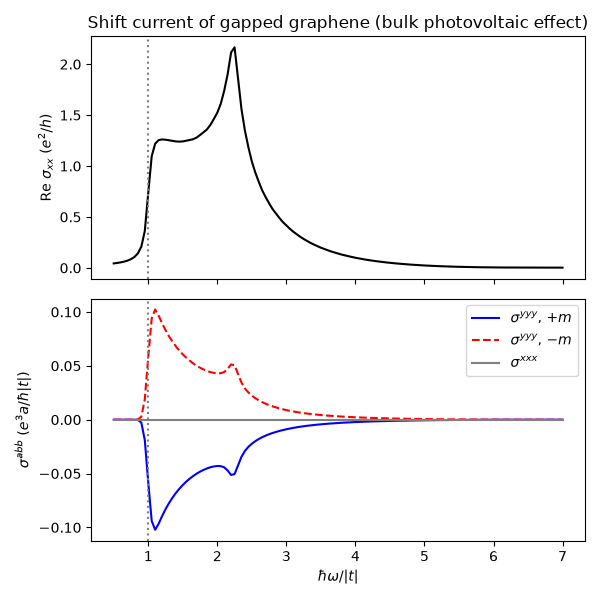
Nothing flows below the gap \(2m\): the current needs real transitions.
sigma = {c: shift_current(hbn, omega, eta=0.05, nk=150, component=c)
             for c in ('yyy', 'yxx', 'xxy', 'xxx')}
assert np.abs(sigma['yyy']).max() > 1e-2
assert np.allclose(sigma['yxx'], -sigma['yyy'], atol=1e-8)
assert np.allclose(sigma['xxy'], -sigma['yyy'], atol=1e-8)
assert np.allclose(sigma['xxx'], 0., atol=1e-10)
below = omega < 2 * m - 0.25
assert np.abs(sigma['yyy'][below]).max() < 1e-8
absorption = optical_conductivity(hbn, omega, eta=0.05, nk=150).real
assert absorption[below].max() < 0.05 * absorption.max()
print('max |sigma^yyy| = {:.4f} at hbar omega = {:.2f}'.format(
    np.abs(sigma['yyy']).max(), omega[np.argmax(np.abs(sigma['yyy']))]))
max |sigma^yyy| = 0.1022 at hbar omega = 1.10
The current follows the broken inversion#
Swapping the two sublattice potentials (\(m\to-m\)) is the image of the crystal under inversion: the current reverses. Without the staggered potential graphene is centrosymmetric, and there is no shift current at all.
flipped = shift_current(gapped_graphene(-m), omega, eta=0.05, nk=150, component='yyy')
assert np.allclose(flipped, -sigma['yyy'], atol=1e-8)
centrosymmetric = shift_current(gapped_graphene(0.), omega, eta=0.05, nk=60, component='yyy')
assert np.abs(centrosymmetric).max() < 1e-10

fig, axes = plt.subplots(2, 1, figsize=(6, 6), sharex=True)
axes[0].plot(omega, absorption, '-k')
axes[0].set_ylabel(r'Re $\sigma_{xx}$ ($e^2/h$)')
axes[0].axvline(2 * m, color='gray', ls=':')
axes[1].plot(omega, sigma['yyy'], '-b', label=r'$\sigma^{yyy}$, $+m$')
axes[1].plot(omega, flipped, '--r', label=r'$\sigma^{yyy}$, $-m$')
axes[1].plot(omega, sigma['xxx'], '-', color='gray', label=r'$\sigma^{xxx}$')
axes[1].axvline(2 * m, color='gray', ls=':')
axes[1].set_xlabel(r'$\hbar\omega / |t|$')
axes[1].set_ylabel(r'$\sigma^{abb}$ ($e^3a/\hbar|t|$)')
axes[1].legend()
axes[0].set_title('Shift current of gapped graphene (bulk photovoltaic effect)')
fig.set_layout_engine('tight')
Total running time of the script: (0 minutes 0.374 seconds)