
Note
Go to the end to download the full example code.
The 38-Fold Way: Symmetry Classes of Non-Hermitian Bands#
The tenfold way (topology/plot_tenfold_way.py) sorts Hermitian
Hamiltonians by time reversal, particle-hole and chiral symmetry. For a
non-Hermitian Hamiltonian, complex conjugation and transposition are no
longer the same operation, \(H^* \neq H^T\), so each of these
symmetries splits in two. Time reversal \(U_TH^*(\mathbf{k})U_T^\dagger
= H(-\mathbf{k})\) gets a partner \(\mathrm{TRS}^\dagger\),
\(U_{C_+}H^T(\mathbf{k})U_{C_+}^\dagger = H(-\mathbf{k})\), which is
reciprocity. Particle-hole symmetry gets a partner
\(\mathrm{PHS}^\dagger\), and the chiral symmetry
\(U_\Gamma H^\dagger U_\Gamma^\dagger = -H\) becomes distinct from the
sublattice symmetry \(U_SHU_S^\dagger = -H\) and from
pseudo-Hermiticity \(U_\eta H^\dagger U_\eta^\dagger = H\).
Kawabata, Shiozaki, Ueda and Sato (2019), and Zhou and Lee (2019), counted the classes these symmetries generate: 38, not 10. Several pairs of symmetry sets are equivalent, because multiplying \(H\) by \(i\) turns time reversal into \(\mathrm{PHS}^\dagger\). For each class and gap type (a point gap, \(E \neq E_P\) for every \(\mathbf{k}\), or a real or imaginary line gap), they then gave the topological invariant in every dimension.
non_hermitian_class() checks each operator with
symmetry_error() and names the class.
import itertools

import numpy as np
import matplotlib.pyplot as plt

import tbkit.lattices as lattices
from tbkit.lattice import Lattice
from tbkit.kspace import KSpace, PAULI

I1, I2, SZ = np.eye(1), np.eye(2), PAULI['z']


def chain(t_right, t_left, onsite=0.):
    model = KSpace(lattices.chain())
    model.set_hopping([{'i': 0, 'j': 0, 'R': (1,), 't': t_right},
                                {'i': 0, 'j': 0, 'R': (-1,), 't': t_left}], hermitian=False)
    model.onsite[0] = onsite
    return model


def ssh(t1, t2, gamma=0.):
    lat = Lattice(unit_cell=[{'tag': 'a', 'r0': (0., 0.)}, {'tag': 'b', 'r0': (0.5, 0.)}],
                         prim_vec=[(1., 0.)])
    model = KSpace(lat)
    model.set_hopping([{'i': 0, 'j': 1, 'R': (0,), 't': t1 + gamma / 2},
                                {'i': 1, 'j': 0, 'R': (0,), 't': t1 - gamma / 2},
                                {'i': 1, 'j': 0, 'R': (1,), 't': t2},
                                {'i': 0, 'j': 1, 'R': (-1,), 't': t2}], hermitian=False)
    return model
Classifying non-Hermitian chains#
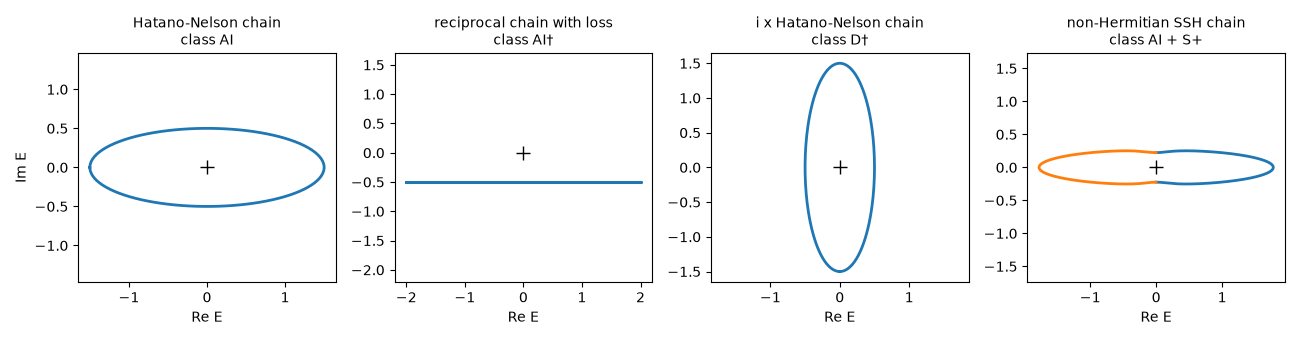
The Hatano-Nelson chain \(H(k) = t_Re^{ik} + t_Le^{-ik}\) has real
hoppings, hence time reversal \(U_T = 1\). Its non-reciprocity
\(t_R \neq t_L\) breaks \(\mathrm{TRS}^\dagger\)
(\(H^T(k) = H(k) \neq H(-k)\)): class AI. A reciprocal chain with
loss, \(H(k) = 2t\cos k - i\gamma\), has \(\mathrm{TRS}^\dagger\)
but not time reversal: class AI†. Multiplying the Hatano-Nelson chain by
\(i\) swaps time reversal for \(\mathrm{PHS}^\dagger\): class D†,
the same class as AI with real and imaginary line gaps exchanged
(canonical=True). The non-Hermitian SSH chain of Yao and Wang adds a
sublattice symmetry \(\sigma_z\) to time reversal, and their product
is a \(\mathrm{PHS}^\dagger\). A Hermitian model has all the
symmetries at once, since \(H^T = H^*\) and \(\eta = 1\), so the
Hermitian SSH chain (BDI) is BDI + S++.
hatano_nelson = chain(1., 0.5)
lossy = chain(1., 1., onsite=-0.5j)
i_hatano_nelson = chain(1j, 0.5j)
nh_ssh = ssh(1., 0.8, gamma=0.6)
herm_ssh = ssh(1., 0.6)

# the broken symmetries: TRS^dagger of Hatano-Nelson, TRS of the lossy chain
assert hatano_nelson.symmetry_error(I1, transpose=True) > 0.1
assert lossy.symmetry_error(I1, antiunitary=True) > 0.1

cases = [
    ('Hatano-Nelson chain', hatano_nelson, dict(time_reversal=I1), 'AI'),
    ('reciprocal chain with loss', lossy, dict(time_reversal_dagger=I1), 'AI†'),
    ('i x Hatano-Nelson chain', i_hatano_nelson, dict(particle_hole_dagger=I1), 'D†'),
    ('non-Hermitian SSH chain', nh_ssh, dict(time_reversal=I2, sublattice=SZ), 'AI + S+'),
    ('Hermitian SSH chain', herm_ssh,
     dict(time_reversal=I2, chiral=SZ, time_reversal_dagger=I2, pseudo_hermiticity=I2), 'BDI + S++'),
]
for name, model, symmetries, expected in cases:
    cls = model.non_hermitian_class(**symmetries)
    print('{:<28s} class {:<10s} (38-fold: {})'.format(
        name, cls, model.non_hermitian_class(**symmetries, canonical=True)))
    assert cls == expected
assert i_hatano_nelson.non_hermitian_class(particle_hole_dagger=I1, canonical=True) == 'AI'
# the tenfold way only sees the Hermitian class
assert herm_ssh.tenfold_class(time_reversal=I2, chiral=SZ) == 'BDI'
Hatano-Nelson chain          class AI         (38-fold: AI)
reciprocal chain with loss   class AI†        (38-fold: AI†)
i x Hatano-Nelson chain      class D†         (38-fold: AI)
non-Hermitian SSH chain      class AI + S+    (38-fold: AI + S+)
Hermitian SSH chain          class BDI + S++  (38-fold: BDI + S++)
The class decides the point-gap topology#
In one dimension a point gap at \(E_P\) carries the spectral winding
number \(W(E_P)\) (see plot_skin_effect.py). The periodic table
of Kawabata et al. allows it, \(\mathbb{Z}\), in classes A and AI.
In class AI† it is trivial, 0: reciprocity forbids the winding, and with
it the skin effect. The Hatano-Nelson ellipse winds once around
\(E = 0\). The lossy chain traces its arc twice, once in each
direction. Twenty random reciprocal chains with four orbitals
(\(H^T(k) = H(-k)\)) never wind around any point, while random
chains without the symmetry do.
rng = np.random.default_rng(0)


def matrix_chain(blocks):
    """The chain with hopping matrices blocks[R] (R = -1, 0, 1) between cells n and n + R."""
    norb = len(blocks[0])
    model = KSpace(Lattice(unit_cell=[{'tag': 'a', 'r0': (0., 0.)}] * norb, prim_vec=[(1., 0.)]))
    hops = []
    for R, block in blocks.items():
        for i, j in itertools.product(range(norb), repeat=2):
            if R == 0 and i == j:
                model.onsite[i] = block[i, i]
            else:
                hops.append({'i': i, 'j': j, 'R': (R,), 't': block[i, j]})
    model.set_hopping(hops, hermitian=False)
    return model


def random_blocks(norb):
    return {R: rng.normal(size=(norb, norb)) + 1j * rng.normal(size=(norb, norb)) for R in (-1, 0, 1)}


e_refs = rng.normal(size=10) + 1j * rng.normal(size=10)
windings_reciprocal, windings_generic = [], []
for _ in range(20):
    blocks = random_blocks(4)
    reciprocal = {R: (blocks[R] + blocks[-R].T) / 2 for R in blocks}  # t(R) = t(-R)^T
    windings_reciprocal.append([matrix_chain(reciprocal).spectral_winding(e) for e in e_refs])
    windings_generic.append([matrix_chain(blocks).spectral_winding(e) for e in e_refs])
assert abs(hatano_nelson.spectral_winding(0.) - 1.) < 1e-10
assert abs(lossy.spectral_winding(-0.5j + 0.1)) < 1e-10
assert np.max(np.abs(windings_reciprocal)) < 1e-8
assert np.max(np.abs(np.round(windings_generic))) >= 1
print('largest |W| of the reciprocal chains: {:.1e}; of the generic chains: {:.0f}'.format(
    np.max(np.abs(windings_reciprocal)), np.max(np.abs(np.round(windings_generic)))))

k = np.linspace(-np.pi, np.pi, 201)
fig, axes = plt.subplots(1, 4, figsize=(13, 3.4))
for ax, (name, model, symmetries, cls) in zip(axes, cases[:4]):
    energies = np.array([np.linalg.eigvals(model.get_ham([kk])) for kk in k])
    for band in energies.T:
        ax.plot(band.real, band.imag, lw=2)
    ax.plot(0, 0, 'k+', ms=10)
    ax.set_title('{}\nclass {}'.format(name, cls), fontsize=10)
    ax.set_xlabel('Re E')
    ax.set_aspect('equal', adjustable='datalim')
axes[0].set_ylabel('Im E')
fig.tight_layout()
largest |W| of the reciprocal chains: 4.2e-16; of the generic chains: 2
Thirty-eight classes#
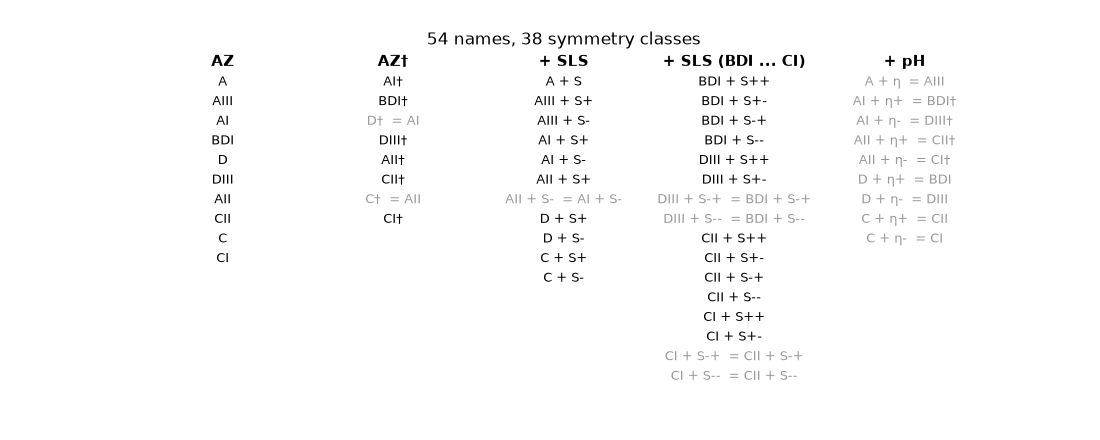
Every class can be realized. Here the operators are random products of Pauli matrices on eight orbitals, and the hoppings of a random chain are averaged over the symmetries they generate (each one maps \(H(k)\) to \(\pm U\,\mathrm{op}[H(\pm k)]\,U^\dagger\)). Random draws reach all 54 names of Kawabata et al.’s tables: 10 AZ classes, 8 AZ† classes, 3 complex and 24 real classes with sublattice symmetry, and 9 with pseudo-Hermiticity. The \(H \to iH\) equivalences fold them into the 38 classes. As a check, every model classified again as \(iH\), with the operators relabelled accordingly, lands in the same class.
KINDS = {'time_reversal': (1, 0, 1), 'particle_hole': (0, 1, -1), 'chiral': (1, 1, -1),
              'time_reversal_dagger': (0, 1, 1), 'particle_hole_dagger': (1, 0, -1),
              'sublattice': (0, 0, -1), 'pseudo_hermiticity': (1, 1, 1)}
I_TIMES = {'time_reversal': 'particle_hole_dagger', 'particle_hole_dagger': 'time_reversal',
                 'chiral': 'pseudo_hermiticity', 'pseudo_hermiticity': 'chiral'}
GENERATORS = [(), ('time_reversal',), ('particle_hole',), ('chiral',), ('time_reversal_dagger',),
                         ('particle_hole_dagger',), ('sublattice',), ('pseudo_hermiticity',),
                         ('time_reversal', 'particle_hole'), ('time_reversal_dagger', 'particle_hole_dagger'),
                         ('time_reversal', 'time_reversal_dagger'), ('particle_hole', 'particle_hole_dagger'),
                         ('time_reversal', 'sublattice'), ('particle_hole', 'sublattice'),
                         ('chiral', 'sublattice'), ('time_reversal', 'particle_hole', 'sublattice')]
paulis = [PAULI[a] for a in '0xyz']
strings = [np.kron(np.kron(a, b), c) for a, b, c in itertools.product(paulis, repeat=3)]


def symmetrize(blocks, symmetries):
    for name, u in symmetries.items():
        conj, transpose, sign = KINDS[name]
        image = {}
        for R in blocks:
            t = blocks[-R if transpose else R]
            t = t.conj() if conj else t
            image[R] = sign * u @ (t.T if transpose else t) @ u.conj().T
        blocks = {R: (blocks[R] + image[R]) / 2 for R in blocks}
    return blocks


names = {}
while len(names) < 54:
    generators = GENERATORS[rng.integers(len(GENERATORS))]
    symmetries = {g: strings[rng.integers(64)] for g in generators}
    blocks = symmetrize(random_blocks(8), symmetries)
    try:  # a product of the operators may be an extra unitary symmetry: draw again
        name = matrix_chain(blocks).non_hermitian_class(**symmetries)
    except ValueError:
        continue
    if name not in names:
        times_i = matrix_chain({R: 1j * b for R, b in blocks.items()})
        relabelled = {I_TIMES.get(g, g): u for g, u in symmetries.items()}
        names[name] = (matrix_chain(blocks).non_hermitian_class(**symmetries, canonical=True),
                              times_i.non_hermitian_class(**relabelled, canonical=True))
assert all(c == c_i for c, c_i in names.values())
classes = sorted({c for c, _ in names.values()})
print('{} names, {} classes'.format(len(names), len(classes)))
assert len(classes) == 38
54 names, 38 classes
The 54 names, grouped into the 38 classes (black: the representative; grey: an equivalent name, with the representative it maps to).
families = [
    ('AZ', ['A', 'AIII', 'AI', 'BDI', 'D', 'DIII', 'AII', 'CII', 'C', 'CI']),
    ('AZ†', ['AI†', 'BDI†', 'D†', 'DIII†', 'AII†', 'CII†', 'C†', 'CI†']),
    ('+ SLS', ['A + S', 'AIII + S+', 'AIII + S-', 'AI + S+', 'AI + S-', 'AII + S+', 'AII + S-',
                  'D + S+', 'D + S-', 'C + S+', 'C + S-']),
    ('+ SLS (BDI ... CI)', [cls + ' + S' + s for cls in ('BDI', 'DIII', 'CII', 'CI')
                                    for s in ('++', '+-', '-+', '--')]),
    ('+ pH', ['A + η', 'AI + η+', 'AI + η-', 'AII + η+', 'AII + η-', 'D + η+', 'D + η-',
                 'C + η+', 'C + η-']),
]
assert sorted(n for _, family in families for n in family) == sorted(names)
fig, ax = plt.subplots(figsize=(11, 4.4))
for col, (title, family) in enumerate(families):
    ax.text(col, 0, title, ha='center', fontsize=11, weight='bold')
    for row, name in enumerate(family, start=1):
        canonical = names[name][0]
        label = name if canonical == name else '{}  = {}'.format(name, canonical)
        ax.text(col, -0.6 * row, label, ha='center', fontsize=9.5,
                    color='k' if canonical == name else '0.6')
ax.set_xlim(-0.5, len(families) - 0.5)
ax.set_ylim(-0.6 * 16.6, 0.4)
ax.set_title('{} names, {} symmetry classes'.format(len(names), len(classes)))
ax.axis('off')
plt.show()
Total running time of the script: (0 minutes 32.418 seconds)