
Note
Go to the end to download the full example code.
Chern Numbers from Rotation Eigenvalues#
C. Fang, M. J. Gilbert and B. A. Bernevig (2012) showed that in a crystal with an n-fold rotation \(C_n\) the Chern number of the occupied bands is fixed modulo \(n\) by their rotation eigenvalues at a few points, without any integral of the Berry curvature:
over one point \(\mathbf{k}_*\) of each orbit of rotation-invariant momenta, with the power \(C_n^s\) that keeps it: for \(C_4\) the \(C_4\) eigenvalues at \(\Gamma\) and M and the \(C_2\) eigenvalue at X, \(i^C = \xi(\Gamma)\,\xi(\mathrm{M})\,\zeta(\mathrm{X})\); for \(C_3\), the eigenvalues at \(\Gamma\), K and K’.
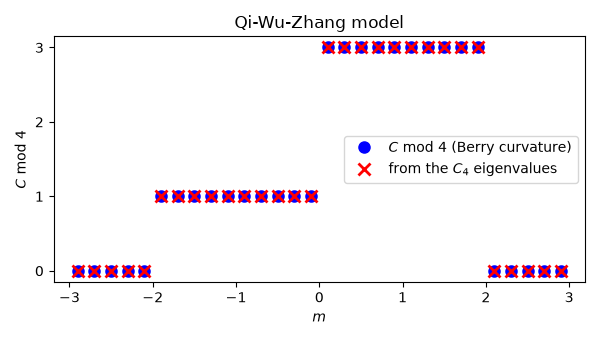
rotation_indicator() computes it. It is compared
with chern_number() (an integral over a
\(30\times30\) mesh) across the phase diagrams of the Qi-Wu-Zhang
model (\(C_4\), two orbitals on one site) and of the Haldane model
(\(C_3\), and \(C_6\) without a sublattice mass).
import numpy as np
import matplotlib.pyplot as plt

from tbkit import lattices
from tbkit.kspace import KSpace, PAULI
from tbkit.lattice import Lattice
from tbkit.symmetry import Operation, find_symmetries, rotation, rotation_indicator


def qwz(m):
    r'''H = sin kx sigma_x + sin ky sigma_y + (m + cos kx + cos ky) sigma_z.'''
    lat = Lattice(unit_cell=[{'tag': 'a', 'r0': (0., 0.)}, {'tag': 'b', 'r0': (0., 0.)}],
                         prim_vec=[(1., 0.), (0., 1.)])
    ks = KSpace(lat)
    hops = []
    for R, s in (((1, 0), PAULI['x']), ((0, 1), PAULI['y'])):
        t = s / 2j + PAULI['z'] / 2
        hops += [{'i': i, 'j': j, 'R': R, 't': t[i, j]} for i in range(2) for j in range(2) if t[i, j] != 0]
    ks.set_hopping(hops)
    ks.set_onsite({'a': m, 'b': -m})
    return ks


def haldane(t2, mass):
    ks = KSpace(lattices.honeycomb())
    ks.set_hopping([{'i': 0, 'j': 1, 'R': R, 't': 1.} for R in [(0, 0), (-1, 0), (0, -1)]])
    for R in [(0, 1), (-1, 0), (1, -1)]:
        ks.set_hopping([{'i': 0, 'j': 0, 'R': R, 't': 1j * t2}, {'i': 1, 'j': 1, 'R': R, 't': -1j * t2}])
    ks.set_onsite({'a': mass, 'b': -mass})
    return ks
The rotation of the Qi-Wu-Zhang model#
\(C_4\) sends \((\sigma_x, \sigma_y)\) to \((\sigma_y, -\sigma_x)\):
it acts on the two orbitals as diag(1, i), with \(C_4^4 = 1\).
C4 = Operation(rotation(np.pi / 2), orbitals=np.diag([1., 1j]))
assert qwz(-1.).symmetry_error(C4) < 1e-12

masses = np.linspace(-2.9, 2.9, 30)  # gapped: avoids m = 0, +-2
c_qwz = [qwz(m).chern_number(0) for m in masses]
c4_qwz = [rotation_indicator(qwz(m), C4, [0]) for m in masses]
c2_qwz = [rotation_indicator(qwz(m), C4 ** 2, [0]) for m in masses]
for c, c4, c2 in zip(c_qwz, c4_qwz, c2_qwz):
    assert round(c) % 4 == c4 and round(c) % 2 == c2
print('QWZ  C:', [int(round(c)) for c in c_qwz])
print('     C mod 4 from C4 eigenvalues:', c4_qwz)
QWZ  C: [0, 0, 0, 0, 0, 1, 1, 1, 1, 1, 1, 1, 1, 1, 1, -1, -1, -1, -1, -1, -1, -1, -1, -1, -1, 0, 0, 0, 0, 0]
     C mod 4 from C4 eigenvalues: [0, 0, 0, 0, 0, 1, 1, 1, 1, 1, 1, 1, 1, 1, 1, 3, 3, 3, 3, 3, 3, 3, 3, 3, 3, 0, 0, 0, 0, 0]
Haldane model#
\(C_3\) about the centre of a hexagon, found by
find_symmetries(); \(C_6\) as well without a mass.
phases = [(0.2, 0.), (-0.2, 0.), (0.2, 0.5), (0.2, 1.5), (-0.1, 0.2), (0.1, 1.)]
for t2, mass in phases:
    model = haldane(t2, mass)
    ops = {op.name: op for op in find_symmetries(model, antiunitary=False)}
    c = int(round(model.chern_number(0)))
    c3 = rotation_indicator(model, ops['C3'], [0])
    c6 = rotation_indicator(model, ops['C6'], [0]) if 'C6' in ops else None
    print('Haldane t2 = {:5.2f}, M = {:4.2f}: C = {:2d}, C mod 3 = {}, C mod 6 = {}'.format(t2, mass, c, c3, c6))
    assert c3 == c % 3 and (c6 is None or c6 == c % 6)
Haldane t2 =  0.20, M = 0.00: C =  1, C mod 3 = 1, C mod 6 = 1
Haldane t2 = -0.20, M = 0.00: C = -1, C mod 3 = 2, C mod 6 = 5
Haldane t2 =  0.20, M = 0.50: C =  1, C mod 3 = 1, C mod 6 = None
Haldane t2 =  0.20, M = 1.50: C =  0, C mod 3 = 0, C mod 6 = None
Haldane t2 = -0.10, M = 0.20: C = -1, C mod 3 = 2, C mod 6 = None
Haldane t2 =  0.10, M = 1.00: C =  0, C mod 3 = 0, C mod 6 = None
The same Chern numbers, two ways#
fig, ax = plt.subplots(figsize=(6, 3.4))
ax.plot(masses, np.round(c_qwz).astype(int) % 4, 'ob', ms=8, label=r'$C\ \mathrm{mod}\ 4$ (Berry curvature)')
ax.plot(masses, c4_qwz, 'xr', ms=9, mew=2, label=r'from the $C_4$ eigenvalues')
ax.set_xlabel('$m$')
ax.set_ylabel(r'$C\ \mathrm{mod}\ 4$')
ax.set_yticks(range(4))
ax.legend(loc='center right')
ax.set_title('Qi-Wu-Zhang model')
fig.set_layout_engine('tight')
Total running time of the script: (0 minutes 1.648 seconds)