
Note
Go to the end to download the full example code.
Symmetry Indicators: Topology from the Parities at Eight Points#
In 2017 H. C. Po, A. Vishwanath and H. Watanabe, and B. Bradlyn and coauthors (topological quantum chemistry), turned the symmetry eigenvalues of the occupied bands at the high-symmetry momenta into a diagnosis of topology for every space group: a set of bands whose eigenvalues cannot come from any atomic insulator is topological. For a 3D insulator with inversion and time reversal, the indicators of Khalaf, Po, Vishwanath and Watanabe (2018) count the occupied states of parity \(\pm1\) at the eight time-reversal-invariant momenta \(\mathbf{K}\):
\(z_4 \bmod 2\) is the strong \(\mathbb{Z}_2\) index of Fu and Kane and the \(z_{2,i}\) are the weak ones; \(z_4 = 2\) is new: an insulator that every \(\mathbb{Z}_2\) index calls trivial, two copies of a strong topological insulator, with hinge states instead of surface Dirac cones.
inversion_indicators() is checked here against
z2_indices_3d() (Wannier-centre flows, which
need no inversion) on the phases of a cubic Dirac model, and on two
copies of its strong phase, where only \(z_4\) sees the topology.
import numpy as np
import matplotlib.pyplot as plt

from tbkit.kspace import KSpace, PAULI
from tbkit.lattice import Lattice
from tbkit.symmetry import Operation, inversion_indicators

SIGMA = [PAULI['x'], PAULI['y'], PAULI['z']]


def cubic_ti(M, copies=1):
    r'''
    H = m(k) tau_z + sum_i sin k_i tau_x sigma_i, m = M - 2 sum_i (1 - cos k_i),
    an s and a p orbital with spin on a simple cubic lattice, *copies* times.
    '''
    cell = [{'tag': o + str(c), 'r0': (0., 0., 0.)} for c in range(copies) for o in 'sp']
    ks = KSpace(Lattice(unit_cell=cell, prim_vec=[(1., 0., 0.), (0., 1., 0.), (0., 0., 1.)]), spin=True)
    hops = []
    for c in range(copies):
        s, p = 2 * c, 2 * c + 1
        for d in range(3):
            R = tuple(int(x) for x in np.eye(3, dtype=int)[d])
            hops += [{'i': s, 'j': s, 'R': R, 't': PAULI['0']}, {'i': p, 'j': p, 'R': R, 't': -PAULI['0']},
                         {'i': s, 'j': p, 'R': R, 't': -0.5j * SIGMA[d]},
                         {'i': p, 'j': s, 'R': R, 't': -0.5j * SIGMA[d]}]
    ks.set_hopping(hops)
    ks.set_onsite({o + str(c): (1 if o == 's' else -1) * (M - 6) * PAULI['0'] for c in range(copies) for o in 'sp'})
    return ks


def inversion(copies=1):
    '''s even, p odd, the identity on spin'''
    return Operation(-np.eye(3), orbitals=np.kron(np.diag([1., -1.] * copies), np.eye(2)))
Indicators and Z2 indices across the phase diagram#
masses = [-2., 2., 6., 10.]
rows = []
for M in masses:
    ks = cubic_ti(M)
    assert ks.symmetry_error(inversion()) < 1e-12
    z4, *weak = inversion_indicators(ks, inversion(), [0, 1])
    z2 = ks.z2_indices_3d([0, 1], nk=30, nk_perp=15)
    print('M = {:5.1f}: (z4; z2) = ({}; {}{}{})   Z2 = ({}; {}{}{})'.format(M, z4, *weak, *z2))
    assert (z4 % 2, *weak) == z2
    rows.append((z4, *weak, *z2))
M =  -2.0: (z4; z2) = (0; 000)   Z2 = (0; 000)
M =   2.0: (z4; z2) = (3; 000)   Z2 = (1; 000)
M =   6.0: (z4; z2) = (0; 111)   Z2 = (0; 111)
M =  10.0: (z4; z2) = (1; 111)   Z2 = (1; 111)
Two copies of a strong topological insulator#
Each copy has \(z_4 = 3\); together \(z_4 = 2\), while the \(\mathbb{Z}_2\) indices of the four occupied bands all vanish.
two copies: (z4; z2) = (2, 0, 0, 0) Z2 = (0, 0, 0, 0)
The parities at the eight momenta#
\(n^+ - n^-\) at each TRIM for the strong phase (\(M = 2\)): only \(\Gamma\) is inverted.
fracs = np.array(np.meshgrid(*[[0., 0.5]] * 3, indexing='ij')).reshape(3, -1).T
ks = cubic_ti(2.)
diff = []
for f in fracs:
    k = 2 * np.pi * f
    v = np.linalg.eigh(ks.get_ham(k))[1][:, :2]  # the occupied Kramers pair
    xi = np.linalg.eigvals(v.conj().T @ np.kron(np.diag([1., -1.]), np.eye(2)) @ v).real
    diff.append(int(np.sum(xi > 0) - np.sum(xi < 0)))
print('n+ - n- at the TRIMs:', diff)
assert diff[0] == -2 and all(d == 2 for d in diff[1:])

fig, ax = plt.subplots(figsize=(6.5, 3.2))
names = ['({:g},{:g},{:g})'.format(*f) for f in fracs]
ax.bar(names, diff, color=['r' if d < 0 else 'b' for d in diff])
ax.axhline(0, color='k', lw=0.5)
ax.set_ylabel('$n^+ - n^-$')
ax.set_xlabel(r'TRIM (fractional coordinates)')
ax.set_title('strong phase: z4 = (-2 + 7 x 2)/4 mod 4 = 3')
plt.setp(ax.get_xticklabels(), rotation=30)
fig.set_layout_engine('tight')
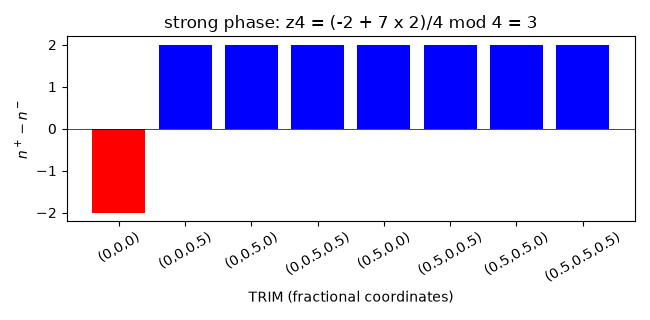
n+ - n- at the TRIMs: [-2, 2, 2, 2, 2, 2, 2, 2]
Total running time of the script: (0 minutes 0.332 seconds)