

Note
Go to the end to download the full example code.
The Kane-Mele Z2 Invariant from Wannier-Centre Flow#
Kane and Mele’s quantum spin Hall insulator has zero Chern number – its two spins carry opposite ones – yet it is topological: it carries a \(\mathbb{Z}_2\) invariant \(\nu\), protected by time reversal, that survives even when spin-orbit terms mix the two spins.
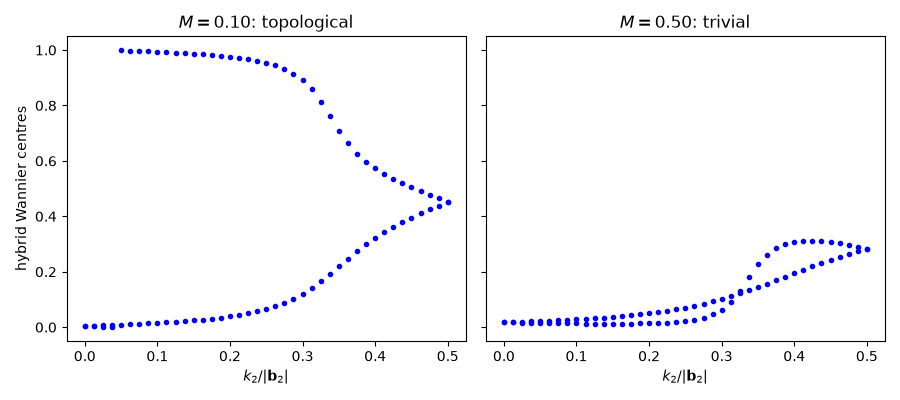
The cleanest way to see \(\nu\) is the flow of the hybrid Wannier
centres: take Wilson loops along \(\mathbf{b}_1\) and move them along
\(\mathbf{b}_2\) across half the Brillouin zone. Time reversal pairs
the centres at the two ends (Kramers pairs); in the topological phase the
pairs swap partners on the way, so any horizontal line is crossed an
odd number of times. z2_invariant() counts
those crossings (the largest-gap method of Soluyanov and Vanderbilt,
2011): \(\nu = 1\) below the critical staggered mass
\(|M| = 3\sqrt3\lambda\), \(\nu = 0\) above it – with or without
Rashba coupling.
import numpy as np
import matplotlib.pyplot as plt

import tbkit.lattices as lattices
from tbkit.kspace import KSpace, PAULI
from tbkit.orbital import OrbitalSystem
from tbkit.plot import Plot
from tbkit.system import System


lat = lattices.honeycomb()
lam = 0.06
M_c = 3 * np.sqrt(3) * lam


def kane_mele(M=0., rashba=0.):
    km = KSpace(lat, spin=True)
    km.set_hopping([{'i': 0, 'j': 1, 'R': R, 't': 1.} for R in [(0, 0), (-1, 0), (0, -1)]])
    for R in [(0, 1), (-1, 0), (1, -1)]:
        km.set_hopping([{'i': 0, 'j': 0, 'R': R, 't': 1j*lam*PAULI['z']},
                                {'i': 1, 'j': 1, 'R': R, 't': -1j*lam*PAULI['z']}])
    if rashba:
        tau = np.array([d['r0'] for d in lat.unit_cell])
        a = np.array(lat.prim_vec)
        for R in [(0, 0), (-1, 0), (0, -1)]:
            d = tau[1] + R[0]*a[0] + R[1]*a[1] - tau[0]
            d = d / np.linalg.norm(d)
            km.set_hopping([{'i': 0, 'j': 1, 'R': R,
                                     't': 1j*rashba*(PAULI['x']*d[1] - PAULI['y']*d[0])}])
    km.set_onsite({'a': M, 'b': -M})
    return km
The lattice#
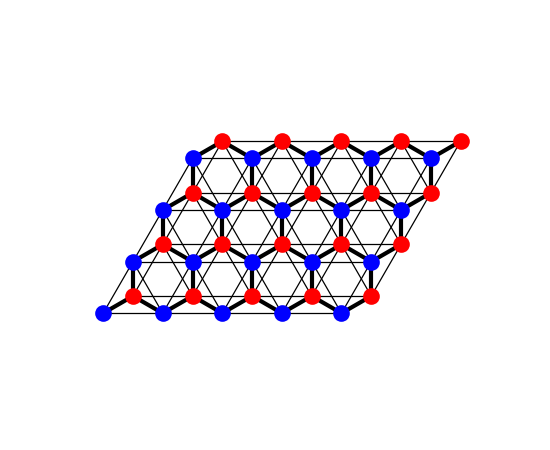
The Kane-Mele model lives on the honeycomb lattice: sublattices ‘a’ and ‘b’ in two colours, each site holding a spin-1/2 orbital, with the nearest-neighbour hopping (thick) and the spin-orbit hoppings \(\pm i\lambda\sigma_z\) between second neighbours (thin, not to scale; their spin matrices are not drawn).
patch = lattices.honeycomb()
patch.get_lattice(n1=5, n2=4)
vis = System(patch)
vis.set_hopping([{'n': 1, 't': 1.}, {'n': 2, 't': 0.3}])
fig_lat = Plot(vis).lattice(plt_hop=True, ms=12, figsize=(5.5, 4.5))
The flow: Kramers pairs swap partners#
fig, axes = plt.subplots(1, 2, figsize=(9, 4), sharey=True)
for ax, M, title in [(axes[0], 0.1, 'topological'), (axes[1], 0.5, 'trivial')]:
    fracs, centres = kane_mele(M).wannier_flow([0, 1], nk=60, nk_perp=41, k_range=(0., 0.5),
                                                                   positions=False)
    ax.plot(fracs, centres, 'o', color='b', ms=3)
    ax.set_title(r'$M = {:.2f}$: {}'.format(M, title))
    ax.set_xlabel(r'$k_2/|\mathbf{b}_2|$')
axes[0].set_ylabel('hybrid Wannier centres')
fig.set_layout_engine('tight')
The invariant across the phase diagram#
masses = np.array([0., 0.1, 0.2, 0.4, 0.5])
nu = [kane_mele(M).z2_invariant([0, 1], nk=60, nk_perp=41) for M in masses]
print('M / M_c:', np.round(masses / M_c, 2), '-> nu =', nu)
assert nu == [int(M < M_c) for M in masses]

# Rashba coupling mixes the spins (S_z is no longer conserved, so the two
# spins no longer carry Chern numbers of their own), but nu does not change
nu_r = kane_mele(0.1, rashba=0.05).z2_invariant([0, 1], nk=60, nk_perp=41)
assert nu_r == 1
print('With Rashba coupling: nu = {}.'.format(nu_r))
# and the total Chern number is zero throughout
assert abs(kane_mele(0.1, rashba=0.05).chern_number([0, 1], nk=20)) < 1e-6
M / M_c: [0.   0.32 0.64 1.28 1.6 ] -> nu = [1, 1, 1, 0, 0]
With Rashba coupling: nu = 1.
The same model in real space: a spinful flake#
OrbitalSystem builds the same Hamiltonian on a
finite flake (Kane-Mele’s \(\nu_{ij}\) from the geometry of each
second-neighbour path). Its spectrum equals that of the Bloch model cut
to the same open parallelogram, and shows in-gap states on the edges in
the topological phase.
flake = lattices.honeycomb()
flake.get_lattice(12, 12)
sys = OrbitalSystem(flake, spin=True)
sys.set_hopping([{'n': 1, 't': 1.}])
sys.set_spin_orbit(lam)
sys.set_onsite({'a': 0.1, 'b': -0.1})
sys.get_ham()
sys.get_eig(eigenvec=True)
assert np.allclose(sys.en, np.linalg.eigvalsh(kane_mele(0.1).finite_ham((12, 12))))
bands = kane_mele(0.1).mesh_bands(60)
bulk_gap = np.min(bands[:, 2] - bands[:, 1])
in_gap = np.abs(sys.en) < bulk_gap / 2
x, y = flake.coor['x'], flake.coor['y']
edge = (x - x.min() < 1.5) | (x.max() - x < 1.5) | (y - y.min() < 1.) | (y.max() - y < 1.)
weight_on_edge = sys.intensity[edge][:, in_gap].sum(axis=0)
print('{} in-gap states, {:.0%} of their weight on the edge sites ({:.0%} of the sites).'
          .format(in_gap.sum(), weight_on_edge.mean(), edge.mean()))
assert in_gap.sum() > 0 and weight_on_edge.mean() > 2 * edge.mean()
20 in-gap states, 51% of their weight on the edge sites (17% of the sites).
Total running time of the script: (0 minutes 0.407 seconds)