

Note
Go to the end to download the full example code.
Quantized Electric Quadrupole Insulators: the Benalcazar-Bernevig-Hughes Model#
In 2017 W. Benalcazar, B. A. Bernevig and T. L. Hughes showed that a crystal can carry a quantized electric quadrupole moment while having no dipole moment at all. Their model (BBH) has four orbitals per square cell, intra-cell hoppings \(\gamma\), inter-cell hoppings \(\lambda\), and a \(\pi\) flux through every plaquette. For \(|\gamma| < |\lambda|\):
the Wilson loop along \(x\) splits the occupied bands into two gapped Wannier sectors \(\nu_x^\pm(k_y)\);
the nested Wilson loop of one sector along \(y\) gives the Wannier-sector polarization \(p_y^{\nu_x^-} = 1/2\) (and likewise \(p_x^{\nu_y^-} = 1/2\)), so the quadrupole moment \(q_{xy} = 2p_y^{\nu_x^-}p_x^{\nu_y^-} = 1/2\);
a finite square flake has four zero-energy states in the gap, one at each corner, and a fractional charge \(\pm e/2\) bound to each corner – the first higher-order topological insulator, seen in 2018 in phononic, microwave and electric-circuit metamaterials.
For \(|\gamma| > |\lambda|\) all of these vanish. tbkit.higher_order
computes each one: bbh_model, wannier_bands,
wannier_sector_polarization, quadrupole_moment and corner_charges.
import numpy as np
import matplotlib.pyplot as plt
import scipy.linalg as LA

from tbkit.bridges import finite_system
from tbkit.higher_order import (bbh_model, corner_charges, flake_positions, quadrupole_moment,
                                                    wannier_bands, wannier_sector_polarization)
from tbkit.plot import Plot


def circ(a, b):
    '''Distance modulo 1.'''
    d = abs(a - b) % 1.
    return min(d, 1. - d)


occ = [0, 1]  # half filling: the two lower bands
The lattice#
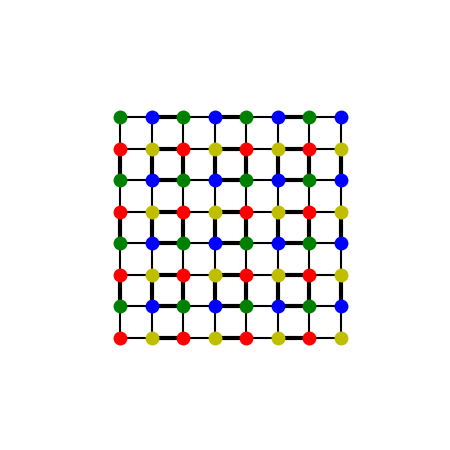
The BBH model (bbh_model()) on a patch of
\(4\times4\) cells (finite_system()): four
orbitals per square cell (one colour each), bond widths proportional to
the amplitudes – the intra-cell hoppings \(\gamma\) (thin, here
\(\gamma/\lambda = 1/2\)) and the inter-cell ones \(\lambda\)
(thick). Their signs, which thread a \(\pi\) flux through every
plaquette, are not drawn.
fig_lat = Plot(finite_system(bbh_model(0.5, 1.), (4, 4))).lattice(plt_hop=True, ms=10, figsize=(4.5, 4.5))
Wannier bands: two gapped sectors#
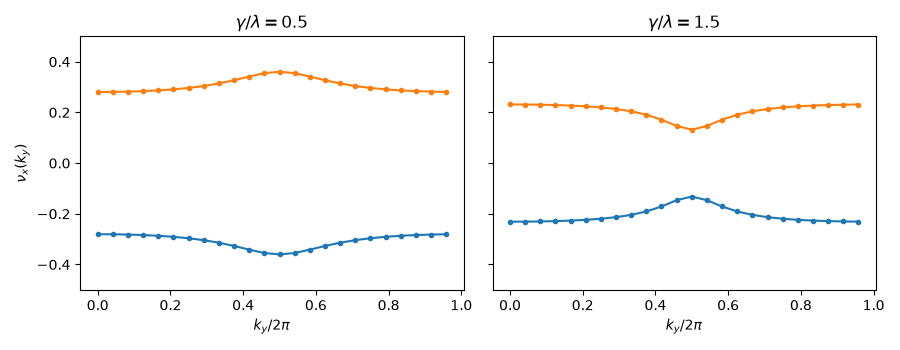
The hybrid Wannier centres \(\nu_x(k_y)\) of the occupied bands come in pairs \(\pm\nu_x\), separated by gaps at 0 and 1/2 in both phases: the Wannier sectors are well defined.
nk = 24
fig, axes = plt.subplots(1, 2, figsize=(9, 3.5), sharey=True)
for ax, gamma in zip(axes, (0.5, 1.5)):
    nu, _ = wannier_bands(bbh_model(gamma, 1.), occ, nk)
    ky = np.arange(nk) / nk
    for j in range(2):
        ax.plot(ky, nu[0, :, j], 'o-', ms=3)
    np.testing.assert_allclose(nu[..., 0], -nu[..., 1], atol=1e-10)
    assert nu[..., 1].min() > 0.05 and nu[..., 1].max() < 0.45
    ax.set_xlabel(r'$k_y / 2\pi$')
    ax.set_title(r'$\gamma/\lambda = {}$'.format(gamma))
axes[0].set_ylabel(r'$\nu_x(k_y)$')
axes[0].set_ylim(-0.5, 0.5)
fig.tight_layout()
The nested Wilson loop and the quadrupole moment#
\(p_y^{\nu_x^-}\) and \(p_x^{\nu_y^-}\) jump from 1/2 to 0 at \(|\gamma| = |\lambda|\), where the bulk gap closes, and so does \(q_{xy}\).
gammas = np.array([-1.6, -1.2, -0.8, -0.4, 0., 0.4, 0.8, 1.2, 1.6])
q = np.array([quadrupole_moment(bbh_model(g, 1.), occ, nk=20) for g in gammas])
p_y = np.array([wannier_sector_polarization(bbh_model(g, 1.), occ, nk=20) for g in gammas])
for g, qq, pp in zip(gammas, q, p_y):
    target = 0.5 if abs(g) < 1 else 0.
    assert circ(qq, target) < 1e-8 and circ(pp, target) < 1e-8
    print('gamma/lambda = {:5.2f}:  p_y^(nu_x-) = {:.3f}   q_xy = {:.3f}'.format(g, pp % 1, qq % 1))
gamma/lambda = -1.60:  p_y^(nu_x-) = 0.000   q_xy = 0.000
gamma/lambda = -1.20:  p_y^(nu_x-) = 0.000   q_xy = 0.000
gamma/lambda = -0.80:  p_y^(nu_x-) = 0.500   q_xy = 0.500
gamma/lambda = -0.40:  p_y^(nu_x-) = 0.500   q_xy = 0.500
gamma/lambda =  0.00:  p_y^(nu_x-) = 0.500   q_xy = 0.500
gamma/lambda =  0.40:  p_y^(nu_x-) = 0.500   q_xy = 0.500
gamma/lambda =  0.80:  p_y^(nu_x-) = 0.500   q_xy = 0.500
gamma/lambda =  1.20:  p_y^(nu_x-) = 0.000   q_xy = 0.000
gamma/lambda =  1.60:  p_y^(nu_x-) = 0.000   q_xy = 0.000
Four corner states and the corner charges#
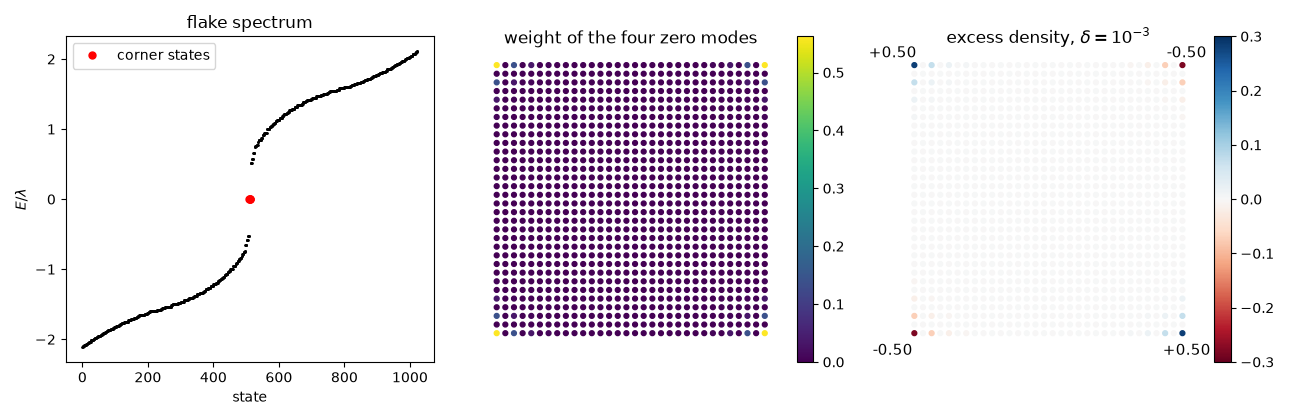
A 16 x 16 flake at \(\gamma/\lambda = 1/2\) has exactly four states at zero energy (up to their exponentially small overlap), inside the gap of the bulk and of the edges. A small \(\delta\Gamma_0\) shifts two of them to \(-\delta\) and two to \(+\delta\); at half filling the corners then carry \(\mp e/2\) (the excess electron number of each quadrant of the flake, over a neutralizing background).
n = 16
flake = bbh_model(0.5, 1.)
en, vec = LA.eigh(flake.finite_ham(n))
zero = np.abs(en) < 1e-4
assert zero.sum() == 4 and np.sort(np.abs(en))[4] > 0.3
pos = flake_positions(flake, n)
weight = (np.abs(vec[:, zero]) ** 2).sum(axis=1)

res = corner_charges(bbh_model(0.5, 1., 1e-3), n)
assert np.allclose(np.abs(res.charges), 0.5, atol=2e-3)
triv = corner_charges(bbh_model(1.5, 1., 1e-3), n)
assert np.allclose(triv.charges, 0., atol=1e-3)
print('Corner charges (quadrupole phase):\n', res.charges.round(3))
print('Corner charges (trivial phase):\n', triv.charges.round(3))

fig, axes = plt.subplots(1, 3, figsize=(13, 4.2))
axes[0].plot(en, 'k.', ms=2)
axes[0].plot(np.where(zero)[0], en[zero], 'ro', ms=5, label='corner states')
axes[0].set_xlabel('state')
axes[0].set_ylabel('$E/\\lambda$')
axes[0].legend(loc='upper left')
axes[0].set_title('flake spectrum')
sc = axes[1].scatter(pos[:, 0], pos[:, 1], c=weight, s=12, cmap='viridis')
axes[1].set_title('weight of the four zero modes')
fig.colorbar(sc, ax=axes[1])
excess = res.density - res.background
sc = axes[2].scatter(pos[:, 0], pos[:, 1], c=excess, s=12, cmap='RdBu', vmin=-0.3, vmax=0.3)
for a in (0, 1):
    for b in (0, 1):
        x = -1.5 if a == 0 else n - 0.5
        y = -1.5 if b == 0 else n - 0.3
        axes[2].text(x, y, '{:+.2f}'.format(res.charges[a, b]), ha='center', fontsize=11)
axes[2].set_title('excess density, $\\delta = 10^{-3}$')
fig.colorbar(sc, ax=axes[2])
for ax in axes[1:]:
    ax.set_aspect('equal')
    ax.axis('off')
fig.tight_layout()
Corner charges (quadrupole phase):
 [[-0.499  0.499]
 [ 0.499 -0.499]]
Corner charges (trivial phase):
 [[-0.  0.]
 [ 0. -0.]]
Total running time of the script: (0 minutes 1.441 seconds)