

Note
Go to the end to download the full example code.
The Spin Chern Number: Quantum Spin Hall Without Spin Conservation#
In Kane and Mele’s model each spin is a Haldane model: spin up has Chern number \(+1\), spin down \(-1\), and the spin Chern number \(C_s = (C_\uparrow - C_\downarrow)/2 = 1\) counts the helical edge pairs. Rashba coupling ruins this picture, since \(s_z\) is no longer conserved and the bands are no longer spin up or spin down.
Sheng, Weng, Sheng and Haldane (2006) found numerically that a spin Chern number survives anyway, and E. Prodan (2009) made it exact: project the spin operator onto the occupied bands, \(P s_z P\). As long as its spectrum keeps a gap around zero (a spin gap), its positive and negative eigenvectors split the occupied bands into two sectors, each with a well-defined Chern number \(C_\pm\), and
is quantized. With time reversal, \(C_s\) modulo 2 is the \(\mathbb{Z}_2\) invariant; \(C_s\) survives even when time reversal is broken, as long as the bulk gap and the spin gap stay open.
spin_chern_number() computes it
(sector_chern_numbers() gives \(C_\pm\) for any
operator).
import numpy as np
import matplotlib.pyplot as plt

import tbkit.lattices as lattices
from tbkit.kspace import KSpace, PAULI
from tbkit.plot import Plot
from tbkit.system import System


lat = lattices.honeycomb()
lam = 0.06
S_Z = np.kron(np.eye(2), PAULI['z'])  # sigma_z on both sites


def kane_mele(M=0.1, rashba=0.):
    km = KSpace(lat, spin=True)
    km.set_hopping([{'i': 0, 'j': 1, 'R': R, 't': 1.} for R in [(0, 0), (-1, 0), (0, -1)]])
    for R in [(0, 1), (-1, 0), (1, -1)]:
        km.set_hopping([{'i': 0, 'j': 0, 'R': R, 't': 1j*lam*PAULI['z']},
                                {'i': 1, 'j': 1, 'R': R, 't': -1j*lam*PAULI['z']}])
    if rashba:
        tau = np.array([d['r0'] for d in lat.unit_cell])
        a = np.array(lat.prim_vec)
        for R in [(0, 0), (-1, 0), (0, -1)]:
            d = tau[1] + R[0]*a[0] + R[1]*a[1] - tau[0]
            d = d / np.linalg.norm(d)
            km.set_hopping([{'i': 0, 'j': 1, 'R': R,
                                     't': 1j*rashba*(PAULI['x']*d[1] - PAULI['y']*d[0])}])
    km.set_onsite({'a': M, 'b': -M})
    return km


def spin_spectrum(km, ks):
    '''Eigenvalues of P s_z P within the two occupied bands.'''
    _, vec = km.get_bands(ks, eigenvec=True)
    occ = vec[:, :, :2]
    return np.linalg.eigvalsh(occ.conj().transpose(0, 2, 1) @ S_Z @ occ)
The lattice#
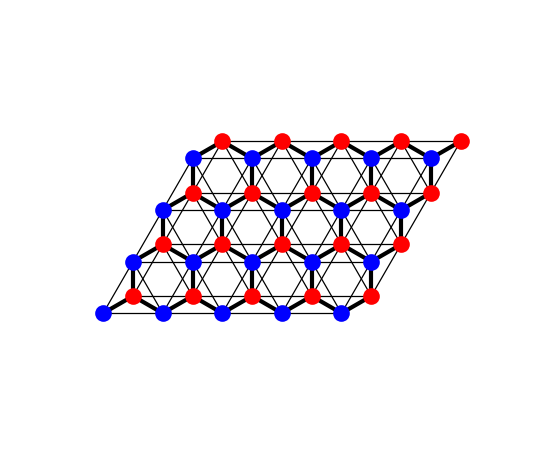
The Kane-Mele model lives on the honeycomb lattice: sublattices ‘a’ (onsite \(+M\)) and ‘b’ (\(-M\)) in two colours, each site holding a spin-1/2 orbital, with the nearest-neighbour hopping (thick) and the spin-orbit hoppings \(\pm i\lambda\sigma_z\) between second neighbours (thin, not to scale; their spin matrices are not drawn).
patch = lattices.honeycomb()
patch.get_lattice(n1=5, n2=4)
vis = System(patch)
vis.set_hopping([{'n': 1, 't': 1.}, {'n': 2, 't': 0.3}])
fig_lat = Plot(vis).lattice(plt_hop=True, ms=12, figsize=(5.5, 4.5))
Without Rashba coupling: the Chern numbers of the two spins#
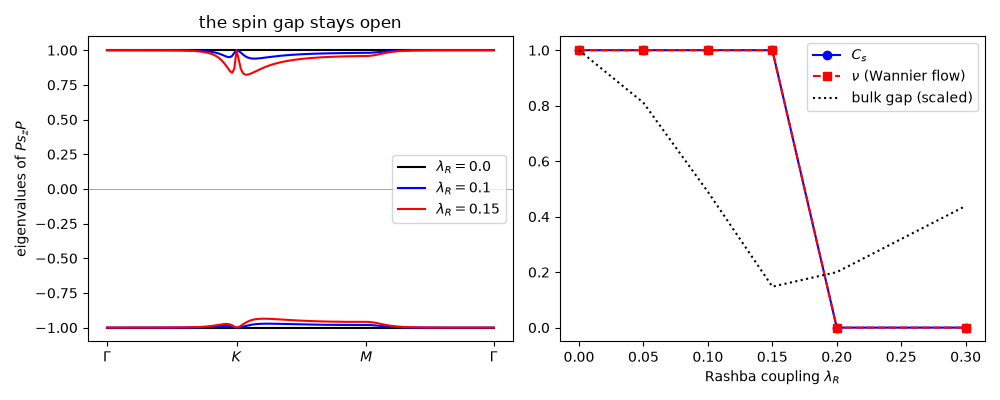
\(P s_z P\) has eigenvalues exactly \(\pm1\): the sectors are spin up and spin down, with Chern numbers \(\pm1\).
Rashba 0: C_+ = 1.000, C_- = -1.000
With Rashba coupling: the spin gap, and the invariant#
Rashba coupling does not commute with \(s_z\), and the eigenvalues of \(P s_z P\) move away from \(\pm1\) – but not to zero. The spin Chern number stays 1 until the bulk gap closes (between \(\lambda_R = 0.15\) and 0.2), where the insulator turns trivial; it agrees with the \(\mathbb{Z}_2\) invariant of the Wannier-centre flow throughout.
rashbas = np.array([0., 0.05, 0.1, 0.15, 0.2, 0.3])
fracs = np.stack(np.meshgrid(np.arange(40) / 40, np.arange(40) / 40, indexing='ij'), -1).reshape(-1, 2)
c_s, nu, spin_gap, bulk_gap = [], [], [], []
for r in rashbas:
    km = kane_mele(rashba=r)
    c_s.append(km.spin_chern_number([0, 1]))
    nu.append(km.z2_invariant([0, 1], nk=60, nk_perp=41))
    spin_gap.append(np.min(np.abs(spin_spectrum(km, fracs @ km.rec_vec_k))))
    bands = km.mesh_bands(60)
    bulk_gap.append(np.min(bands[:, 2] - bands[:, 1]))
c_s = np.array(c_s)
for row in zip(rashbas, c_s, nu, spin_gap, bulk_gap):
    print('lambda_R = {:.2f}: C_s = {:+.3f}, nu = {}, spin gap {:.3f}, bulk gap {:.3f}'.format(*row))
km = kane_mele(rashba=0.1)
ham = km.get_ham([0.3, 0.7])
assert np.max(np.abs(ham @ S_Z - S_Z @ ham)) > 0.05  # s_z is not conserved
assert np.allclose(c_s, [1, 1, 1, 1, 0, 0], atol=1e-6)
assert np.allclose(np.round(c_s) % 2, nu)
assert min(spin_gap) > 0.1
lambda_R = 0.00: C_s = +1.000, nu = 1, spin gap 1.000, bulk gap 0.424
lambda_R = 0.05: C_s = +1.000, nu = 1, spin gap 0.987, bulk gap 0.343
lambda_R = 0.10: C_s = +1.000, nu = 1, spin gap 0.943, bulk gap 0.207
lambda_R = 0.15: C_s = +1.000, nu = 1, spin gap 0.828, bulk gap 0.063
lambda_R = 0.20: C_s = +0.000, nu = 0, spin gap 0.439, bulk gap 0.085
lambda_R = 0.30: C_s = +0.000, nu = 0, spin gap 0.148, bulk gap 0.186
Without time reversal#
An in-plane Zeeman field \(B s_x\) breaks time reversal (so there is no \(\mathbb{Z}_2\) invariant any more) and conserves no spin component, yet the spin Chern number is still 1, with a total Chern number of zero.
time_reversal = np.kron(np.eye(2), 1j*PAULI['y'])
for B in (0.02, 0.05):
    km_b = kane_mele(rashba=0.1)
    km_b.set_onsite({'a': 0.1*PAULI['0'] + B*PAULI['x'], 'b': -0.1*PAULI['0'] + B*PAULI['x']})
    assert km_b.symmetry_error(time_reversal, antiunitary=True) > 0.01
    assert np.isclose(km_b.spin_chern_number([0, 1]), 1.) and abs(km_b.chern_number([0, 1])) < 1e-8
    print('Zeeman B = {}: time reversal broken, C_s = {:.3f}.'.format(B, km_b.spin_chern_number([0, 1])))
Zeeman B = 0.02: time reversal broken, C_s = 1.000.
Zeeman B = 0.05: time reversal broken, C_s = 1.000.
The spectrum of P s_z P along a path#
b1, b2 = km.rec_vec_k
corners = [np.zeros(2), (b1 - b2) / 3, b1 / 2, np.zeros(2)]  # Gamma, K, M, Gamma
kpts = np.concatenate([np.linspace(corners[i], corners[i + 1], 60, endpoint=False) for i in range(3)])

fig, axes = plt.subplots(1, 2, figsize=(10, 4))
for r, color in ((0., 'k'), (0.1, 'b'), (0.15, 'r')):
    w = spin_spectrum(kane_mele(rashba=r), kpts)
    axes[0].plot(w, color=color, label=[r'$\lambda_R = {}$'.format(r), None])
axes[0].axhline(0., color='gray', lw=0.5)
axes[0].set_xticks([0, 60, 120, 179], [r'$\Gamma$', '$K$', '$M$', r'$\Gamma$'])
axes[0].set_ylabel(r'eigenvalues of $P s_z P$')
axes[0].set_title('the spin gap stays open')
axes[0].legend()
axes[1].plot(rashbas, c_s, 'o-b', label='$C_s$')
axes[1].plot(rashbas, nu, 's--r', label=r'$\nu$ (Wannier flow)')
axes[1].plot(rashbas, np.array(bulk_gap) / max(bulk_gap), ':k', label='bulk gap (scaled)')
axes[1].set_xlabel(r'Rashba coupling $\lambda_R$')
axes[1].legend()
fig.set_layout_engine('tight')
Total running time of the script: (0 minutes 0.328 seconds)