

Note
Go to the end to download the full example code.
Weyl Semimetals: Monopoles of Berry Curvature and Fermi Arcs#
A 3D band touching where two bands meet linearly in every direction, \(H \approx \mathbf{v}\cdot\mathbf{q}\,\boldsymbol\sigma\), is a Weyl point: a source or sink of Berry curvature, of charge \(\pm1\). Wan, Turner, Vishwanath and Savrasov (2011) predicted Weyl semimetals in real materials, and in 2015 Xu et al. and Lv et al. observed them in TaAs by photoemission – through their unmistakable surface signature, open Fermi arcs.
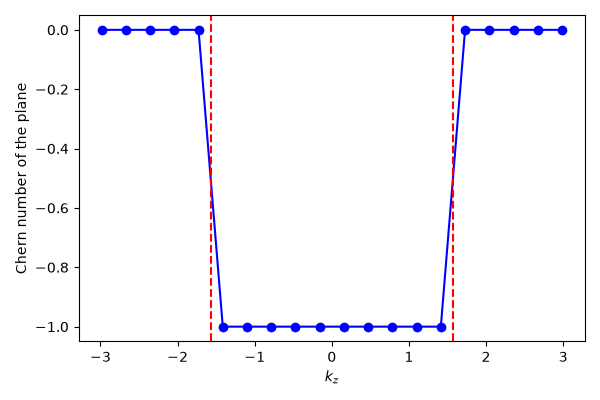
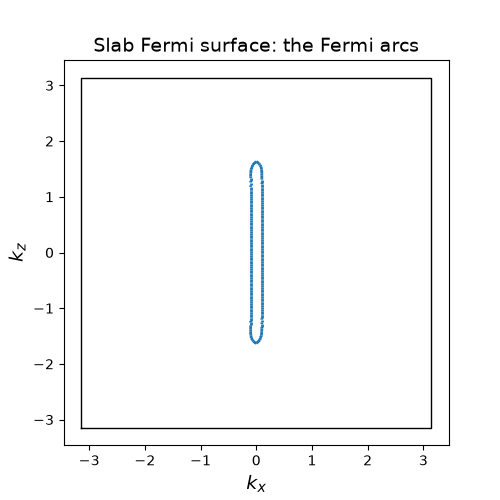
Both follow from topology. Every plane \(k_z = \mathrm{const}\) of the Brillouin zone is a 2D insulator with a Chern number, which jumps by the monopole charge (the chirality) as the plane crosses a Weyl point: here \(|C(k_z)| = 1\) between the two Weyl points and 0 outside. Each plane with \(C = 1\) contributes one chiral edge state to a surface; together they draw a line of zero-energy surface states that ends at the projections of the Weyl points – the Fermi arc.
The model: \(H(\mathbf{k}) = \sin k_x\,\sigma_x + \sin k_y\,\sigma_y + (2 + \cos k_0 - \cos k_x - \cos k_y - \cos k_z)\,\sigma_z\), Weyl points at \((0, 0, \pm k_0)\).
import numpy as np
import matplotlib.pyplot as plt
from mpl_toolkits.mplot3d.art3d import Line3DCollection

from tbkit.lattice import Lattice
from tbkit.kspace import KSpace, PAULI, ribbon
from tbkit.system import System
from tbkit.topology import find_weyl_points

k0 = np.pi / 2
cubic = [(1., 0., 0.), (0., 1., 0.), (0., 0., 1.)]
lat = Lattice(unit_cell=[{'tag': 'a', 'r0': (0., 0., 0.)}], prim_vec=cubic)
# the two components are the "spin" of a spinful site
hops = [{'i': 0, 'j': 0, 'R': (1, 0, 0), 't': -0.5j*PAULI['x'] - 0.5*PAULI['z']},
            {'i': 0, 'j': 0, 'R': (0, 1, 0), 't': -0.5j*PAULI['y'] - 0.5*PAULI['z']},
            {'i': 0, 'j': 0, 'R': (0, 0, 1), 't': -0.5*PAULI['z']}]
onsite = {'a': (2. + np.cos(k0)) * PAULI['z']}
weyl = KSpace(lat, spin=True)
weyl.set_hopping(hops)
weyl.set_onsite(onsite)
The lattice#
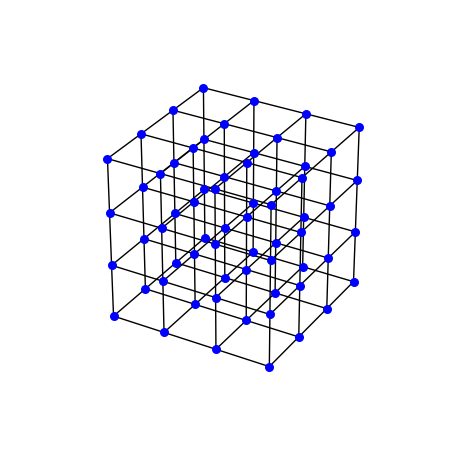
The simple cubic lattice, here \(4\times4\times4\) sites, with its nearest-neighbour bonds. Each site holds a two-component orbital, and the hoppings along \(x\) and \(y\) are \(2\times2\) matrices that act on it (not drawn).
lat_vis = Lattice(unit_cell=lat.unit_cell, prim_vec=cubic)
lat_vis.get_lattice(4, 4, 4)
vis = System(lat_vis)
vis.set_hopping([{'n': 1, 't': 1.}])
pos = np.column_stack([lat_vis.coor[f] for f in 'xyz'])
bonds = np.stack([pos[vis.hop['i'].astype(int)], pos[vis.hop['j'].astype(int)]], axis=1)
fig_lat = plt.figure(figsize=(4.5, 4.5))
ax_lat = fig_lat.add_subplot(projection='3d')
ax_lat.add_collection3d(Line3DCollection(bonds, colors='k', linewidths=1))
ax_lat.scatter(*pos.T, s=30, c='b', depthshade=False)
ax_lat.set_aspect('equal')
ax_lat.set_axis_off()
The Weyl points and their chirality#
find_weyl_points() scans the gap between the two
bands over a mesh of the zone, refines its minima by Newton’s method, and
measures the chirality of each touching: the Berry flux of the lower band
out of a small sphere around it, divided by \(2\pi\). The two
chiralities cancel, as they must over a whole zone (Nielsen-Ninomiya).
points = find_weyl_points(weyl, bands=0)
order = np.argsort(points.k[:, 2])
k_weyl, chirality = points.k[order], points.chirality[order]
print('Weyl points (k_x, k_y, k_z):', np.round(k_weyl, 6).tolist(), 'chiralities:', chirality.tolist())
assert np.allclose(k_weyl, [[0., 0., -k0], [0., 0., k0]], atol=1e-8)
assert np.all(points.gap < 1e-8) and np.allclose(points.energy, 0., atol=1e-8)
assert chirality.tolist() == [-1, 1] and points.total_chirality == 0
# linear in every direction around them
q = 1e-4
for d in np.eye(3):
    gap = np.diff(np.linalg.eigvalsh(weyl.get_ham(k_weyl[1] + q * d)))[0]
    assert np.isclose(gap / (2 * q), 1., atol=1e-3)
print('Two Weyl points at k = (0, 0, +-pi/2), linear in every direction, of chirality -1 and +1.')
Weyl points (k_x, k_y, k_z): [[0.0, 0.0, -1.570796], [0.0, 0.0, 1.570796]] chiralities: [-1, 1]
Two Weyl points at k = (0, 0, +-pi/2), linear in every direction, of chirality -1 and +1.
The Chern number of the k_z planes#
By Gauss’s law, the Chern number of the plane jumps by the chirality as the plane crosses a Weyl point upwards: \(-1\) at \(-k_0\), back up by \(+1\) at \(+k_0\).
kz_fracs = np.linspace(-0.475, 0.475, 20)
chern = np.array([weyl.chern_number(bands=[0], nk=20, k_fixed=f) for f in kz_fracs])
inside = np.abs(kz_fracs) < k0 / (2 * np.pi)
print('C(k_z):', np.round(chern).astype(int))
assert np.allclose(chern[inside], chirality[0], atol=1e-6) and np.allclose(chern[~inside], 0., atol=1e-6)
C(k_z): [ 0 0 0 0 0 -1 -1 -1 -1 -1 -1 -1 -1 -1 -1 0 0 0 0 0]
The Fermi arc#
A slab, finite along y (ribbon() of the 3D model):
at \(k_x = 0\), zero-energy states exist only for \(|k_z| < k_0\),
and live on the two surfaces.
width = 30
slab = ribbon(lat, hops, width=width, direction=1, onsite=onsite, spin=True)
kzs = np.linspace(-np.pi, np.pi, 61)
en, vec = slab.get_bands(np.array([[0., kz] for kz in kzs]), eigenvec=True)
lowest = np.min(np.abs(en), axis=1)
arc = np.abs(kzs) < k0 - 0.2
far = np.abs(kzs) > k0 + 0.3
assert np.all(lowest[arc] < 1e-2) and np.all(lowest[far] > 0.2)
n = np.argmin(np.abs(en[30]))  # k_z = 0
weight = np.abs(vec[30][:, n]) ** 2
rows = weight.reshape(width, 2).sum(axis=1)
surface = rows[:3].sum() + rows[-3:].sum()
print('Zero-energy slab state at k_z = 0: {:.0%} of its weight on the outer 3 layers.'.format(surface))
assert surface > 0.9

fig, ax = plt.subplots(figsize=(6, 4))
ax.plot(kz_fracs * 2 * np.pi, chern, 'o-b')
for kz, chi in zip(k_weyl[:, 2], chirality):
    ax.axvline(kz, color='r', ls='--')
    ax.annotate(r'$\chi = {:+d}$'.format(chi), (kz, 0.1), color='r', ha='center')
ax.set_xlabel('$k_z$')
ax.set_ylabel('Chern number of the plane')
fig.set_layout_engine('tight')
Zero-energy slab state at k_z = 0: 100% of its weight on the outer 3 layers.
The Fermi surface of the slab#
fermi_surface() of the slab at a small energy
\(E = 0.1\): each surface carries an arc of states with
\(k_x = \pm E\) (velocity 1, opposite on the two surfaces) for
\(|k_z| < k_0\), and the two arcs join through the small bulk
pockets around the projections of the Weyl points – one closed contour,
half on each surface.
energy = 0.1
middle = slab.norb // 2  # the lowest band above zero energy
contour = slab.fermi_surface(energy, nk=(40, 80), bands=middle)[0].reshape(-1, 2)
on_arc = np.abs(contour[:, 1]) < k0 - 0.3
assert np.allclose(np.abs(contour[on_arc, 0]), energy, atol=1e-3)
assert np.abs(contour[:, 1]).max() < k0 + 0.15  # it ends at the Weyl points
print('Fermi arcs at E = {}: |k_x| = E for |k_z| < k0, closing at k_z = +-k0.'.format(energy))
fig2 = slab.plot_fermi_surface(energy, nk=(40, 80), bands=middle, fs=14, figsize=(5, 5))
fig2.axes[0].set_title('Slab Fermi surface: the Fermi arcs', fontsize=14)
Fermi arcs at E = 0.1: |k_x| = E for |k_z| < k0, closing at k_z = +-k0.

Text(0.5, 1.0, 'Slab Fermi surface: the Fermi arcs')
Total running time of the script: (0 minutes 1.368 seconds)