

Building, Bridging and Saving Models#
Tools that make realistic models easy to build and move around: Bloch
Hamiltonians set up by neighbour order (1st, 2nd, 3rd, … neighbours) as
in real space, bridges between the real-space System
and the reciprocal-space KSpace pipelines, k·p
(continuum) Hamiltonians discretized into lattice models and the fermion
doubling that comes with it, models
saved to and loaded from disk, tight-binding models imported from
Wannier90’s _hr.dat files, and Wannier functions built from any model
(isolated or entangled bands), with their Wannier-interpolated model.
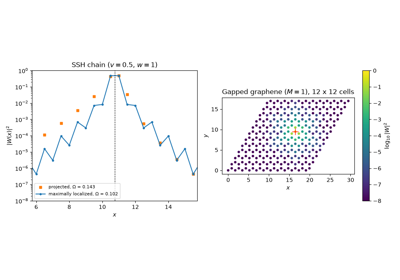
Maximally Localized Wannier Functions: Projection and Spread Minimization
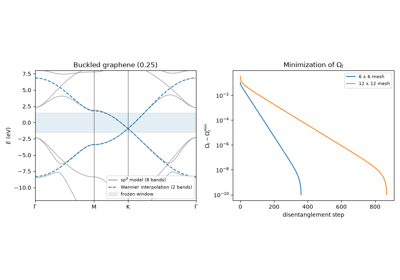
Disentanglement: Wannier Functions of the π Bands of Graphene
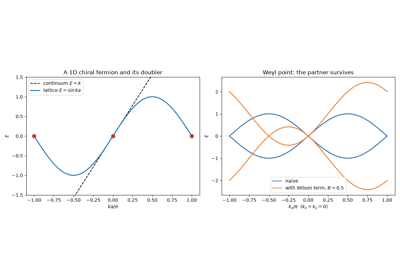
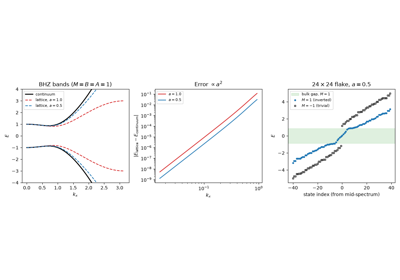
k·p Theory on a Lattice: from a Continuum Hamiltonian to Tight-Binding
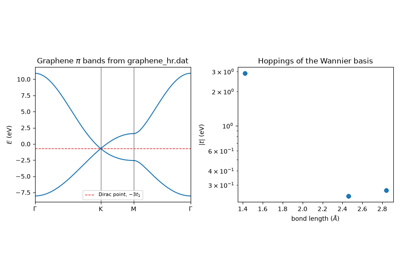
Maximally Localized Wannier Functions: Graphene from a Wannier90 File
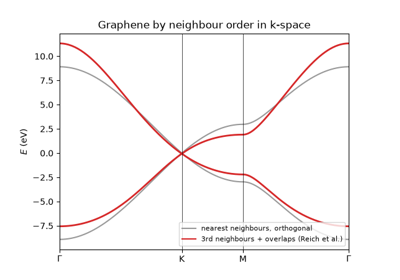
Hoppings by Neighbour Order in k-Space: Third-Nearest-Neighbour Graphene
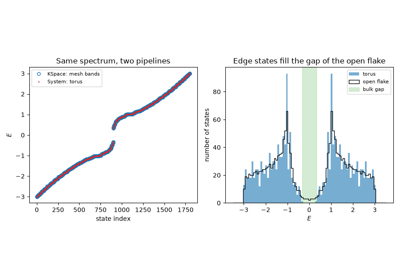
From Real Space to k-Space and Back: the Haldane Model on a Torus
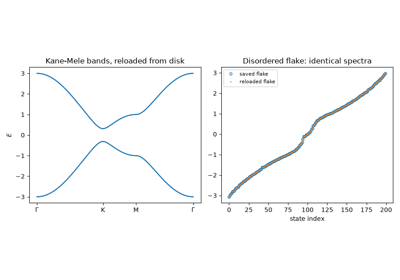
Saving and Reloading Models: a Kane-Mele Model on Disk