
Note
Go to the end to download the full example code.
The Thouless Quantum Pump (Rice-Mele Model)#
Take the SSH model (The SSH Model: Bulk-Boundary Correspondence) and cycle its two parameters – the dimerization v-w and a staggered onsite potential – slowly around a closed loop enclosing the SSH gap-closing point. Thouless showed that the charge transported around one full cycle is exactly quantized, equal to the Chern number of the \((k,\phi)\) torus swept out by the cycle – a 1D adiabatic pump is, in this sense, a slice through a 2D Chern insulator, with the pump parameter \(\phi\) playing the role of a second crystal momentum.
Because \(v(\phi)\) and \(w(\phi)\) only ever appear as
\(\cos\phi = (e^{i\phi}+e^{-i\phi})/2\), this is a completely ordinary
2D Bloch Hamiltonian, built with tbkit.kspace.KSpace exactly like
any other – no new machinery needed, just one extra “synthetic”
reciprocal dimension.
import numpy as np
import matplotlib.pyplot as plt

from tbkit.lattice import Lattice
from tbkit.kspace import KSpace
from tbkit.system import System
from tbkit.plot import Plot


unit_cell = [{'tag': 'a', 'r0': (0., 0.)}, {'tag': 'b', 'r0': (0.5, 0.)}]
prim_vec = [(1., 0.), (0., 1.)]  # 2nd direction: the synthetic pump parameter


def rice_mele(v0, delta, Delta, onsite_offset=0.):
    '''
    Rice-Mele model as a 2D Bloch Hamiltonian H(k, phi): a family of SSH
    chains (dimerization v(phi), w(phi)) with a staggered onsite potential
    Delta*sin(phi) + onsite_offset, phi playing the role of a second,
    synthetic crystal momentum.
    '''
    lat = Lattice(unit_cell=unit_cell, prim_vec=prim_vec)
    rm = KSpace(lat)
    rm.set_hopping([{'i': 0, 'j': 1, 'R': (0, 0), 't': v0},
                            {'i': 0, 'j': 1, 'R': (-1, 0), 't': v0},
                            {'i': 0, 'j': 1, 'R': (0, 1), 't': delta/2},
                            {'i': 0, 'j': 1, 'R': (0, -1), 't': delta/2},
                            {'i': 0, 'j': 1, 'R': (-1, 1), 't': -delta/2},
                            {'i': 0, 'j': 1, 'R': (-1, -1), 't': -delta/2},
                            {'i': 0, 'j': 0, 'R': (0, 1), 't': Delta/(2j)},
                            {'i': 1, 'j': 1, 'R': (0, 1), 't': -Delta/(2j)}])
    if onsite_offset:
        rm.set_onsite({'a': onsite_offset, 'b': -onsite_offset})
    return rm
The chain being pumped#
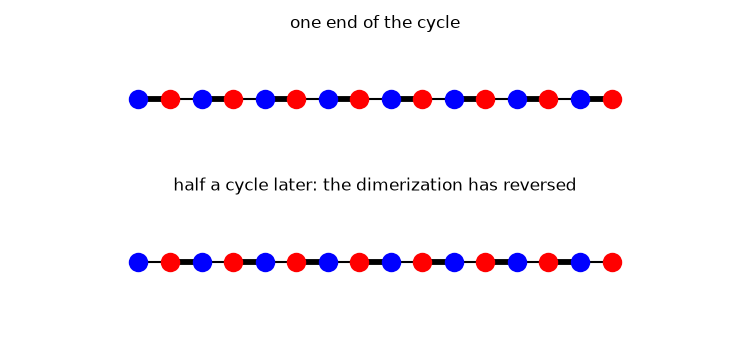
At each value of the pump parameter the model is an SSH-like chain: two sites per cell, with a dimerization that the cycle drives. Drawn here at the two extremes of the cycle, where the strong bond has swapped ends – which is exactly how one electron per cycle gets carried across.
def draw_chain(v, w, ax, n_cells=8):
    '''Draw a finite real-space chain with the given dimerization.'''
    lat = Lattice(unit_cell=unit_cell, prim_vec=[(1., 0.)])
    lat.get_lattice(n1=n_cells)
    sys = System(lat)
    hop = {}
    for n in range(n_cells):
        hop[(2*n, 2*n + 1)] = v
        if n < n_cells - 1:
            hop[(2*n + 1, 2*n + 2)] = w
    sys.set_hopping_manual(hop)
    Plot(sys).lattice(plt_hop=True, ms=14, ax=ax)


fig_chain, axes_chain = plt.subplots(2, 1, figsize=(7.5, 3.4))
draw_chain(v=1.4, w=0.5, ax=axes_chain[0])
axes_chain[0].set_title(r'one end of the cycle', fontsize=12)
draw_chain(v=0.5, w=1.4, ax=axes_chain[1])
axes_chain[1].set_title(r'half a cycle later: the dimerization has reversed',
                                  fontsize=12)
fig_chain.tight_layout()
The pump is quantized only when the loop encircles the gap-closing point#
Chern number \(\pm 1\) when the (v-w, staggering) loop encircles the SSH gap-closing point at the origin; offsetting the loop so it misses the origin entirely gives a trivial, unquantized (here, exactly zero) pump instead.
rm = rice_mele(v0, delta, Delta)
chern = rm.chern_number(bands=[0], nk=50)
print('Loop encircling the origin: Chern number = {:.4f} (expect exactly +-1).'.format(chern))
assert np.isclose(abs(chern), 1., atol=1e-3)

rm_offset = rice_mele(v0, delta, Delta, onsite_offset=2*Delta)
chern_offset = rm_offset.chern_number(bands=[0], nk=50)
print('Loop missing the origin (large constant offset): Chern number = {:.4f} '
           '(expect exactly 0).'.format(chern_offset))
assert np.isclose(chern_offset, 0., atol=1e-6)
Loop encircling the origin: Chern number = -1.0000 (expect exactly +-1).
Loop missing the origin (large constant offset): Chern number = 0.0000 (expect exactly 0).
The physical signature: polarization winds by exactly one lattice vector#
The instantaneous electric polarization (the lower band’s Zak/Berry phase at fixed phi, in units of the lattice constant) winds by exactly one full lattice vector over one pump cycle – “one electron pumped through the bulk per cycle”.
def polarization(rm, phi, nk=300):
    ks = np.linspace(0., 2*np.pi, nk, endpoint=False)
    us = [np.linalg.eigh(rm.get_ham((k, phi)))[1][:, 0] for k in ks]
    prod = np.prod([np.vdot(us[n], us[(n + 1) % nk]) for n in range(nk)])
    return -np.angle(prod) / (2*np.pi)


phis = np.linspace(0., 2*np.pi, 41)
pols = np.array([polarization(rm, phi) for phi in phis])
pols_unwrapped = np.unwrap(pols * 2*np.pi) / (2*np.pi)
winding = pols_unwrapped[-1] - pols_unwrapped[0]
print('Polarization winding over one pump cycle: {:.4f} (expect exactly +-1).'.format(winding))
assert np.isclose(abs(winding), 1., atol=1e-2)

fig, ax = plt.subplots()
ax.plot(phis / (2*np.pi), pols_unwrapped - pols_unwrapped[0], 'o-b')
ax.set_xlabel(r'pump cycle $\phi / 2\pi$')
ax.set_ylabel('polarization (lattice constants)')
ax.set_title('Thouless pump: polarization vs. pump parameter')
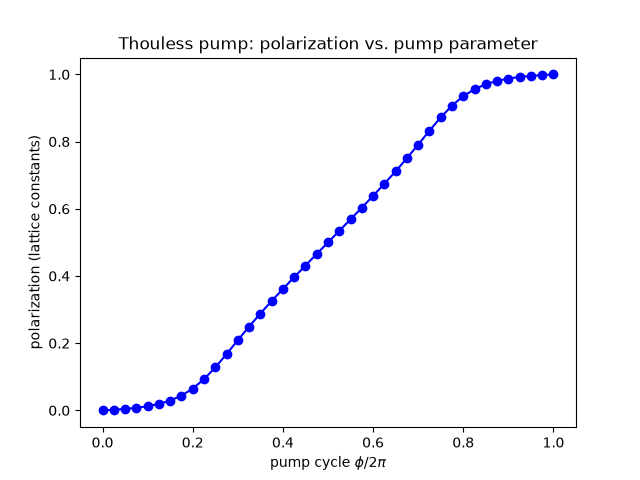
Polarization winding over one pump cycle: 1.0000 (expect exactly +-1).

Text(0.5, 1.0, 'Thouless pump: polarization vs. pump parameter')
Total running time of the script: (0 minutes 0.270 seconds)