

Note
Go to the end to download the full example code.
The Tenfold Way: Symmetry Classes of Tight-Binding Models#
A. Altland and M. Zirnbauer (1997) completed Dyson’s classification of random matrices: a Hamiltonian’s non-spatial symmetries – time reversal \(T = U_T\mathcal{K}\), particle-hole \(C = U_C\mathcal{K}\) (each squaring to \(+1\) or \(-1\), or absent) and their product, the chiral symmetry \(S\) – sort it into exactly ten classes. Schnyder, Ryu, Furusaki and Ludwig, and Kitaev, then showed (2008-2009) that the class and the dimension alone decide which topological invariant a gapped phase can carry: the periodic table of topological insulators and superconductors. In 1D, for instance, classes AIII and BDI carry an integer winding number, D a \(\mathbb{Z}_2\); in 2D, classes A and D carry a Chern number, AII a \(\mathbb{Z}_2\).
symmetry_error() checks each symmetry on the
Bloch Hamiltonian, and tenfold_class() names
the class of the models of this gallery.
import numpy as np
import matplotlib.pyplot as plt

import tbkit.lattices as lattices
from tbkit.bridges import finite_system
from tbkit.lattice import Lattice
from tbkit.kspace import KSpace, PAULI
from tbkit.bdg import bdg_kspace, particle_hole
from tbkit.plot import Plot


def ssh(v, w):
    lat = Lattice(unit_cell=[{'tag': 'a', 'r0': (0., 0.)}, {'tag': 'b', 'r0': (0.5, 0.)}],
                         prim_vec=[(1., 0.)])
    model = KSpace(lat)
    model.set_hopping([{'i': 0, 'j': 1, 'R': (0,), 't': v}, {'i': 1, 'j': 0, 'R': (1,), 't': w}])
    return model


def honeycomb_model(t2=0., lam=0., spin=False):
    model = KSpace(lattices.honeycomb(), spin=spin)
    model.set_hopping([{'i': 0, 'j': 1, 'R': R, 't': 1.} for R in [(0, 0), (-1, 0), (0, -1)]])
    for R in [(0, 1), (-1, 0), (1, -1)]:
        if spin:
            model.set_hopping([{'i': 0, 'j': 0, 'R': R, 't': 1j*lam*PAULI['z']},
                                        {'i': 1, 'j': 1, 'R': R, 't': -1j*lam*PAULI['z']}])
        else:
            model.set_hopping([{'i': 0, 'j': 0, 'R': R, 't': 1j*t2}, {'i': 1, 'j': 1, 'R': R, 't': -1j*t2}])
    return model


def kitaev(delta):
    chain = KSpace(lattices.chain())
    chain.set_hopping([{'i': 0, 'j': 0, 'R': (1,), 't': 1.}])
    return bdg_kspace(chain, [{'i': 0, 'j': 0, 'R': (1,), 'delta': delta}], mu=0.5)


SZ = PAULI['z']
T_SPINLESS = np.eye(2)
T_SPINFUL = np.kron(np.eye(2), 1j * PAULI['y'])
The lattices#
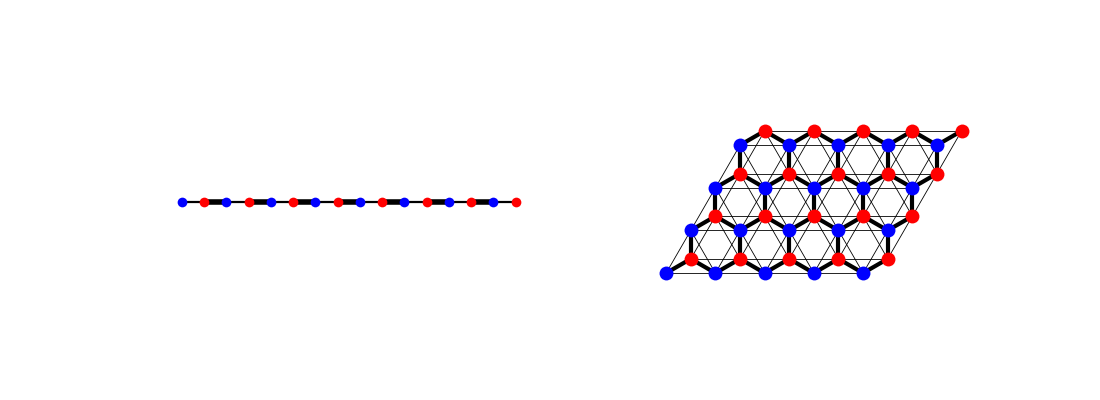
The models below live on two lattices (finite_system(),
bond widths proportional to the hoppings): a chain, here the SSH chain
with \(v = 0.4\) inside each cell and \(w = 1\) between cells
(the Kitaev chain has one site per cell), and the honeycomb lattice,
here with the second-neighbour hoppings \(\pm 0.2i\) of the Haldane
model (thin).
fig_lat, axes_lat = plt.subplots(1, 2, figsize=(11, 4), width_ratios=(1.2, 1))
Plot(finite_system(ssh(0.4, 1.), 8)).lattice(plt_hop=True, ms=7, c=4., ax=axes_lat[0])
Plot(finite_system(honeycomb_model(t2=0.2), (5, 4))).lattice(plt_hop=True, ms=10, ax=axes_lat[1])
<Figure size 1100x400 with 2 Axes>
Time reversal, particle-hole, chiral: which hold?#
Complex hoppings break the (spinless) time reversal of the SSH chain, but not its sublattice (chiral) symmetry; a complex hopping phase breaks the Kitaev chain’s time reversal, leaving particle-hole symmetry alone.
lat = Lattice(unit_cell=[{'tag': 'a', 'r0': (0., 0.)}, {'tag': 'b', 'r0': (0.5, 0.)}], prim_vec=[(1., 0.)])
ssh_complex = KSpace(lat)
ssh_complex.set_hopping([{'i': 0, 'j': 1, 'R': (0,), 't': 0.5j}, {'i': 1, 'j': 0, 'R': (1,), 't': 1.}])
chain = KSpace(lattices.chain())
chain.set_hopping([{'i': 0, 'j': 0, 'R': (1,), 't': np.exp(0.4j)}])
kitaev_complex = bdg_kspace(chain, [{'i': 0, 'j': 0, 'R': (1,), 'delta': 0.6j}], mu=0.5)

for model in (ssh_complex, kitaev_complex, honeycomb_model(t2=0.2)):
    assert model.symmetry_error(np.eye(model.norb), antiunitary=True) > 0.1

cases = [
    ('SSH chain', ssh(0.5, 1.), dict(time_reversal=T_SPINLESS, chiral=SZ), 'BDI'),
    ('SSH chain, complex hoppings', ssh_complex, dict(chiral=SZ), 'AIII'),
    ('Haldane model', honeycomb_model(t2=0.2), {}, 'A'),
    ('graphene (spinless)', honeycomb_model(), dict(time_reversal=np.eye(2), chiral=SZ), 'BDI'),
    ('Kane-Mele model', honeycomb_model(lam=0.06, spin=True), dict(time_reversal=T_SPINFUL), 'AII'),
    ('Kitaev chain', kitaev(0.6), dict(time_reversal=np.eye(2), particle_hole=particle_hole(1)), 'BDI'),
    ('Kitaev chain, complex hopping', kitaev_complex, dict(particle_hole=particle_hole(1)), 'D'),
]
for name, model, symmetries, expected in cases:
    cls = model.tenfold_class(**symmetries)
    print('{:<32s} class {}'.format(name, cls))
    assert cls == expected
SSH chain                        class BDI
SSH chain, complex hoppings      class AIII
Haldane model                    class A
graphene (spinless)              class BDI
Kane-Mele model                  class AII
Kitaev chain                     class BDI
Kitaev chain, complex hopping    class D
Total running time of the script: (0 minutes 0.044 seconds)